<!-- wp:paragraph -->
<p><strong>Last reviewed: August 2026</strong> — Dress and footwear guidance checked against the official Taj Mahal (ASI) Do's & Don'ts page and current traveler reports from Agra.</p>
<!-- /wp:paragraph -->
<!-- wp:heading -->
<h2 class="wp-block-heading">Taj Mahal Dress Code: Quick Answer</h2>
<!-- /wp:heading -->
<!-- wp:paragraph -->
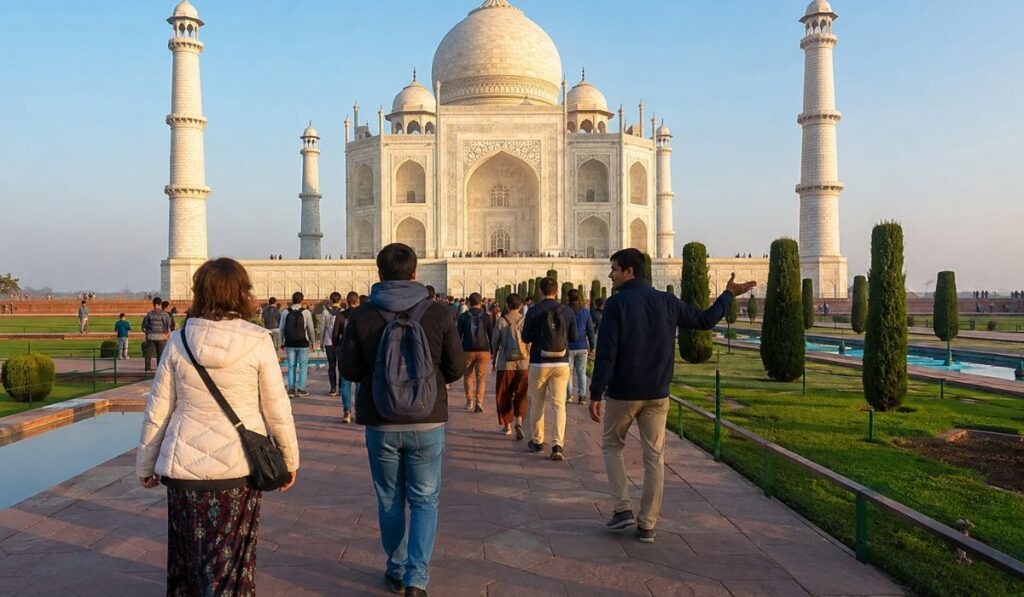
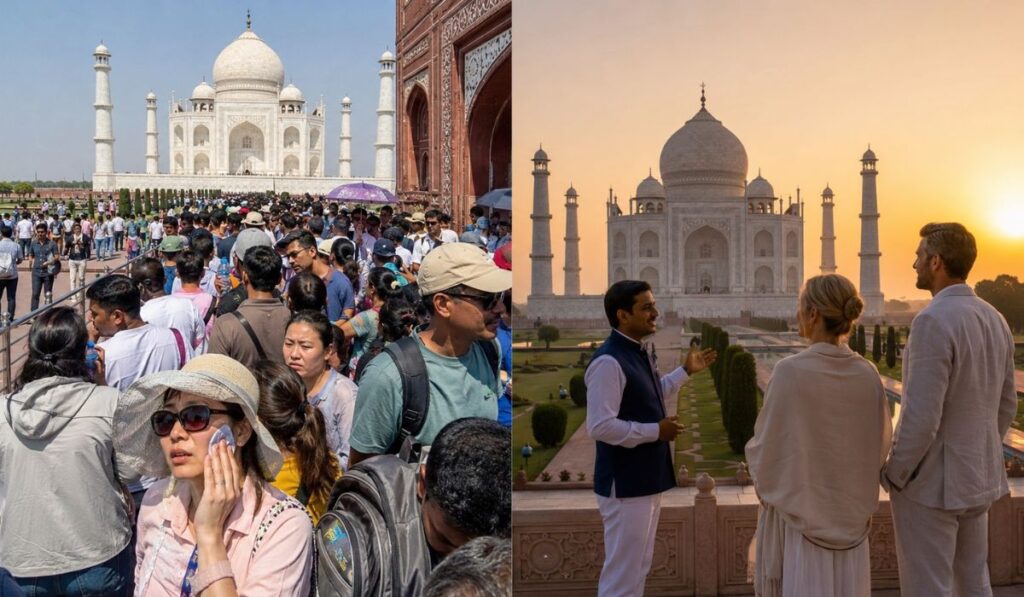
<p>There is no official <strong>Taj Mahal dress code</strong> enforced by the Archaeological Survey of India. You won't be turned away at the gate for wearing shorts or a sleeveless top. But because the Taj Mahal is a mausoleum — the resting place of Mumtaz Mahal and Shah Jahan — modest, comfortable clothing is the practical and respectful choice. Cover your shoulders and knees where possible, wear shoes you can slip off easily, and dress for a lot of walking in the sun. That's really the whole <strong>Taj Mahal dress code</strong> in one paragraph. Whichever <a href="https://www.tajwondertour.com/tour-packages/taj-mahal/">Taj Mahal tour package</a> you end up booking, the rest of this guide fills in the outfit details you'll actually need before you land in Agra.</p>
<!-- /wp:paragraph -->
<!-- wp:heading -->
<h2 class="wp-block-heading">Is There an Official Dress Code at the Taj Mahal?</h2>
<!-- /wp:heading -->
<!-- wp:paragraph -->
<p>No. Neither the ASI nor the Uttar Pradesh Department of Tourism publishes a mandatory clothing policy on the official Taj Mahal website. What they do publish is a clear list of prohibited items — food, tobacco, tripods, headphones, chargers, and so on — but nothing about what you must wear.</p>
<!-- /wp:paragraph -->
<!-- wp:paragraph -->
<p>That gap is exactly why so many travelers search for a <strong>Taj Mahal dress code</strong> before their trip: the absence of an official rule creates uncertainty, not clarity. Security staff are not checking outfits at the gate. What they are checking is your bag, your ticket, and whether you're carrying anything on the banned list. So think of dress code guidance here as cultural etiquette and practical comfort advice, not law.</p>
<!-- /wp:paragraph -->
<!-- wp:heading -->
<h2 class="wp-block-heading">Taj Mahal Dress Code for Women</h2>
<!-- /wp:heading -->
<!-- wp:image {"id":2054,"sizeSlug":"large","linkDestination":"none"} -->
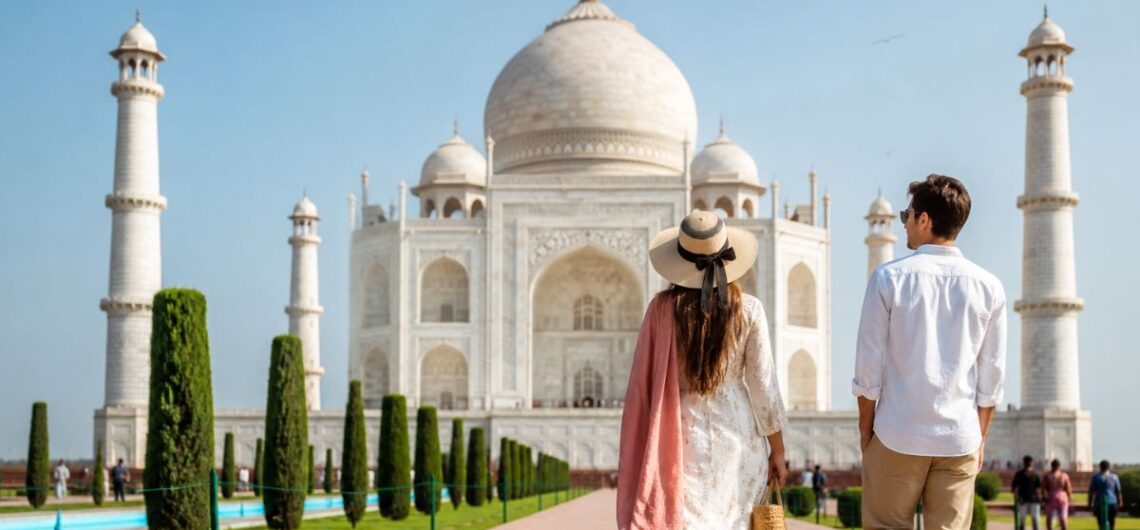
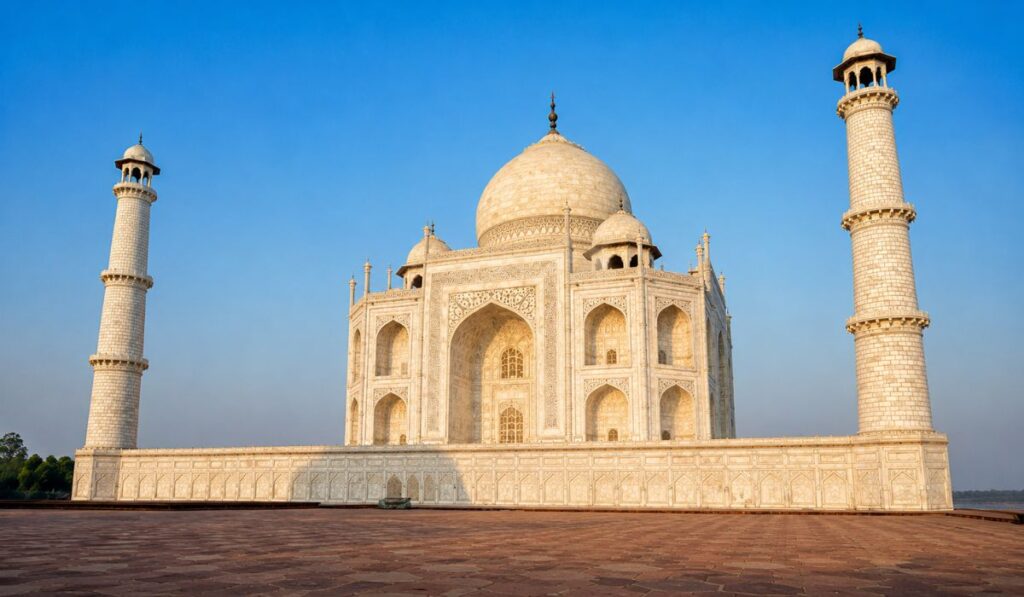
<figure class="wp-block-image size-large"><img src="https://www.tajwondertour.com/wp-content/uploads/2026/08/Untitled-design-2026-08-14T144627.799-1024x597.jpg" alt="Taj Mahal Dress Code for Women
For women, the safest and most comfortable approach is to cover the shoulders and keep hemlines at or below the knee. Long pants, a maxi dress, or a salwar kameez all work well and hold up for hours of walking across marble and gravel paths.
Practical picks that suit the Taj Mahal dress code for women:
Loose cotton or linen trousers with a top that covers the shoulders
A long kurti or tunic over leggings
A light scarf or dupatta — genuinely useful for sun protection and as a quick shoulder cover if needed
Flat, closed-toe shoes over heels; the walkways are uneven marble and gravel
Sleeveless tops aren't banned, but women who wear them sometimes report more stares than they'd like — a minor but real trade-off worth knowing before you pack." class="wp-image-2054"/></figure>
<!-- /wp:image -->
<!-- wp:paragraph -->
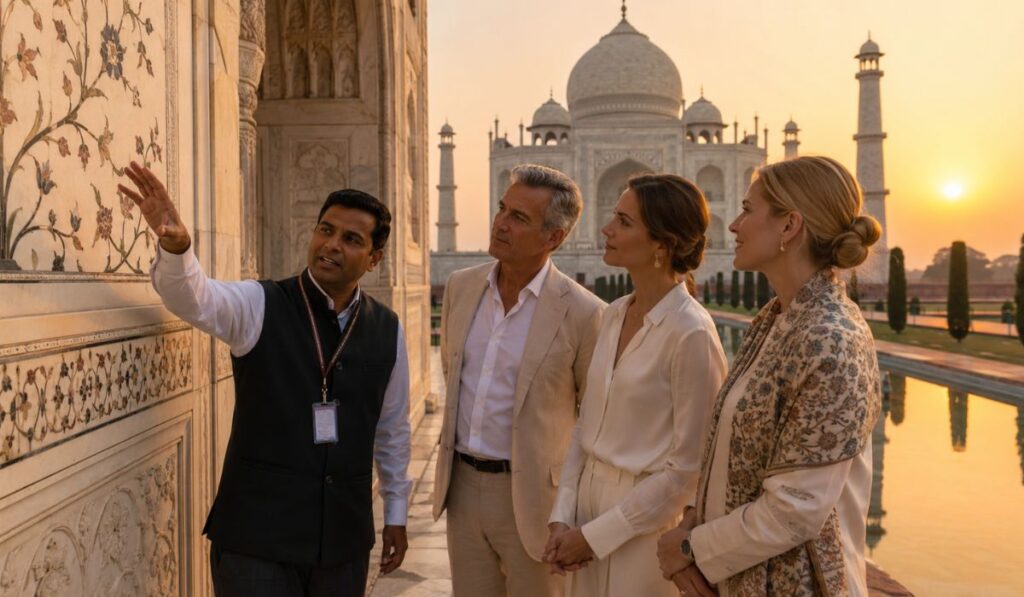
<p>For women, the safest and most comfortable approach is to cover the shoulders and keep hemlines at or below the knee. Long pants, a maxi dress, or a salwar kameez all work well and hold up for hours of walking across marble and gravel paths.</p>
<!-- /wp:paragraph -->
<!-- wp:paragraph -->
<p>Practical picks that suit the <strong>Taj Mahal dress code</strong> for women:</p>
<!-- /wp:paragraph -->
<!-- wp:list -->
<ul class="wp-block-list"><!-- wp:list-item -->
<li>Loose cotton or linen trousers with a top that covers the shoulders</li>
<!-- /wp:list-item -->
<!-- wp:list-item -->
<li>A long kurti or tunic over leggings</li>
<!-- /wp:list-item -->
<!-- wp:list-item -->
<li>A light scarf or dupatta — genuinely useful for sun protection and as a quick shoulder cover if needed</li>
<!-- /wp:list-item -->
<!-- wp:list-item -->
<li>Flat, closed-toe shoes over heels; the walkways are uneven marble and gravel</li>
<!-- /wp:list-item --></ul>
<!-- /wp:list -->
<!-- wp:paragraph -->
<p>Sleeveless tops aren't banned, but women who wear them sometimes report more stares than they'd like — a minor but real trade-off worth knowing before you pack.</p>
<!-- /wp:paragraph -->
<!-- wp:heading -->
<h2 class="wp-block-heading">Taj Mahal Dress Code for Men</h2>
<!-- /wp:heading -->
<!-- wp:image {"id":2056,"sizeSlug":"large","linkDestination":"none"} -->
<figure class="wp-block-image size-large"><img src="https://www.tajwondertour.com/wp-content/uploads/2026/08/Untitled-design-2026-08-14T151843.382-1024x597.jpg" alt="Taj Mahal Dress Code: What to Wear on Your Agra Visit (2026 Guide)" class="wp-image-2056"/></figure>
<!-- /wp:image -->
<!-- wp:paragraph -->
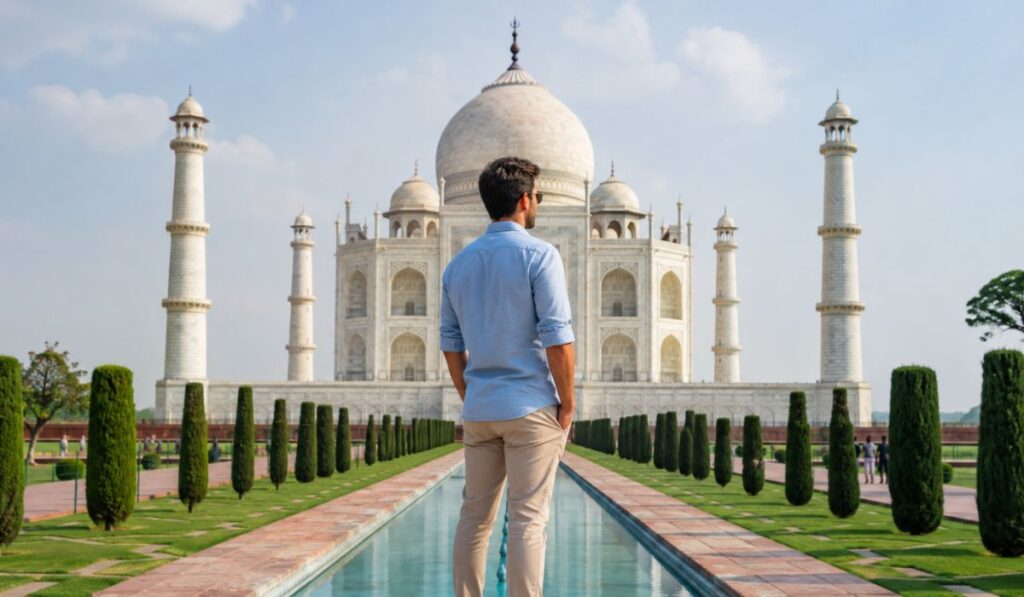
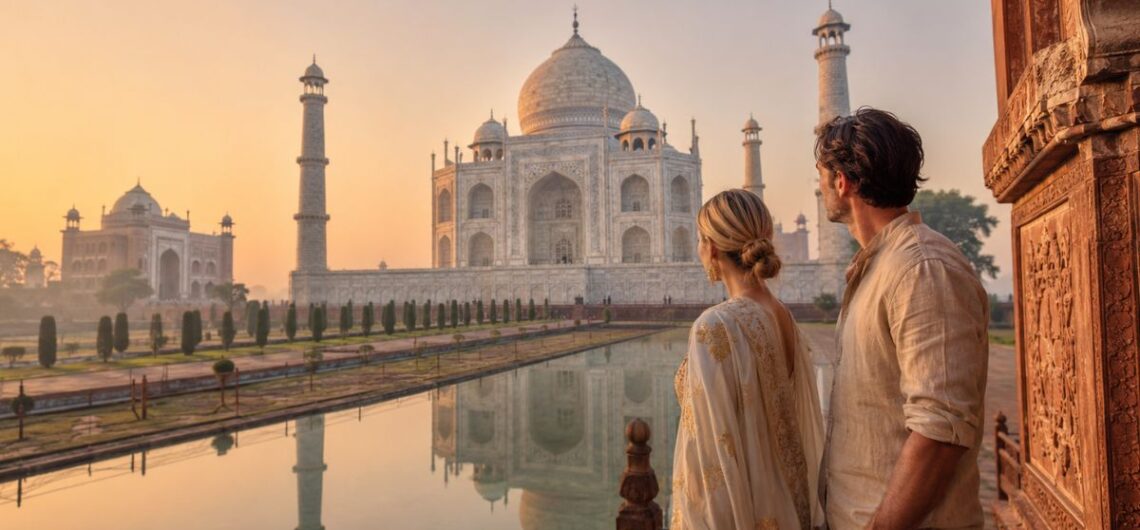
<p>For men, the same logic applies with a bit more flexibility. Knee-length shorts are generally fine and are commonly worn by both foreign and Indian male visitors, especially in summer. Very short shorts draw more attention and aren't the best fit for a mausoleum visit.</p>
<!-- /wp:paragraph -->
<!-- wp:paragraph -->
<p>A comfortable <strong>Taj Mahal dress code</strong> for men usually looks like:</p>
<!-- /wp:paragraph -->
<!-- wp:list -->
<ul class="wp-block-list"><!-- wp:list-item -->
<li>Knee-length shorts or lightweight trousers</li>
<!-- /wp:list-item -->
<!-- wp:list-item -->
<li>A breathable cotton shirt or t-shirt</li>
<!-- /wp:list-item -->
<!-- wp:list-item -->
<li>Closed or slip-on shoes rather than tight lace-ups, since you'll need to deal with footwear rules inside the main platform</li>
<!-- /wp:list-item --></ul>
<!-- /wp:list -->
<!-- wp:paragraph -->
<p>If you're doing a combined itinerary that includes mosques, forts, or other religious sites the same day, full-length trousers are the more versatile option so you don't have to change outfits mid-trip.</p>
<!-- /wp:paragraph -->
<!-- wp:heading -->
<h2 class="wp-block-heading">Can You Wear Shorts to the Taj Mahal?</h2>
<!-- /wp:heading -->
<!-- wp:paragraph -->
<p>Yes — shorts are allowed. There's no rule barring them. Real visitor reports from the Agra tourism forums back this up consistently: knee-length shorts are common for men, and even TripAdvisor's long-running local discussion threads confirm there's no enforced restriction. The unofficial guidance most local drivers give is simple: knee-length is comfortable and low-key, very short shorts stand out more than they need to.</p>
<!-- /wp:paragraph -->
<!-- wp:paragraph -->
<p>If you're coming from Delhi as part of a longer day, some travelers prefer full-length pants purely for practicality — fewer mosquito bites at dawn, more sun protection at midday, and no wardrobe rethink if your itinerary adds a temple stop.</p>
<!-- /wp:paragraph -->
<!-- wp:heading -->
<h2 class="wp-block-heading">Are Shoes Allowed at the Taj Mahal?</h2>
<!-- /wp:heading -->
<!-- wp:paragraph -->
<p>This is where most first-time visitors get confused, and it's a separate issue from the <strong>Taj Mahal dress code</strong> itself. Shoes are allowed throughout the complex. The only restriction is on the white marble platform around the main mausoleum, where you have three options:</p>
<!-- /wp:paragraph -->
<!-- wp:list {"ordered":true} -->
<ol class="wp-block-list"><!-- wp:list-item -->
<li><strong>Wear disposable shoe covers</strong> — provided free with foreigner, SAARC, and BIMSTEC tickets</li>
<!-- /wp:list-item -->
<!-- wp:list-item -->
<li><strong>Remove your shoes and go barefoot</strong> — many visitors do this, especially at sunrise before the marble heats up</li>
<!-- /wp:list-item -->
<!-- wp:list-item -->
<li><strong>Carry your shoes</strong> in hand or in a small permitted bag while walking barefoot</li>
<!-- /wp:list-item --></ol>
<!-- /wp:list -->
<!-- wp:paragraph -->
<p>Domestic Indian visitors don't get free shoe covers with their ticket, but pairs are available for a small fee (around ₹20) from vendor kiosks near the ticket counters, or from shops near the eastern gate.</p>
<!-- /wp:paragraph -->
<!-- wp:paragraph -->
<p>One practical tip that rarely makes it into generic guides: the marble genuinely gets hot in the sun. If you're visiting midday in summer, wear socks under your shoe covers or bring a spare pair — barefoot visitors regularly regret it by mid-morning.</p>
<!-- /wp:paragraph -->
<!-- wp:heading -->
<h2 class="wp-block-heading">What Not to Wear (and What Not to Carry)</h2>
<!-- /wp:heading -->
<!-- wp:paragraph -->
<p>Beyond the <strong>Taj Mahal dress code</strong> itself, a few practical avoidances will make your visit smoother:</p>
<!-- /wp:paragraph -->
<!-- wp:list -->
<ul class="wp-block-list"><!-- wp:list-item -->
<li><strong>Skip heavy jewelry</strong> — metal detectors at security will flag it and slow you down</li>
<!-- /wp:list-item -->
<!-- wp:list-item -->
<li><strong>Avoid brand-new shoes</strong> — hours of walking on stone paths is not the time to break them in</li>
<!-- /wp:list-item -->
<!-- wp:list-item -->
<li><strong>Leave large backpacks behind</strong> — only small bags are allowed through security; anything bulky adds time at the checkpoint</li>
<!-- /wp:list-item -->
<!-- wp:list-item -->
<li><strong>No tripods, drones, selfie sticks, or headphones</strong> — these are on the official prohibited items list, unrelated to clothing but worth packing around</li>
<!-- /wp:list-item --></ul>
<!-- /wp:list -->
<!-- wp:heading -->
<h2 class="wp-block-heading">What to Wear by Season</h2>
<!-- /wp:heading -->
<!-- wp:paragraph -->
<p>Your <strong>Taj Mahal dress code</strong> choices should flex with the season too — what works at a cool sunrise won't hold up by noon in summer.</p>
<!-- /wp:paragraph -->
<!-- wp:paragraph -->
<p><strong>Winter (October–March):</strong> Mornings are cold, especially at sunrise. Layer up — a light jacket over your outfit works, and you can shed it once the sun is up.</p>
<!-- /wp:paragraph -->
<!-- wp:paragraph -->
<p><strong>Summer (April–June):</strong> Expect 40°C-plus heat. Loose cotton or linen in light colors is far more comfortable than synthetic fabrics, and a hat or scarf helps with sun exposure during the walk from the gate to the mausoleum.</p>
<!-- /wp:paragraph -->
<!-- wp:paragraph -->
<p><strong>Monsoon (July–September):</strong> Light rain is common. A thin, packable rain layer beats an umbrella once you're moving through security and crowds.</p>
<!-- /wp:paragraph -->
<!-- wp:heading -->
<h2 class="wp-block-heading">What to Know Before Your Taj Mahal Tour</h2>
<!-- /wp:heading -->
<!-- wp:paragraph -->
<p>A few practical basics tie directly into your outfit choices:</p>
<!-- /wp:paragraph -->
<!-- wp:list -->
<ul class="wp-block-list"><!-- wp:list-item -->
<li>Visiting hours run from roughly 30 minutes before sunrise to 30 minutes before sunset</li>
<!-- /wp:list-item -->
<!-- wp:list-item -->
<li>The Taj Mahal is closed to general tourists on Fridays</li>
<!-- /wp:list-item -->
<!-- wp:list-item -->
<li>Carry a government-issued photo ID — passport for foreign nationals</li>
<!-- /wp:list-item -->
<!-- wp:list-item -->
<li>Water bottles are permitted inside</li>
<!-- /wp:list-item -->
<!-- wp:list-item -->
<li>Vehicles aren't allowed within 500 meters of the monument, so plan for a short walk or battery-bus ride from the parking area to the entrance regardless of what you're wearing</li>
<!-- /wp:list-item --></ul>
<!-- /wp:list -->
<!-- wp:paragraph -->
<p>If you're planning your trip from Delhi and want the logistics — pickup, drive time, ticketing — handled for you, a <a href="https://www.tajwondertour.com/tours/taj-mahal-day-tour-from-delhi-by-car/">Taj Mahal day tour from Delhi by car</a> covers the full round trip in a single day, so you can focus on packing the right outfit rather than the transport details.</p>
<!-- /wp:paragraph -->
<!-- wp:heading -->
<h2 class="wp-block-heading">Dressing for a Sunrise Visit</h2>
<!-- /wp:heading -->
<!-- wp:paragraph -->
<p>If you're planning to catch the Taj Mahal at sunrise — widely considered the best time to visit for both light and lower crowds — dress in layers. Early mornings in Agra can be genuinely chilly even when the afternoon forecast says otherwise, and you'll want to shed a layer as the sun climbs. Comfortable, slip-on footwear also matters more here since you'll likely be removing shoes or putting on covers while it's still dim and slightly rushed near the entrance. Travelers who prioritize this experience often book a <a href="https://www.tajwondertour.com/tours/sunrise-taj-mahal-tour-from-delhi/">sunrise Taj Mahal tour from Delhi</a>, which times pickup around the monument's exact opening window.</p>
<!-- /wp:paragraph -->
<!-- wp:heading -->
<h2 class="wp-block-heading">Which Tour Fits Your Trip?</h2>
<!-- /wp:heading -->
<!-- wp:paragraph -->
<p>Your outfit plan might also depend on how much time you're spending in Agra. A same-day round trip from Delhi means dressing for one long day of heat, walking, and travel in a single outfit. If you'd rather split the trip and explore Agra more slowly — including the Taj Mahal, Agra Fort, and local markets without rushing — a <a href="https://www.tajwondertour.com/tours/taj-mahal-agra-overnight-tour-by-car/">Taj Mahal and Agra overnight tour by car</a> gives you two days to plan around, so your daytime outfit doesn't have to double as your evening one too. For travelers comparing options across multiple visit styles, our full range of Taj Mahal tour packages breaks down car tours, express train options, and premium vehicle choices side by side.</p>
<!-- /wp:paragraph -->
<!-- wp:heading -->
<h2 class="wp-block-heading">Final Thoughts</h2>
<!-- /wp:heading -->
<!-- wp:paragraph -->
<p>The <strong>Taj Mahal dress code</strong> isn't a strict rulebook — it's really a mix of comfort, practicality, and cultural respect. Cover up where it makes sense, wear shoes you can deal with easily at the marble platform, and pack for the season you're visiting in. Get that right, and the only thing you'll need to think about once you're there is how good that first view of the dome actually looks.</p>
<!-- /wp:paragraph -->
<!-- wp:heading -->
<h2 class="wp-block-heading">Frequently Asked Questions About Taj Mahal Dress Code & Visit Rules</h2>
<!-- /wp:heading -->
<!-- wp:heading {"level":3} -->
<h3 class="wp-block-heading">1. Is there a dress code at the Taj Mahal?</h3>
<!-- /wp:heading -->
<!-- wp:paragraph -->
<p>There is no clearly published mandatory clothing dress code for general visitors on the official Taj Mahal visitor guidance. For a comfortable and respectful visit, choose modest, breathable clothing that works well for walking and Agra’s weather.</p>
<!-- /wp:paragraph -->
<!-- wp:heading {"level":3} -->
<h3 class="wp-block-heading">2. Can I wear shorts to the Taj Mahal?</h3>
<!-- /wp:heading -->
<!-- wp:paragraph -->
<p>Shorts are not listed among the prohibited items in the official Taj Mahal visitor guidance. Knee-length shorts are a practical option, although lightweight trousers may be more versatile if you are visiting other heritage or religious sites in Agra.</p>
<!-- /wp:paragraph -->
<!-- wp:heading {"level":3} -->
<h3 class="wp-block-heading">3. What should women wear to the Taj Mahal?</h3>
<!-- /wp:heading -->
<!-- wp:paragraph -->
<p>Comfortable trousers, longer skirts or dresses, kurtas, and breathable tops are practical choices for women visiting the Taj Mahal. A light scarf or dupatta can also be useful for sun protection and as an optional shoulder covering.</p>
<!-- /wp:paragraph -->
<!-- wp:heading {"level":3} -->
<h3 class="wp-block-heading">4. Are shoes allowed at the Taj Mahal?</h3>
<!-- /wp:heading -->
<!-- wp:paragraph -->
<p>Yes, visitors can wear shoes in the Taj Mahal complex, but footwear rules apply around the main mausoleum and its marble area. Depending on the ticket category and current arrangements, visitors may need to use shoe covers or remove their footwear.</p>
<!-- /wp:paragraph -->
<!-- wp:heading {"level":3} -->
<h3 class="wp-block-heading">5. Do I need to remove my shoes inside the Taj Mahal?</h3>
<!-- /wp:heading -->
<!-- wp:paragraph -->
<p>Visitors must follow the footwear rules for the main marble mausoleum area. Shoe-cover arrangements vary by ticket category, while shoe racks are also available. Check the latest official visitor information before your trip.</p>
<!-- /wp:paragraph -->
<!-- wp:heading {"level":3} -->
<h3 class="wp-block-heading">6. What should I wear for a sunrise Taj Mahal tour?</h3>
<!-- /wp:heading -->
<!-- wp:paragraph -->
<p>Wear comfortable layers that you can remove as the temperature rises. Choose walking-friendly footwear that is easy to take off and put back on, especially when visiting the marble area around the mausoleum.</p>
<!-- /wp:paragraph -->
<!-- wp:heading {"level":3} -->
<h3 class="wp-block-heading">7. What should I carry when visiting the Taj Mahal?</h3>
<!-- /wp:heading -->
<!-- wp:paragraph -->
<p>Carry your ticket, required identification, phone, water where permitted, and only essential personal items. Avoid large bags and unnecessary belongings because they can increase the time needed for security checks.</p>
<!-- /wp:paragraph -->
<!-- wp:heading {"level":3} -->
<h3 class="wp-block-heading">8. What is not allowed inside the Taj Mahal?</h3>
<!-- /wp:heading -->
<!-- wp:paragraph -->
<p>The official Taj Mahal visitor guidance prohibits several items, including food or eatables, tobacco products, liquor, tripods, drones, knives, and other restricted articles. Visitors should check the latest official rules before entering.</p>
<!-- /wp:paragraph -->
<!-- wp:heading {"level":3} -->
<h3 class="wp-block-heading">9. What shoes are best for visiting the Taj Mahal?</h3>
<!-- /wp:heading -->
<!-- wp:paragraph -->
<p>Choose comfortable walking shoes or sandals that are easy to remove and put back on. You may need to deal with footwear restrictions near the main mausoleum, so comfort and convenience are more important than formal footwear.</p>
<!-- /wp:paragraph -->
<!-- wp:heading {"level":3} -->
<h3 class="wp-block-heading">10. What should I wear to the Taj Mahal in summer or winter?</h3>
<!-- /wp:heading -->
<!-- wp:paragraph -->
<p>In summer, wear loose, breathable fabrics such as cotton or linen and protect yourself from the sun. For winter or sunrise visits, use removable layers because early mornings in Agra can be much cooler than the afternoon.</p>
<!-- /wp:paragraph -->
Last reviewed: August 2026 — Dress and footwear guidance checked against the official Taj Mahal (ASI) Do’s & Don’ts page and current traveler reports from Agra.
Taj Mahal Dress Code: Quick Answer
There is no official Taj Mahal dress code enforced by the Archaeological Survey of India. You won’t be turned away at the gate for wearing shorts or a sleeveless top. But because the Taj Mahal is a mausoleum — the resting place of Mumtaz Mahal and Shah Jahan — modest, comfortable clothing is the practical and respectful choice. Cover your shoulders and knees where possible, wear shoes you can slip off easily, and dress for a lot of walking in the sun. That’s really the whole Taj Mahal dress code in one paragraph. Whichever Taj Mahal tour package you end up booking, the rest of this guide fills in the outfit details you’ll actually need before you land in Agra.
Is There an Official Dress Code at the Taj Mahal?
No. Neither the ASI nor the Uttar Pradesh Department of Tourism publishes a mandatory clothing policy on the official Taj Mahal website. What they do publish is a clear list of prohibited items — food, tobacco, tripods, headphones, chargers, and so on — but nothing about what you must wear.
That gap is exactly why so many travelers search for a Taj Mahal dress code before their trip: the absence of an official rule creates uncertainty, not clarity. Security staff are not checking outfits at the gate. What they are checking is your bag, your ticket, and whether you’re carrying anything on the banned list. So think of dress code guidance here as cultural etiquette and practical comfort advice, not law.
Taj Mahal Dress Code for Women
For women, the safest and most comfortable approach is to cover the shoulders and keep hemlines at or below the knee. Long pants, a maxi dress, or a salwar kameez all work well and hold up for hours of walking across marble and gravel paths.
Practical picks that suit the Taj Mahal dress code for women:
Loose cotton or linen trousers with a top that covers the shoulders
A long kurti or tunic over leggings
A light scarf or dupatta — genuinely useful for sun protection and as a quick shoulder cover if needed
Flat, closed-toe shoes over heels; the walkways are uneven marble and gravel
Sleeveless tops aren’t banned, but women who wear them sometimes report more stares than they’d like — a minor but real trade-off worth knowing before you pack.
Taj Mahal Dress Code for Men
For men, the same logic applies with a bit more flexibility. Knee-length shorts are generally fine and are commonly worn by both foreign and Indian male visitors, especially in summer. Very short shorts draw more attention and aren’t the best fit for a mausoleum visit.
A comfortable Taj Mahal dress code for men usually looks like:
Knee-length shorts or lightweight trousers
A breathable cotton shirt or t-shirt
Closed or slip-on shoes rather than tight lace-ups, since you’ll need to deal with footwear rules inside the main platform
If you’re doing a combined itinerary that includes mosques, forts, or other religious sites the same day, full-length trousers are the more versatile option so you don’t have to change outfits mid-trip.
Can You Wear Shorts to the Taj Mahal?
Yes — shorts are allowed. There’s no rule barring them. Real visitor reports from the Agra tourism forums back this up consistently: knee-length shorts are common for men, and even TripAdvisor’s long-running local discussion threads confirm there’s no enforced restriction. The unofficial guidance most local drivers give is simple: knee-length is comfortable and low-key, very short shorts stand out more than they need to.
If you’re coming from Delhi as part of a longer day, some travelers prefer full-length pants purely for practicality — fewer mosquito bites at dawn, more sun protection at midday, and no wardrobe rethink if your itinerary adds a temple stop.
Are Shoes Allowed at the Taj Mahal?
This is where most first-time visitors get confused, and it’s a separate issue from the Taj Mahal dress code itself. Shoes are allowed throughout the complex. The only restriction is on the white marble platform around the main mausoleum, where you have three options:
Wear disposable shoe covers — provided free with foreigner, SAARC, and BIMSTEC tickets
Remove your shoes and go barefoot — many visitors do this, especially at sunrise before the marble heats up
Carry your shoes in hand or in a small permitted bag while walking barefoot
Domestic Indian visitors don’t get free shoe covers with their ticket, but pairs are available for a small fee (around ₹20) from vendor kiosks near the ticket counters, or from shops near the eastern gate.
One practical tip that rarely makes it into generic guides: the marble genuinely gets hot in the sun. If you’re visiting midday in summer, wear socks under your shoe covers or bring a spare pair — barefoot visitors regularly regret it by mid-morning.
What Not to Wear (and What Not to Carry)
Beyond the Taj Mahal dress code itself, a few practical avoidances will make your visit smoother:
Skip heavy jewelry — metal detectors at security will flag it and slow you down
Avoid brand-new shoes — hours of walking on stone paths is not the time to break them in
Leave large backpacks behind — only small bags are allowed through security; anything bulky adds time at the checkpoint
No tripods, drones, selfie sticks, or headphones — these are on the official prohibited items list, unrelated to clothing but worth packing around
What to Wear by Season
Your Taj Mahal dress code choices should flex with the season too — what works at a cool sunrise won’t hold up by noon in summer.
Winter (October–March): Mornings are cold, especially at sunrise. Layer up — a light jacket over your outfit works, and you can shed it once the sun is up.
Summer (April–June): Expect 40°C-plus heat. Loose cotton or linen in light colors is far more comfortable than synthetic fabrics, and a hat or scarf helps with sun exposure during the walk from the gate to the mausoleum.
Monsoon (July–September): Light rain is common. A thin, packable rain layer beats an umbrella once you’re moving through security and crowds.
What to Know Before Your Taj Mahal Tour
A few practical basics tie directly into your outfit choices:
Visiting hours run from roughly 30 minutes before sunrise to 30 minutes before sunset
The Taj Mahal is closed to general tourists on Fridays
Carry a government-issued photo ID — passport for foreign nationals
Water bottles are permitted inside
Vehicles aren’t allowed within 500 meters of the monument, so plan for a short walk or battery-bus ride from the parking area to the entrance regardless of what you’re wearing
If you’re planning your trip from Delhi and want the logistics — pickup, drive time, ticketing — handled for you, a Taj Mahal day tour from Delhi by car covers the full round trip in a single day, so you can focus on packing the right outfit rather than the transport details.
Dressing for a Sunrise Visit
If you’re planning to catch the Taj Mahal at sunrise — widely considered the best time to visit for both light and lower crowds — dress in layers. Early mornings in Agra can be genuinely chilly even when the afternoon forecast says otherwise, and you’ll want to shed a layer as the sun climbs. Comfortable, slip-on footwear also matters more here since you’ll likely be removing shoes or putting on covers while it’s still dim and slightly rushed near the entrance. Travelers who prioritize this experience often book a sunrise Taj Mahal tour from Delhi, which times pickup around the monument’s exact opening window.
Which Tour Fits Your Trip?
Your outfit plan might also depend on how much time you’re spending in Agra. A same-day round trip from Delhi means dressing for one long day of heat, walking, and travel in a single outfit. If you’d rather split the trip and explore Agra more slowly — including the Taj Mahal, Agra Fort, and local markets without rushing — a Taj Mahal and Agra overnight tour by car gives you two days to plan around, so your daytime outfit doesn’t have to double as your evening one too. For travelers comparing options across multiple visit styles, our full range of Taj Mahal tour packages breaks down car tours, express train options, and premium vehicle choices side by side.
Final Thoughts
The Taj Mahal dress code isn’t a strict rulebook — it’s really a mix of comfort, practicality, and cultural respect. Cover up where it makes sense, wear shoes you can deal with easily at the marble platform, and pack for the season you’re visiting in. Get that right, and the only thing you’ll need to think about once you’re there is how good that first view of the dome actually looks.
Frequently Asked Questions About Taj Mahal Dress Code & Visit Rules
1. Is there a dress code at the Taj Mahal?
There is no clearly published mandatory clothing dress code for general visitors on the official Taj Mahal visitor guidance. For a comfortable and respectful visit, choose modest, breathable clothing that works well for walking and Agra’s weather.
2. Can I wear shorts to the Taj Mahal?
Shorts are not listed among the prohibited items in the official Taj Mahal visitor guidance. Knee-length shorts are a practical option, although lightweight trousers may be more versatile if you are visiting other heritage or religious sites in Agra.
3. What should women wear to the Taj Mahal?
Comfortable trousers, longer skirts or dresses, kurtas, and breathable tops are practical choices for women visiting the Taj Mahal. A light scarf or dupatta can also be useful for sun protection and as an optional shoulder covering.
4. Are shoes allowed at the Taj Mahal?
Yes, visitors can wear shoes in the Taj Mahal complex, but footwear rules apply around the main mausoleum and its marble area. Depending on the ticket category and current arrangements, visitors may need to use shoe covers or remove their footwear.
5. Do I need to remove my shoes inside the Taj Mahal?
Visitors must follow the footwear rules for the main marble mausoleum area. Shoe-cover arrangements vary by ticket category, while shoe racks are also available. Check the latest official visitor information before your trip.
6. What should I wear for a sunrise Taj Mahal tour?
Wear comfortable layers that you can remove as the temperature rises. Choose walking-friendly footwear that is easy to take off and put back on, especially when visiting the marble area around the mausoleum.
7. What should I carry when visiting the Taj Mahal?
Carry your ticket, required identification, phone, water where permitted, and only essential personal items. Avoid large bags and unnecessary belongings because they can increase the time needed for security checks.
8. What is not allowed inside the Taj Mahal?
The official Taj Mahal visitor guidance prohibits several items, including food or eatables, tobacco products, liquor, tripods, drones, knives, and other restricted articles. Visitors should check the latest official rules before entering.
9. What shoes are best for visiting the Taj Mahal?
Choose comfortable walking shoes or sandals that are easy to remove and put back on. You may need to deal with footwear restrictions near the main mausoleum, so comfort and convenience are more important than formal footwear.
10. What should I wear to the Taj Mahal in summer or winter?
In summer, wear loose, breathable fabrics such as cotton or linen and protect yourself from the sun. For winter or sunrise visits, use removable layers because early mornings in Agra can be much cooler than the afternoon.
<!-- wp:heading -->
<h2 class="wp-block-heading">Quick Answer For Luxury vs Budget Rajasthan Tour: Which One Is Right for You?</h2>
<!-- /wp:heading -->
<!-- wp:paragraph -->
<p><strong>What is a luxury tour?</strong> A premium experience with heritage palace hotels, private chauffeur-driven vehicles, fine dining, and exclusive cultural experiences — prices typically range from ₹1,00,000 to ₹5,00,000+ per person for a week-long itinerary.</p>
<!-- /wp:paragraph -->
<!-- wp:paragraph -->
<p><strong>What is a budget tour?</strong> An affordable option with clean 3-star hotels, shared or economical transport, local restaurants, and excellent value — prices typically range from ₹18,000 to ₹35,000 per person for 4–6 days.</p>
<!-- /wp:paragraph -->
<!-- wp:paragraph -->
<p><strong>Which travelers should choose each?</strong> Choose a <strong>luxury tour</strong> if you value exclusivity, comfort, and once-in-a-lifetime palace experiences. Choose a <strong>budget tour</strong> if you're cost-conscious, enjoy authentic local interactions, and want to stretch your travel budget further.</p>
<!-- /wp:paragraph -->
<!-- wp:separator -->
<hr class="wp-block-separator has-alpha-channel-opacity"/>
<!-- /wp:separator -->
<!-- wp:heading -->
<h2 class="wp-block-heading">Key Takeaways</h2>
<!-- /wp:heading -->
<!-- wp:table -->
<figure class="wp-block-table"><table class="has-fixed-layout"><thead><tr><th>Category</th><th>Luxury Tour</th><th>Budget Tour</th></tr></thead><tbody><tr><td><strong>Hotel Quality</strong></td><td>5-star palaces, heritage properties</td><td>3-star hotels, guesthouses, hostels</td></tr><tr><td><strong>Privacy</strong></td><td>Private vehicle, exclusive experiences</td><td>Shared transport, group tours</td></tr><tr><td><strong>Cost (7 days)</strong></td><td>₹1,00,000 – ₹5,00,000+</td><td>₹18,000 – ₹35,000</td></tr><tr><td><strong>Transport</strong></td><td>Private SUV with chauffeur</td><td>Sedan, train, or shared taxi</td></tr><tr><td><strong>Best for Families</strong></td><td>✅ Yes — comfort and convenience</td><td>✅ Yes — affordable group travel</td></tr><tr><td><strong>Best for Couples</strong></td><td>✅ Yes — romantic palace stays</td><td>✅ Yes — intimate budget getaways</td></tr><tr><td><strong>Best for Solo Travelers</strong></td><td>⚠️ Can be expensive alone</td><td>✅ Yes — budget-friendly</td></tr><tr><td><strong>Best for Foreign Tourists</strong></td><td>✅ Yes — premium experience</td><td>✅ Yes — great value</td></tr><tr><td><strong>Best Time to Travel</strong></td><td>October–March (peak season)</td><td>July–September (off-season deals)</td></tr></tbody></table></figure>
<!-- /wp:table -->
<!-- wp:separator -->
<hr class="wp-block-separator has-alpha-channel-opacity"/>
<!-- /wp:separator -->
<!-- wp:heading -->
<h2 class="wp-block-heading">Introduction</h2>
<!-- /wp:heading -->
<!-- wp:paragraph -->
<p>Rajasthan is India's crown jewel — a land of maharajas, magnificent forts, golden deserts, and palaces that seem to float on lakes. But when it comes to planning your trip, one question dominates every traveler's mind: <strong>should you splurge on a luxury experience or travel on a budget?</strong></p>
<!-- /wp:paragraph -->
<!-- wp:paragraph -->
<p>Here's the truth: <strong>both options can deliver an unforgettable Rajasthan experience.</strong> The difference isn't about quality — it's about <em>what kind</em> of experience you want. A <strong>luxury vs budget Rajasthan tour</strong> comparison isn't about one being "better" than the other; it's about finding the right fit for your travel style, budget, and priorities.</p>
<!-- /wp:paragraph -->
<!-- wp:paragraph -->
<p>Is luxury really worth it? For many travelers, the answer is yes — sleeping in a real palace, having a private chauffeur, and enjoying exclusive cultural experiences can transform a good trip into a life-changing one. But can budget travelers still enjoy Rajasthan? Absolutely. Rajasthan is one of India's most accessible and rewarding destinations, with incredible value at every price point.</p>
<!-- /wp:paragraph -->
<!-- wp:paragraph -->
<p>Ready to explore your options? Browse our <strong><a href="https://www.tajwondertour.com/tour-packages/rajasthan/">Rajasthan Tour Packages</a></strong> for expertly crafted itineraries at every budget level.</p>
<!-- /wp:paragraph -->
<!-- wp:separator -->
<hr class="wp-block-separator has-alpha-channel-opacity"/>
<!-- /wp:separator -->
<!-- wp:heading -->
<h2 class="wp-block-heading">What Is a Luxury Rajasthan Tour?</h2>
<!-- /wp:heading -->
<!-- wp:paragraph -->
<p>A <strong>luxury Rajasthan tour</strong> is the royal treatment — literally. It's designed for travelers who want to experience Rajasthan the way maharajas once did, with every detail curated for comfort, exclusivity, and unforgettable moments.</p>
<!-- /wp:paragraph -->
<!-- wp:paragraph -->
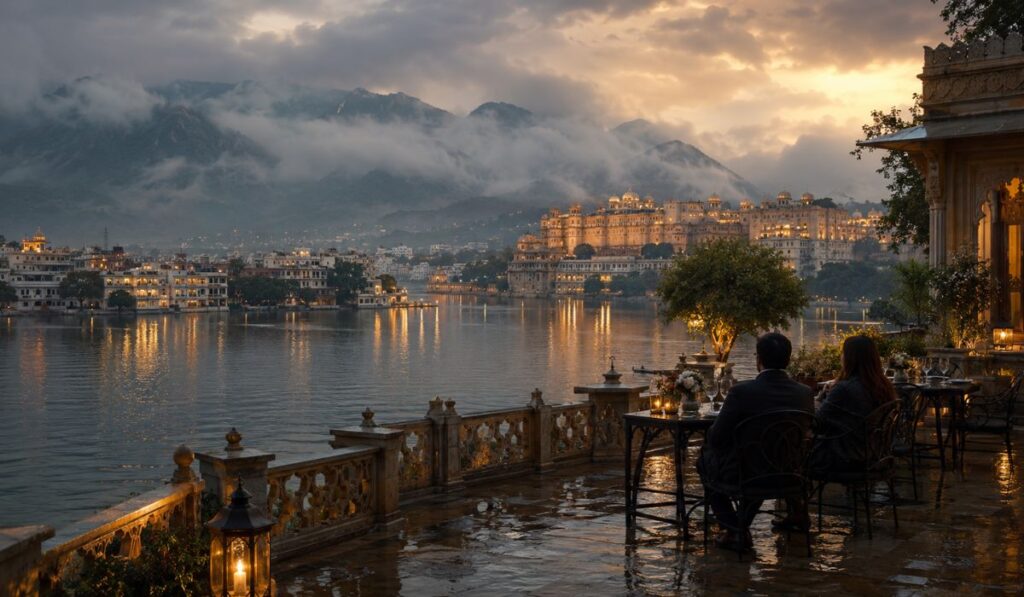
<p><strong>Heritage palaces and 5-star hotels:</strong> Stay in properties like the <strong>Rambagh Palace</strong> in Jaipur (from ₹30,375 per night), <strong>Umaid Bhawan Palace</strong> in Jodhpur (from ₹5,655,460 IDR per night), or the iconic <strong>Taj Lake Palace</strong> in Udaipur (from ₹5,089,913 IDR per night). These are not just hotels — they're living museums where every room tells a story.</p>
<!-- /wp:paragraph -->
<!-- wp:paragraph -->
<p><strong>Boutique heritage stays:</strong> For a more intimate experience, boutique heritage hotels like <strong>RAAS Devigarh</strong> near Udaipur or <strong>The Ajit Bhawan</strong> in Jodhpur offer personalized service and authentic Rajasthani charm.</p>
<!-- /wp:paragraph -->
<!-- wp:paragraph -->
<p><strong>Private chauffeur:</strong> A private SUV with an English-speaking driver gives you complete flexibility. You set the pace, stop when you want, and travel in air-conditioned comfort between cities.</p>
<!-- /wp:paragraph -->
<!-- wp:paragraph -->
<p><strong>Flexible itinerary:</strong> No fixed schedules. Want to spend an extra hour at Amber Fort? Skip a stop? Add a last-minute detour? Your itinerary bends to your wishes.</p>
<!-- /wp:paragraph -->
<!-- wp:paragraph -->
<p><strong>Fine dining:</strong> From palace rooftop dinners overlooking Lake Pichola to exclusive meals at heritage properties, luxury dining in Rajasthan is an experience in itself. Expect to pay <strong>$90–$150 per person</strong> for premium dining experiences.</p>
<!-- /wp:paragraph -->
<!-- wp:paragraph -->
<p><strong>Cultural experiences:</strong> Private heritage walks, curated shopping tours with local artisans, hot air balloon rides over Jaipur, and exclusive access to cultural performances.</p>
<!-- /wp:paragraph -->
<!-- wp:separator -->
<hr class="wp-block-separator has-alpha-channel-opacity"/>
<!-- /wp:separator -->
<!-- wp:heading -->
<h2 class="wp-block-heading">What Is a Budget Rajasthan Tour?</h2>
<!-- /wp:heading -->
<!-- wp:paragraph -->
<p>A <strong>budget Rajasthan tour</strong> proves that you don't need a maharaja's treasury to experience Rajasthan's magic. It's designed for savvy travelers who want to maximize experiences while minimizing costs.</p>
<!-- /wp:paragraph -->
<!-- wp:paragraph -->
<p><strong>Clean 3-star hotels and guesthouses:</strong> Comfortable, centrally located hotels with all the essentials — hot water, clean rooms, and friendly service. Heritage guesthouses and hostels offer character without the palace price tag.</p>
<!-- /wp:paragraph -->
<!-- wp:paragraph -->
<p><strong>Affordable transport:</strong> Travel by train (comfortable and scenic), shared taxis, or economical private sedans. Rajasthan's rail network connects all major cities efficiently and affordably.</p>
<!-- /wp:paragraph -->
<!-- wp:paragraph -->
<p><strong>Shared experiences:</strong> Join group tours, share safari vehicles, and meet fellow travelers. The social aspect of budget travel often creates unexpected friendships and shared memories.</p>
<!-- /wp:paragraph -->
<!-- wp:paragraph -->
<p><strong>Great value:</strong> Rajasthan offers incredible value at every price point. Street food, local markets, and affordable restaurants let you experience authentic Rajasthani culture without breaking the bank.</p>
<!-- /wp:paragraph -->
<!-- wp:paragraph -->
<p><strong>Local restaurants:</strong> Skip the hotel buffets and eat where locals eat. From dal baati churma to laal maas, Rajasthan's cuisine is world-class and surprisingly affordable.</p>
<!-- /wp:paragraph -->
<!-- wp:paragraph -->
<p><strong>Popular sightseeing:</strong> All the same magnificent forts, palaces, and monuments — just without the private guide or VIP access. The views are just as spectacular.</p>
<!-- /wp:paragraph -->
<!-- wp:separator -->
<hr class="wp-block-separator has-alpha-channel-opacity"/>
<!-- /wp:separator -->
<!-- wp:heading -->
<h2 class="wp-block-heading">Luxury vs Budget Rajasthan Tour Comparison</h2>
<!-- /wp:heading -->
<!-- wp:image {"id":2041,"sizeSlug":"large","linkDestination":"none"} -->
<figure class="wp-block-image size-large"><img src="https://www.tajwondertour.com/wp-content/uploads/2026/08/Untitled-design-22-1024x597.jpg" alt="" class="wp-image-2041"/></figure>
<!-- /wp:image -->
<!-- wp:table -->
<figure class="wp-block-table"><table class="has-fixed-layout"><thead><tr><th>Feature</th><th>Luxury Tour</th><th>Budget Tour</th></tr></thead><tbody><tr><td><strong>Hotel Quality</strong></td><td>5-star palaces, heritage properties (₹10,000–₹50,000+/night)</td><td>3-star hotels, guesthouses, hostels (₹1,000–₹4,000/night)</td></tr><tr><td><strong>Privacy</strong></td><td>Private vehicle, private guides, exclusive experiences</td><td>Shared transport, group tours, public areas</td></tr><tr><td><strong>Cost (7 days)</strong></td><td>₹1,00,000 – ₹5,00,000+ per person</td><td>₹18,000 – ₹35,000 per person</td></tr><tr><td><strong>Transport</strong></td><td>Private SUV with chauffeur</td><td>Sedan, train, or shared taxi</td></tr><tr><td><strong>Dining</strong></td><td>Fine dining, palace restaurants ($90–$150/meal)</td><td>Local restaurants, street food (₹200–₹800/meal)</td></tr><tr><td><strong>Photography</strong></td><td>Sunrise/sunset private tours, exclusive access</td><td>Public hours, standard viewpoints</td></tr><tr><td><strong>Experiences</strong></td><td>Palace dinners, hot air balloon, private heritage walks</td><td>Camel safaris, local markets, public cultural shows</td></tr><tr><td><strong>Flexibility</strong></td><td>Complete flexibility — your schedule, your pace</td><td>Fixed itineraries, group schedules</td></tr><tr><td><strong>Guides</strong></td><td>Private, licensed, expert guides</td><td>Group guides or self-guided</td></tr><tr><td><strong>Safety</strong></td><td>Premium safety standards</td><td>Standard tourist safety</td></tr></tbody></table></figure>
<!-- /wp:table -->
<!-- wp:separator -->
<hr class="wp-block-separator has-alpha-channel-opacity"/>
<!-- /wp:separator -->
<!-- wp:heading -->
<h2 class="wp-block-heading">Rajasthan Tour Cost Breakdown</h2>
<!-- /wp:heading -->
<!-- wp:heading {"level":3} -->
<h3 class="wp-block-heading">Luxury Tour (7 Days)</h3>
<!-- /wp:heading -->
<!-- wp:list -->
<ul class="wp-block-list"><!-- wp:list-item -->
<li><strong>Hotels:</strong> ₹70,000 – ₹3,50,000 (heritage palaces, 5-star properties)</li>
<!-- /wp:list-item -->
<!-- wp:list-item -->
<li><strong>Transport:</strong> ₹30,000 – ₹80,000 (private SUV with chauffeur)</li>
<!-- /wp:list-item -->
<!-- wp:list-item -->
<li><strong>Meals:</strong> ₹20,000 – ₹50,000 (fine dining, palace restaurants)</li>
<!-- /wp:list-item -->
<!-- wp:list-item -->
<li><strong>Entry tickets & activities:</strong> ₹15,000 – ₹40,000 (private guides, exclusive experiences)</li>
<!-- /wp:list-item -->
<!-- wp:list-item -->
<li><strong>Total:</strong> ₹1,35,000 – ₹5,20,000+ per person</li>
<!-- /wp:list-item --></ul>
<!-- /wp:list -->
<!-- wp:heading {"level":3} -->
<h3 class="wp-block-heading">Mid-Range Tour (7 Days)</h3>
<!-- /wp:heading -->
<!-- wp:list -->
<ul class="wp-block-list"><!-- wp:list-item -->
<li><strong>Hotels:</strong> ₹15,000 – ₹35,000 (3–4 star hotels)</li>
<!-- /wp:list-item -->
<!-- wp:list-item -->
<li><strong>Transport:</strong> ₹15,000 – ₹25,000 (private sedan)</li>
<!-- /wp:list-item -->
<!-- wp:list-item -->
<li><strong>Meals:</strong> ₹8,000 – ₹15,000 (mix of hotel and local restaurants)</li>
<!-- /wp:list-item -->
<!-- wp:list-item -->
<li><strong>Entry tickets & activities:</strong> ₹5,000 – ₹10,000</li>
<!-- /wp:list-item -->
<!-- wp:list-item -->
<li><strong>Total:</strong> ₹43,000 – ₹85,000 per person</li>
<!-- /wp:list-item --></ul>
<!-- /wp:list -->
<!-- wp:heading {"level":3} -->
<h3 class="wp-block-heading">Budget Tour (7 Days)</h3>
<!-- /wp:heading -->
<!-- wp:list -->
<ul class="wp-block-list"><!-- wp:list-item -->
<li><strong>Hotels:</strong> ₹7,000 – ₹14,000 (guesthouses, hostels, budget hotels)</li>
<!-- /wp:list-item -->
<!-- wp:list-item -->
<li><strong>Transport:</strong> ₹5,000 – ₹12,000 (train, shared taxi, economical sedan)</li>
<!-- /wp:list-item -->
<!-- wp:list-item -->
<li><strong>Meals:</strong> ₹4,000 – ₹8,000 (local restaurants, street food)</li>
<!-- /wp:list-item -->
<!-- wp:list-item -->
<li><strong>Entry tickets & activities:</strong> ₹2,000 – ₹5,000</li>
<!-- /wp:list-item -->
<!-- wp:list-item -->
<li><strong>Total:</strong> ₹18,000 – ₹39,000 per person</li>
<!-- /wp:list-item --></ul>
<!-- /wp:list -->
<!-- wp:heading {"level":3} -->
<h3 class="wp-block-heading">Factors Affecting Prices</h3>
<!-- /wp:heading -->
<!-- wp:list -->
<ul class="wp-block-list"><!-- wp:list-item -->
<li><strong>Season:</strong> Peak season (October–March) vs off-season (April–September) can double or halve prices</li>
<!-- /wp:list-item -->
<!-- wp:list-item -->
<li><strong>Hotels:</strong> Heritage palaces vs standard hotels vs guesthouses</li>
<!-- /wp:list-item -->
<!-- wp:list-item -->
<li><strong>Vehicle:</strong> SUV vs sedan vs shared transport</li>
<!-- /wp:list-item -->
<!-- wp:list-item -->
<li><strong>Entry tickets:</strong> Foreign tourist rates are significantly higher than domestic rates</li>
<!-- /wp:list-item -->
<!-- wp:list-item -->
<li><strong>Duration:</strong> Longer trips reduce daily average costs</li>
<!-- /wp:list-item -->
<!-- wp:list-item -->
<li><strong>Group size:</strong> Traveling with others splits transport and guide costs</li>
<!-- /wp:list-item --></ul>
<!-- /wp:list -->
<!-- wp:separator -->
<hr class="wp-block-separator has-alpha-channel-opacity"/>
<!-- /wp:separator -->
<!-- wp:heading -->
<h2 class="wp-block-heading">Luxury Hotels vs Budget Hotels</h2>
<!-- /wp:heading -->
<!-- wp:heading {"level":3} -->
<h3 class="wp-block-heading">Luxury Hotels</h3>
<!-- /wp:heading -->
<!-- wp:list -->
<ul class="wp-block-list"><!-- wp:list-item -->
<li><strong>Palace hotels:</strong> Rambagh Palace (Jaipur) — ₹30,375/night; Umaid Bhawan Palace (Jodhpur); Taj Lake Palace (Udaipur)</li>
<!-- /wp:list-item -->
<!-- wp:list-item -->
<li><strong>Spa and wellness:</strong> World-class spas, Ayurvedic treatments, yoga sessions</li>
<!-- /wp:list-item -->
<!-- wp:list-item -->
<li><strong>Fine dining:</strong> Multiple restaurants with international and local cuisine</li>
<!-- /wp:list-item -->
<!-- wp:list-item -->
<li><strong>Butler service:</strong> Personalized attention, 24/7 concierge</li>
<!-- /wp:list-item -->
<!-- wp:list-item -->
<li><strong>Amenities:</strong> Pools, gardens, cultural performances, heritage walks</li>
<!-- /wp:list-item --></ul>
<!-- /wp:list -->
<!-- wp:heading {"level":3} -->
<h3 class="wp-block-heading">Budget Hotels</h3>
<!-- /wp:heading -->
<!-- wp:list -->
<ul class="wp-block-list"><!-- wp:list-item -->
<li><strong>3-star hotels:</strong> Clean, comfortable, centrally located</li>
<!-- /wp:list-item -->
<!-- wp:list-item -->
<li><strong>Boutique hotels:</strong> Heritage-style properties with character at affordable prices</li>
<!-- /wp:list-item -->
<!-- wp:list-item -->
<li><strong>Guesthouses:</strong> Family-run, warm hospitality, local insights</li>
<!-- /wp:list-item -->
<!-- wp:list-item -->
<li><strong>Hostels:</strong> Social atmosphere, budget-friendly dorms and private rooms</li>
<!-- /wp:list-item -->
<!-- wp:list-item -->
<li><strong>Amenities:</strong> Hot water, WiFi, breakfast options, helpful staff</li>
<!-- /wp:list-item --></ul>
<!-- /wp:list -->
<!-- wp:separator -->
<hr class="wp-block-separator has-alpha-channel-opacity"/>
<!-- /wp:separator -->
<!-- wp:heading -->
<h2 class="wp-block-heading">Private Car vs Budget Transport</h2>
<!-- /wp:heading -->
<!-- wp:heading {"level":3} -->
<h3 class="wp-block-heading">Luxury: Private SUV</h3>
<!-- /wp:heading -->
<!-- wp:list -->
<ul class="wp-block-list"><!-- wp:list-item -->
<li><strong>Vehicle:</strong> Premium SUVs like Toyota Innova or luxury sedans</li>
<!-- /wp:list-item -->
<!-- wp:list-item -->
<li><strong>Chauffeur:</strong> Professional, English-speaking driver</li>
<!-- /wp:list-item -->
<!-- wp:list-item -->
<li><strong>Flexibility:</strong> Stop anywhere, anytime. Change plans on the go.</li>
<!-- /wp:list-item -->
<!-- wp:list-item -->
<li><strong>Comfort:</strong> Air conditioning, ample space, water bottles provided</li>
<!-- /wp:list-item -->
<!-- wp:list-item -->
<li><strong>Cost:</strong> ₹8,000–₹15,000 per day</li>
<!-- /wp:list-item --></ul>
<!-- /wp:list -->
<!-- wp:heading {"level":3} -->
<h3 class="wp-block-heading">Budget: Sedan or Shared Transport</h3>
<!-- /wp:heading -->
<!-- wp:list -->
<ul class="wp-block-list"><!-- wp:list-item -->
<li><strong>Vehicle:</strong> Standard sedan (Etios, Indigo, Dzire)</li>
<!-- /wp:list-item -->
<!-- wp:list-item -->
<li><strong>Driver:</strong> Professional driver, basic English</li>
<!-- /wp:list-item -->
<!-- wp:list-item -->
<li><strong>Flexibility:</strong> Fixed itinerary, shared with other travelers</li>
<!-- /wp:list-item -->
<!-- wp:list-item -->
<li><strong>Comfort:</strong> Air conditioning, standard space</li>
<!-- /wp:list-item -->
<!-- wp:list-item -->
<li><strong>Cost:</strong> ₹3,000–₹6,000 per day (private sedan) or significantly less (shared)</li>
<!-- /wp:list-item --></ul>
<!-- /wp:list -->
<!-- wp:separator -->
<hr class="wp-block-separator has-alpha-channel-opacity"/>
<!-- /wp:separator -->
<!-- wp:heading -->
<h2 class="wp-block-heading">Luxury Experiences Worth Paying For</h2>
<!-- /wp:heading -->
<!-- wp:paragraph -->
<p><strong>Palace dinner:</strong> A candlelit dinner at a heritage palace with live classical music — pure magic.</p>
<!-- /wp:paragraph -->
<!-- wp:paragraph -->
<p><strong>Hot air balloon:</strong> Float over Jaipur's Amber Fort and pink city at sunrise. Unforgettable views.</p>
<!-- /wp:paragraph -->
<!-- wp:paragraph -->
<p><strong>Private heritage walk:</strong> Explore old cities with an expert historian who brings every alley to life.</p>
<!-- /wp:paragraph -->
<!-- wp:paragraph -->
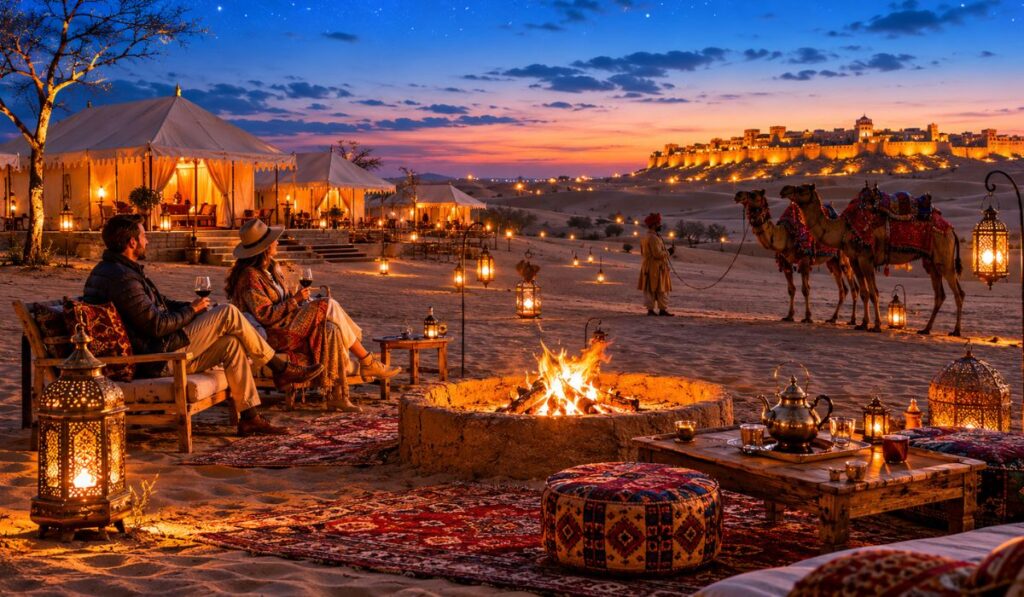
<p><strong>Luxury desert camp:</strong> Glamping in the Thar Desert with private tents, fine dining under the stars, and camel safaris at sunset.</p>
<!-- /wp:paragraph -->
<!-- wp:paragraph -->
<p><strong>Vintage car ride:</strong> Tour Jaipur in a restored vintage Rolls-Royce or Cadillac.</p>
<!-- /wp:paragraph -->
<!-- wp:paragraph -->
<p><strong>Private boat ride:</strong> Sunset cruise on Lake Pichola in Udaipur with champagne and canapés.</p>
<!-- /wp:paragraph -->
<!-- wp:separator -->
<hr class="wp-block-separator has-alpha-channel-opacity"/>
<!-- /wp:separator -->
<!-- wp:heading -->
<h2 class="wp-block-heading">Budget Experiences That Feel Luxurious</h2>
<!-- /wp:heading -->
<!-- wp:image {"id":2046,"sizeSlug":"large","linkDestination":"none"} -->
<figure class="wp-block-image size-large"><img src="https://www.tajwondertour.com/wp-content/uploads/2026/08/25543-1024x597.jpg" alt="" class="wp-image-2046"/></figure>
<!-- /wp:image -->
<!-- wp:paragraph -->
<p><strong>Sunset at Nahargarh Fort:</strong> Watch the sun set over Jaipur's pink city from this hilltop fort — free entry and breathtaking views.</p>
<!-- /wp:paragraph -->
<!-- wp:paragraph -->
<p><strong>Local food tour:</strong> Explore Jaipur's or Jodhpur's street food scene. For a few hundred rupees, you'll taste dishes that rival any fine-dining restaurant.</p>
<!-- /wp:paragraph -->
<!-- wp:paragraph -->
<p><strong>Heritage walk:</strong> Self-guided or with a local guide, explore old cities and discover hidden havelis, temples, and bazaars.</p>
<!-- /wp:paragraph -->
<!-- wp:paragraph -->
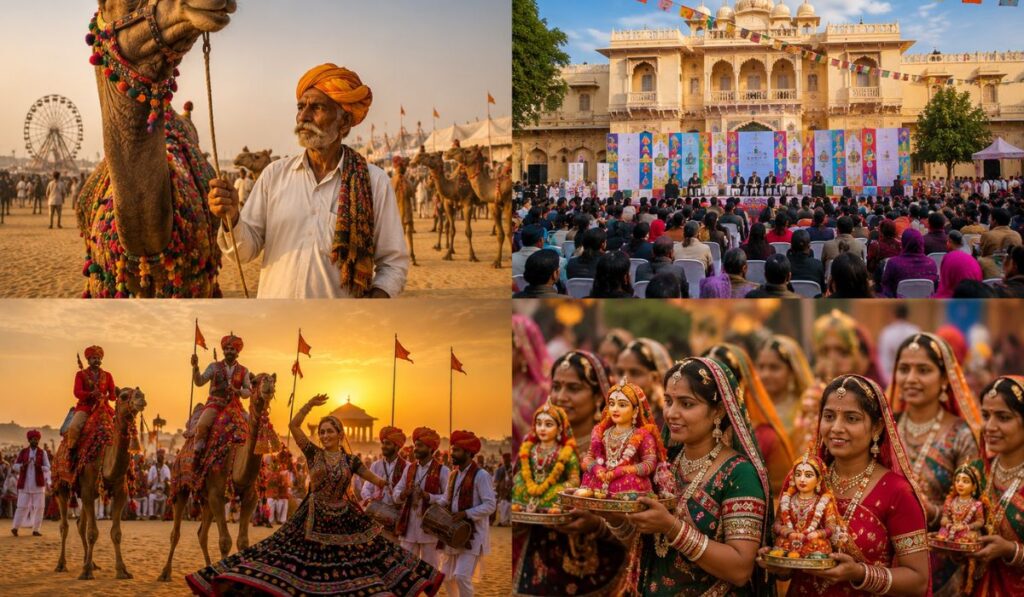
<p><strong>Camel safari:</strong> A short camel ride in Pushkar or Jaisalmer costs just a few hundred rupees but feels like a desert adventure.</p>
<!-- /wp:paragraph -->
<!-- wp:paragraph -->
<p><strong>Folk dance show:</strong> Many hotels and venues offer free or low-cost cultural performances with traditional Rajasthani music and dance.</p>
<!-- /wp:paragraph -->
<!-- wp:paragraph -->
<p><strong>Blue City viewpoint:</strong> Climb to a rooftop in Jodhpur's old city for panoramic views of the blue-washed houses — completely free.</p>
<!-- /wp:paragraph -->
<!-- wp:separator -->
<hr class="wp-block-separator has-alpha-channel-opacity"/>
<!-- /wp:separator -->
<!-- wp:heading -->
<h2 class="wp-block-heading">Which Rajasthan Cities Are Best for Luxury?</h2>
<!-- /wp:heading -->
<!-- wp:paragraph -->
<p><strong>Jaipur:</strong> Home to Rambagh Palace, Jai Mahal Palace, and Fairmont Jaipur. The Pink City offers the widest range of luxury accommodations and experiences.</p>
<!-- /wp:paragraph -->
<!-- wp:paragraph -->
<p><strong>Udaipur:</strong> The City of Lakes is Rajasthan's most romantic destination. Taj Lake Palace, The Leela Palace, and RAAS Devigarh offer unforgettable stays.</p>
<!-- /wp:paragraph -->
<!-- wp:paragraph -->
<p><strong>Jodhpur:</strong> Umaid Bhawan Palace and RAAS Jodhpur provide royal experiences in the Blue City.</p>
<!-- /wp:paragraph -->
<!-- wp:paragraph -->
<p><strong>Ranthambore:</strong> The Oberoi Vanyavilas Wildlife Resort offers luxury tiger safaris starting from Rp8,167,166 per night.</p>
<!-- /wp:paragraph -->
<!-- wp:paragraph -->
<p><strong>Jaisalmer:</strong> Luxury desert camps and heritage havelis offer golden desert experiences.</p>
<!-- /wp:paragraph -->
<!-- wp:separator -->
<hr class="wp-block-separator has-alpha-channel-opacity"/>
<!-- /wp:separator -->
<!-- wp:heading -->
<h2 class="wp-block-heading">Best Rajasthan Cities for Budget Travelers</h2>
<!-- /wp:heading -->
<!-- wp:paragraph -->
<p><strong>Pushkar:</strong> Affordable guesthouses, budget-friendly restaurants, and the famous Pushkar Lake — all at backpacker prices.</p>
<!-- /wp:paragraph -->
<!-- wp:paragraph -->
<p><strong>Bundi:</strong> Off the tourist trail with beautiful stepwells, a stunning fort, and incredibly affordable accommodation.</p>
<!-- /wp:paragraph -->
<!-- wp:paragraph -->
<p><strong>Bikaner:</strong> Budget-friendly hotels, the famous Karni Mata Temple, and excellent camel safari options at low prices.</p>
<!-- /wp:paragraph -->
<!-- wp:paragraph -->
<p><strong>Shekhawati:</strong> The open-air art gallery of Rajasthan — havelis with stunning frescoes, very few tourists, and very low prices.</p>
<!-- /wp:paragraph -->
<!-- wp:paragraph -->
<p><strong>Mount Abu:</strong> Rajasthan's only hill station — budget guesthouses, cool weather, and affordable activities.</p>
<!-- /wp:paragraph -->
<!-- wp:separator -->
<hr class="wp-block-separator has-alpha-channel-opacity"/>
<!-- /wp:separator -->
<!-- wp:heading -->
<h2 class="wp-block-heading">Which Tour Style Fits Your Travel Type?</h2>
<!-- /wp:heading -->
<!-- wp:paragraph -->
<p><strong>Couples:</strong> Luxury offers romantic palace stays and private experiences. Budget can still be romantic with sunset views and intimate local restaurants.</p>
<!-- /wp:paragraph -->
<!-- wp:paragraph -->
<p><strong>Families:</strong> Luxury provides comfort, convenience, and kid-friendly activities. Budget works well for larger families who need to manage costs.</p>
<!-- /wp:paragraph -->
<!-- wp:paragraph -->
<p><strong>Solo Travelers:</strong> Luxury can be expensive alone. Budget travel is perfect for solo adventurers — you'll meet other travelers and save money.</p>
<!-- /wp:paragraph -->
<!-- wp:paragraph -->
<p><strong>Senior Travelers:</strong> Luxury offers comfort, accessibility, and private transport. Budget may involve more walking and shared transport.</p>
<!-- /wp:paragraph -->
<!-- wp:paragraph -->
<p><strong>Luxury Travelers:</strong> Premium experiences, heritage hotels, and exclusive access.</p>
<!-- /wp:paragraph -->
<!-- wp:paragraph -->
<p><strong>Backpackers:</strong> Budget hostels, street food, train travel, and unforgettable experiences at minimal cost.</p>
<!-- /wp:paragraph -->
<!-- wp:paragraph -->
<p><strong>Photographers:</strong> Luxury offers sunrise/sunset access and private tours. Budget still delivers spectacular photo opportunities at public hours.</p>
<!-- /wp:paragraph -->
<!-- wp:paragraph -->
<p><strong>International Tourists:</strong> Both options work well. Luxury provides a hassle-free premium experience. Budget offers authentic cultural immersion at great value.</p>
<!-- /wp:paragraph -->
<!-- wp:separator -->
<hr class="wp-block-separator has-alpha-channel-opacity"/>
<!-- /wp:separator -->
<!-- wp:heading -->
<h2 class="wp-block-heading">Hidden Costs You Should Know</h2>
<!-- /wp:heading -->
<!-- wp:paragraph -->
<p><strong>Parking:</strong> Many hotels charge for parking. Factor in ₹100–₹500 per night.</p>
<!-- /wp:paragraph -->
<!-- wp:paragraph -->
<p><strong>Tips:</strong> Guides, drivers, and hotel staff expect tips. Budget ₹500–₹1,000 per day for gratuities.</p>
<!-- /wp:paragraph -->
<!-- wp:paragraph -->
<p><strong>Guide fees:</strong> Licensed guides cost ₹1,000–₹3,000 per half-day. Some tours include this; others don't.</p>
<!-- /wp:paragraph -->
<!-- wp:paragraph -->
<p><strong>Safari fees:</strong> Ranthambore tiger safaris cost ₹1,500–₹4,000 per person per safari, depending on vehicle and zone.</p>
<!-- /wp:paragraph -->
<!-- wp:paragraph -->
<p><strong>Camera charges:</strong> Many monuments charge extra for cameras (₹25–₹200) and video cameras (₹100–₹500).</p>
<!-- /wp:paragraph -->
<!-- wp:paragraph -->
<p><strong>Shopping:</strong> Rajasthan's bazaars are irresistible. Set a budget and stick to it.</p>
<!-- /wp:paragraph -->
<!-- wp:paragraph -->
<p><strong>Airport transfers:</strong> Some packages include transfers; others charge extra (₹700–₹1,500 per vehicle).</p>
<!-- /wp:paragraph -->
<!-- wp:separator -->
<hr class="wp-block-separator has-alpha-channel-opacity"/>
<!-- /wp:separator -->
<!-- wp:heading -->
<h2 class="wp-block-heading">How to Save Money Without Sacrificing Experience</h2>
<!-- /wp:heading -->
<!-- wp:paragraph -->
<p><strong>Travel shoulder season:</strong> October and March offer good weather with lower prices than peak December–January.</p>
<!-- /wp:paragraph -->
<!-- wp:paragraph -->
<p><strong>Book early:</strong> Early bird discounts can save 10–20% on hotels and packages.</p>
<!-- /wp:paragraph -->
<!-- wp:paragraph -->
<p><strong>Mix luxury and standard hotels:</strong> Splurge on a palace hotel for 1–2 nights, stay in standard hotels for the rest.</p>
<!-- /wp:paragraph -->
<!-- wp:paragraph -->
<p><strong>Choose a private car:</strong> Splitting a private sedan with 3–4 people costs less than individual train or taxi tickets.</p>
<!-- /wp:paragraph -->
<!-- wp:paragraph -->
<p><strong>Stay longer:</strong> Longer trips reduce daily average costs and let you experience more.</p>
<!-- /wp:paragraph -->
<!-- wp:paragraph -->
<p><strong>Eat local:</strong> Local restaurants offer authentic food at a fraction of hotel restaurant prices.</p>
<!-- /wp:paragraph -->
<!-- wp:paragraph -->
<p><strong>Book combo tickets:</strong> Many monuments offer combo tickets that save money on entry fees.</p>
<!-- /wp:paragraph -->
<!-- wp:paragraph -->
<p><strong>Travel in a group:</strong> Groups of 4+ can split transport and guide costs significantly.</p>
<!-- /wp:paragraph -->
<!-- wp:separator -->
<hr class="wp-block-separator has-alpha-channel-opacity"/>
<!-- /wp:separator -->
<!-- wp:heading -->
<h2 class="wp-block-heading">Recommended Rajasthan Itineraries</h2>
<!-- /wp:heading -->
<!-- wp:heading {"level":3} -->
<h3 class="wp-block-heading">Luxury Itinerary (10 Days)</h3>
<!-- /wp:heading -->
<!-- wp:paragraph -->
<p><strong>Delhi → Jaipur (2 nights)</strong> — Rambagh Palace or Jai Mahal Palace<br><strong>→ Jodhpur (2 nights)</strong> — Umaid Bhawan Palace or RAAS Jodhpur<br><strong>→ Udaipur (2 nights)</strong> — Taj Lake Palace or The Leela Palace<br><strong>→ Delhi</strong></p>
<!-- /wp:paragraph -->
<!-- wp:paragraph -->
<p><em>Perfect for travelers seeking Rajasthan's royal heritage with a comfortable, immersive itinerary.</em></p>
<!-- /wp:paragraph -->
<!-- wp:heading {"level":3} -->
<h3 class="wp-block-heading">Budget Itinerary (7 Days)</h3>
<!-- /wp:heading -->
<!-- wp:paragraph -->
<p><strong>Delhi → Jaipur (2 nights)</strong> — Budget hotel or guesthouse<br><strong>→ Jodhpur (2 nights)</strong> — Budget hotel or hostel<br><strong>→ Udaipur (2 nights)</strong> — Budget hotel or guesthouse<br><strong>→ Delhi</strong></p>
<!-- /wp:paragraph -->
<!-- wp:paragraph -->
<p>For travelers wanting an in-depth journey covering Rajasthan's major heritage cities, our <strong><a href="https://www.tajwondertour.com/tours/ultimate-classical-rajasthan-tour-13-days/">Ultimate Classical Rajasthan Tour (13 Days)</a></strong> takes you through Delhi, Agra, Jaipur, Bikaner, Jaisalmer, Jodhpur, and Udaipur.</p>
<!-- /wp:paragraph -->
<!-- wp:paragraph -->
<p>For first-time visitors combining the Golden Triangle with Rajasthan, our <strong><a href="https://www.tajwondertour.com/tours/delhi-agra-jaipur-jodhpur-udaipur-tour-10-days/">Delhi Agra Jaipur Jodhpur Udaipur Tour (10 Days)</a></strong> is the perfect choice.</p>
<!-- /wp:paragraph -->
<!-- wp:separator -->
<hr class="wp-block-separator has-alpha-channel-opacity"/>
<!-- /wp:separator -->
<!-- wp:heading -->
<h2 class="wp-block-heading">Luxury vs Budget Rajasthan Tour: Pros and Cons</h2>
<!-- /wp:heading -->
<!-- wp:heading {"level":3} -->
<h3 class="wp-block-heading">Luxury Tour</h3>
<!-- /wp:heading -->
<!-- wp:table -->
<figure class="wp-block-table"><table class="has-fixed-layout"><thead><tr><th>Pros</th><th>Cons</th></tr></thead><tbody><tr><td>Unforgettable palace stays</td><td>Very expensive</td></tr><tr><td>Complete privacy and flexibility</td><td>Less authentic local interaction</td></tr><tr><td>Expert private guides</td><td>Can feel disconnected from local life</td></tr><tr><td>Stress-free travel</td><td>Less spontaneous</td></tr><tr><td>Premium safety and comfort</td><td>May feel "packaged"</td></tr></tbody></table></figure>
<!-- /wp:table -->
<!-- wp:paragraph -->
<p><strong>Who should choose it:</strong> Honeymooners, luxury travelers, senior citizens, those celebrating special occasions, travelers with limited time who want maximum comfort.</p>
<!-- /wp:paragraph -->
<!-- wp:heading {"level":3} -->
<h3 class="wp-block-heading">Budget Tour</h3>
<!-- /wp:heading -->
<!-- wp:table -->
<figure class="wp-block-table"><table class="has-fixed-layout"><thead><tr><th>Pros</th><th>Cons</th></tr></thead><tbody><tr><td>Affordable — stretch your travel budget</td><td>Less comfort and privacy</td></tr><tr><td>Authentic local experiences</td><td>Fixed itineraries</td></tr><tr><td>Meet other travelers</td><td>More planning required</td></tr><tr><td>More spontaneous</td><td>Less flexibility</td></tr><tr><td>Better value for money</td><td>Can be tiring</td></tr></tbody></table></figure>
<!-- /wp:table -->
<!-- wp:paragraph -->
<p><strong>Who should choose it:</strong> Backpackers, solo travelers, students, budget-conscious families, travelers who value experiences over luxury.</p>
<!-- /wp:paragraph -->
<!-- wp:separator -->
<hr class="wp-block-separator has-alpha-channel-opacity"/>
<!-- /wp:separator -->
<!-- wp:heading -->
<h2 class="wp-block-heading">Frequently Asked Questions (AEO)</h2>
<!-- /wp:heading -->
<!-- wp:heading {"level":3} -->
<h3 class="wp-block-heading">Is a Luxury vs Budget Rajasthan Tour worth comparing?</h3>
<!-- /wp:heading -->
<!-- wp:paragraph -->
<p><strong>Yes — understanding the differences helps you choose the right experience for your travel style.</strong> A <strong>luxury vs budget Rajasthan tour</strong> comparison reveals that both options offer incredible experiences, just in different ways. Luxury provides comfort and exclusivity; budget offers authenticity and value. Your choice depends on your priorities, not just your budget.</p>
<!-- /wp:paragraph -->
<!-- wp:heading {"level":3} -->
<h3 class="wp-block-heading">How much does a Rajasthan trip cost?</h3>
<!-- /wp:heading -->
<!-- wp:paragraph -->
<p><strong>A 7-day Rajasthan trip costs ₹18,000–₹35,000 for budget travelers</strong>, ₹43,000–₹85,000 for mid-range travelers, and ₹1,35,000–₹5,20,000+ for luxury travelers. Costs vary by season, hotel choice, transport, and activities.</p>
<!-- /wp:paragraph -->
<!-- wp:heading {"level":3} -->
<h3 class="wp-block-heading">Are palace hotels worth the price?</h3>
<!-- /wp:heading -->
<!-- wp:paragraph -->
<p><strong>For many travelers, yes.</strong> Staying in a heritage palace like Rambagh Palace or Umaid Bhawan Palace is a once-in-a-lifetime experience. You're not just paying for a room — you're paying for history, architecture, exceptional service, and memories that last forever.</p>
<!-- /wp:paragraph -->
<!-- wp:heading {"level":3} -->
<h3 class="wp-block-heading">Can I enjoy Rajasthan on a budget?</h3>
<!-- /wp:heading -->
<!-- wp:paragraph -->
<p><strong>Absolutely.</strong> Rajasthan is one of India's most budget-friendly destinations. With daily budgets of ₹2,000–₹3,200 per person, you can enjoy comfortable hotels, local food, and all the major attractions. The experiences are just as rich — your wallet just feels lighter.</p>
<!-- /wp:paragraph -->
<!-- wp:heading {"level":3} -->
<h3 class="wp-block-heading">Which cities are expensive?</h3>
<!-- /wp:heading -->
<!-- wp:paragraph -->
<p><strong>Jaipur, Udaipur, and Jodhpur</strong> have the most expensive luxury hotels. Jaisalmer and Ranthambore also have premium options. For budget travel, Pushkar, Bundi, Bikaner, and Mount Abu offer excellent value.</p>
<!-- /wp:paragraph -->
<!-- wp:heading {"level":3} -->
<h3 class="wp-block-heading">How many days are enough for Rajasthan?</h3>
<!-- /wp:heading -->
<!-- wp:paragraph -->
<p><strong>7–10 days</strong> covers the highlights (Jaipur, Jodhpur, Udaipur). <strong>13 days</strong> covers the complete circuit including Bikaner, Jaisalmer, and Pushkar. Longer trips reduce daily average costs.</p>
<!-- /wp:paragraph -->
<!-- wp:heading {"level":3} -->
<h3 class="wp-block-heading">Is private transport worth it?</h3>
<!-- /wp:heading -->
<!-- wp:paragraph -->
<p><strong>Yes — especially for families, couples, and anyone who values flexibility.</strong> A private car with a driver costs more than trains but saves time, reduces stress, and lets you travel at your own pace. For groups of 3–4, the cost difference is minimal.</p>
<!-- /wp:paragraph -->
<!-- wp:heading {"level":3} -->
<h3 class="wp-block-heading">When are luxury hotels cheapest?</h3>
<!-- /wp:heading -->
<!-- wp:paragraph -->
<p><strong>April–September (off-season)</strong> — luxury hotels drop rates by 40–70%. The weather is hot (summer) or wet (monsoon), but if you can handle the conditions, you'll get palace experiences at fraction of peak prices.</p>
<!-- /wp:paragraph -->
<!-- wp:separator -->
<hr class="wp-block-separator has-alpha-channel-opacity"/>
<!-- /wp:separator -->
<!-- wp:heading -->
<h2 class="wp-block-heading">Expert Recommendations</h2>
<!-- /wp:heading -->
<!-- wp:table -->
<figure class="wp-block-table"><table class="has-fixed-layout"><thead><tr><th>Travel Goal</th><th>Recommended Style</th><th>Best Month</th></tr></thead><tbody><tr><td><strong>Honeymoon</strong></td><td>Luxury</td><td>October–November</td></tr><tr><td><strong>Family</strong></td><td>Mid-range or Luxury</td><td>November–February</td></tr><tr><td><strong>Solo Travel</strong></td><td>Budget</td><td>October or March</td></tr><tr><td><strong>Senior Citizens</strong></td><td>Luxury</td><td>November–February</td></tr><tr><td><strong>Budget Travel</strong></td><td>Budget</td><td>July–September</td></tr><tr><td><strong>Photography</strong></td><td>Mid-range</td><td>September–October or November–February</td></tr><tr><td><strong>Luxury Experience</strong></td><td>Luxury</td><td>December–January</td></tr><tr><td><strong>International Tourists</strong></td><td>Mid-range or Luxury</td><td>October–March</td></tr></tbody></table></figure>
<!-- /wp:table -->
<!-- wp:separator -->
<hr class="wp-block-separator has-alpha-channel-opacity"/>
<!-- /wp:separator -->
<!-- wp:heading -->
<h2 class="wp-block-heading">Conclusion</h2>
<!-- /wp:heading -->
<!-- wp:paragraph -->
<p>So, which is right for you — a luxury or budget Rajasthan tour?</p>
<!-- /wp:paragraph -->
<!-- wp:paragraph -->
<p>Here's the honest answer: <strong>both.</strong> Rajasthan is a destination that rewards every type of traveler. The difference isn't about one being "better" — it's about what <em>you</em> want from your journey.</p>
<!-- /wp:paragraph -->
<!-- wp:paragraph -->
<p><strong>Choose a luxury tour if:</strong></p>
<!-- /wp:paragraph -->
<!-- wp:list -->
<ul class="wp-block-list"><!-- wp:list-item -->
<li>You want to sleep in real palaces and heritage hotels</li>
<!-- /wp:list-item -->
<!-- wp:list-item -->
<li>You value privacy, comfort, and exclusivity</li>
<!-- /wp:list-item -->
<!-- wp:list-item -->
<li>You have a higher budget and want a stress-free experience</li>
<!-- /wp:list-item -->
<!-- wp:list-item -->
<li>You're celebrating a special occasion like a honeymoon or anniversary</li>
<!-- /wp:list-item -->
<!-- wp:list-item -->
<li>You have limited time and want to maximize every moment</li>
<!-- /wp:list-item --></ul>
<!-- /wp:list -->
<!-- wp:paragraph -->
<p><strong>Choose a budget tour if:</strong></p>
<!-- /wp:paragraph -->
<!-- wp:list -->
<ul class="wp-block-list"><!-- wp:list-item -->
<li>You want to stretch your travel budget further</li>
<!-- /wp:list-item -->
<!-- wp:list-item -->
<li>You enjoy authentic local experiences and meeting other travelers</li>
<!-- /wp:list-item -->
<!-- wp:list-item -->
<li>You don't mind some planning and flexibility</li>
<!-- /wp:list-item -->
<!-- wp:list-item -->
<li>You're a solo traveler, student, or backpacker</li>
<!-- /wp:list-item -->
<!-- wp:list-item -->
<li>You value experiences over luxury accommodations</li>
<!-- /wp:list-item --></ul>
<!-- /wp:list -->
<!-- wp:paragraph -->
<p>The truth is, <strong>a luxury vs budget Rajasthan tour</strong> isn't a competition — it's a choice. Both options deliver the same magnificent forts, the same golden deserts, the same pink and blue cities, and the same warm Rajasthani hospitality. The difference is simply <em>how</em> you experience them.</p>
<!-- /wp:paragraph -->
<!-- wp:paragraph -->
<p>Whatever you choose, Rajasthan will reward you with memories that last a lifetime. The forts will still be magnificent. The deserts will still be magical. The food will still be extraordinary. The people will still welcome you with warmth.</p>
<!-- /wp:paragraph -->
<!-- wp:paragraph -->
<p><strong>Ready to plan your Rajasthan adventure?</strong> Explore our <strong><a href="https://www.tajwondertour.com/tour-packages/rajasthan/">Rajasthan Tour Packages</a></strong> for expertly crafted itineraries at every budget level.</p>
<!-- /wp:paragraph -->
<!-- wp:paragraph -->
<p>For an immersive heritage journey covering Rajasthan's major cities, consider our <strong><a href="https://www.tajwondertour.com/tours/ultimate-classical-rajasthan-tour-13-days/">Ultimate Classical Rajasthan Tour (13 Days)</a></strong> — the complete royal Rajasthan experience.</p>
<!-- /wp:paragraph -->
<!-- wp:paragraph -->
<p>For first-time visitors wanting a broader North India experience, our <strong><a href="https://www.tajwondertour.com/tours/delhi-agra-jaipur-jodhpur-udaipur-tour-10-days/">Delhi Agra Jaipur Jodhpur Udaipur Tour (10 Days)</a></strong> combines the Golden Triangle with Rajasthan's most iconic cities.</p>
<!-- /wp:paragraph -->
<!-- wp:paragraph -->
<p><em>Plan your Rajasthan journey with Taj Wonder Tour — your trusted partner for royal India experiences.</em></p>
<!-- /wp:paragraph -->
Quick Answer For Luxury vs Budget Rajasthan Tour: Which One Is Right for You?
What is a luxury tour? A premium experience with heritage palace hotels, private chauffeur-driven vehicles, fine dining, and exclusive cultural experiences — prices typically range from ₹1,00,000 to ₹5,00,000+ per person for a week-long itinerary.
What is a budget tour? An affordable option with clean 3-star hotels, shared or economical transport, local restaurants, and excellent value — prices typically range from ₹18,000 to ₹35,000 per person for 4–6 days.
Which travelers should choose each? Choose a luxury tour if you value exclusivity, comfort, and once-in-a-lifetime palace experiences. Choose a budget tour if you’re cost-conscious, enjoy authentic local interactions, and want to stretch your travel budget further.
Key Takeaways
Category
Luxury Tour
Budget Tour
Hotel Quality
5-star palaces, heritage properties
3-star hotels, guesthouses, hostels
Privacy
Private vehicle, exclusive experiences
Shared transport, group tours
Cost (7 days)
₹1,00,000 – ₹5,00,000+
₹18,000 – ₹35,000
Transport
Private SUV with chauffeur
Sedan, train, or shared taxi
Best for Families
✅ Yes — comfort and convenience
✅ Yes — affordable group travel
Best for Couples
✅ Yes — romantic palace stays
✅ Yes — intimate budget getaways
Best for Solo Travelers
⚠️ Can be expensive alone
✅ Yes — budget-friendly
Best for Foreign Tourists
✅ Yes — premium experience
✅ Yes — great value
Best Time to Travel
October–March (peak season)
July–September (off-season deals)
Introduction
Rajasthan is India’s crown jewel — a land of maharajas, magnificent forts, golden deserts, and palaces that seem to float on lakes. But when it comes to planning your trip, one question dominates every traveler’s mind: should you splurge on a luxury experience or travel on a budget?
Here’s the truth: both options can deliver an unforgettable Rajasthan experience. The difference isn’t about quality — it’s about what kind of experience you want. A luxury vs budget Rajasthan tour comparison isn’t about one being “better” than the other; it’s about finding the right fit for your travel style, budget, and priorities.
Is luxury really worth it? For many travelers, the answer is yes — sleeping in a real palace, having a private chauffeur, and enjoying exclusive cultural experiences can transform a good trip into a life-changing one. But can budget travelers still enjoy Rajasthan? Absolutely. Rajasthan is one of India’s most accessible and rewarding destinations, with incredible value at every price point.
Ready to explore your options? Browse our Rajasthan Tour Packages for expertly crafted itineraries at every budget level.
What Is a Luxury Rajasthan Tour?
A luxury Rajasthan tour is the royal treatment — literally. It’s designed for travelers who want to experience Rajasthan the way maharajas once did, with every detail curated for comfort, exclusivity, and unforgettable moments.
Heritage palaces and 5-star hotels: Stay in properties like the Rambagh Palace in Jaipur (from ₹30,375 per night), Umaid Bhawan Palace in Jodhpur (from ₹5,655,460 IDR per night), or the iconic Taj Lake Palace in Udaipur (from ₹5,089,913 IDR per night). These are not just hotels — they’re living museums where every room tells a story.
Boutique heritage stays: For a more intimate experience, boutique heritage hotels like RAAS Devigarh near Udaipur or The Ajit Bhawan in Jodhpur offer personalized service and authentic Rajasthani charm.
Private chauffeur: A private SUV with an English-speaking driver gives you complete flexibility. You set the pace, stop when you want, and travel in air-conditioned comfort between cities.
Flexible itinerary: No fixed schedules. Want to spend an extra hour at Amber Fort? Skip a stop? Add a last-minute detour? Your itinerary bends to your wishes.
Fine dining: From palace rooftop dinners overlooking Lake Pichola to exclusive meals at heritage properties, luxury dining in Rajasthan is an experience in itself. Expect to pay $90–$150 per person for premium dining experiences.
Cultural experiences: Private heritage walks, curated shopping tours with local artisans, hot air balloon rides over Jaipur, and exclusive access to cultural performances.
What Is a Budget Rajasthan Tour?
A budget Rajasthan tour proves that you don’t need a maharaja’s treasury to experience Rajasthan’s magic. It’s designed for savvy travelers who want to maximize experiences while minimizing costs.
Clean 3-star hotels and guesthouses: Comfortable, centrally located hotels with all the essentials — hot water, clean rooms, and friendly service. Heritage guesthouses and hostels offer character without the palace price tag.
Affordable transport: Travel by train (comfortable and scenic), shared taxis, or economical private sedans. Rajasthan’s rail network connects all major cities efficiently and affordably.
Shared experiences: Join group tours, share safari vehicles, and meet fellow travelers. The social aspect of budget travel often creates unexpected friendships and shared memories.
Great value: Rajasthan offers incredible value at every price point. Street food, local markets, and affordable restaurants let you experience authentic Rajasthani culture without breaking the bank.
Local restaurants: Skip the hotel buffets and eat where locals eat. From dal baati churma to laal maas, Rajasthan’s cuisine is world-class and surprisingly affordable.
Popular sightseeing: All the same magnificent forts, palaces, and monuments — just without the private guide or VIP access. The views are just as spectacular.
Amenities: Pools, gardens, cultural performances, heritage walks
Budget Hotels
3-star hotels: Clean, comfortable, centrally located
Boutique hotels: Heritage-style properties with character at affordable prices
Guesthouses: Family-run, warm hospitality, local insights
Hostels: Social atmosphere, budget-friendly dorms and private rooms
Amenities: Hot water, WiFi, breakfast options, helpful staff
Private Car vs Budget Transport
Luxury: Private SUV
Vehicle: Premium SUVs like Toyota Innova or luxury sedans
Chauffeur: Professional, English-speaking driver
Flexibility: Stop anywhere, anytime. Change plans on the go.
Comfort: Air conditioning, ample space, water bottles provided
Cost: ₹8,000–₹15,000 per day
Budget: Sedan or Shared Transport
Vehicle: Standard sedan (Etios, Indigo, Dzire)
Driver: Professional driver, basic English
Flexibility: Fixed itinerary, shared with other travelers
Comfort: Air conditioning, standard space
Cost: ₹3,000–₹6,000 per day (private sedan) or significantly less (shared)
Luxury Experiences Worth Paying For
Palace dinner: A candlelit dinner at a heritage palace with live classical music — pure magic.
Hot air balloon: Float over Jaipur’s Amber Fort and pink city at sunrise. Unforgettable views.
Private heritage walk: Explore old cities with an expert historian who brings every alley to life.
Luxury desert camp: Glamping in the Thar Desert with private tents, fine dining under the stars, and camel safaris at sunset.
Vintage car ride: Tour Jaipur in a restored vintage Rolls-Royce or Cadillac.
Private boat ride: Sunset cruise on Lake Pichola in Udaipur with champagne and canapés.
Budget Experiences That Feel Luxurious
Sunset at Nahargarh Fort: Watch the sun set over Jaipur’s pink city from this hilltop fort — free entry and breathtaking views.
Local food tour: Explore Jaipur’s or Jodhpur’s street food scene. For a few hundred rupees, you’ll taste dishes that rival any fine-dining restaurant.
Heritage walk: Self-guided or with a local guide, explore old cities and discover hidden havelis, temples, and bazaars.
Camel safari: A short camel ride in Pushkar or Jaisalmer costs just a few hundred rupees but feels like a desert adventure.
Folk dance show: Many hotels and venues offer free or low-cost cultural performances with traditional Rajasthani music and dance.
Blue City viewpoint: Climb to a rooftop in Jodhpur’s old city for panoramic views of the blue-washed houses — completely free.
Which Rajasthan Cities Are Best for Luxury?
Jaipur: Home to Rambagh Palace, Jai Mahal Palace, and Fairmont Jaipur. The Pink City offers the widest range of luxury accommodations and experiences.
Udaipur: The City of Lakes is Rajasthan’s most romantic destination. Taj Lake Palace, The Leela Palace, and RAAS Devigarh offer unforgettable stays.
Jodhpur: Umaid Bhawan Palace and RAAS Jodhpur provide royal experiences in the Blue City.
Ranthambore: The Oberoi Vanyavilas Wildlife Resort offers luxury tiger safaris starting from Rp8,167,166 per night.
Jaisalmer: Luxury desert camps and heritage havelis offer golden desert experiences.
Best Rajasthan Cities for Budget Travelers
Pushkar: Affordable guesthouses, budget-friendly restaurants, and the famous Pushkar Lake — all at backpacker prices.
Bundi: Off the tourist trail with beautiful stepwells, a stunning fort, and incredibly affordable accommodation.
Bikaner: Budget-friendly hotels, the famous Karni Mata Temple, and excellent camel safari options at low prices.
Shekhawati: The open-air art gallery of Rajasthan — havelis with stunning frescoes, very few tourists, and very low prices.
Mount Abu: Rajasthan’s only hill station — budget guesthouses, cool weather, and affordable activities.
Which Tour Style Fits Your Travel Type?
Couples: Luxury offers romantic palace stays and private experiences. Budget can still be romantic with sunset views and intimate local restaurants.
Families: Luxury provides comfort, convenience, and kid-friendly activities. Budget works well for larger families who need to manage costs.
Solo Travelers: Luxury can be expensive alone. Budget travel is perfect for solo adventurers — you’ll meet other travelers and save money.
Senior Travelers: Luxury offers comfort, accessibility, and private transport. Budget may involve more walking and shared transport.
Luxury Travelers: Premium experiences, heritage hotels, and exclusive access.
Backpackers: Budget hostels, street food, train travel, and unforgettable experiences at minimal cost.
Photographers: Luxury offers sunrise/sunset access and private tours. Budget still delivers spectacular photo opportunities at public hours.
International Tourists: Both options work well. Luxury provides a hassle-free premium experience. Budget offers authentic cultural immersion at great value.
Hidden Costs You Should Know
Parking: Many hotels charge for parking. Factor in ₹100–₹500 per night.
Tips: Guides, drivers, and hotel staff expect tips. Budget ₹500–₹1,000 per day for gratuities.
Guide fees: Licensed guides cost ₹1,000–₹3,000 per half-day. Some tours include this; others don’t.
Safari fees: Ranthambore tiger safaris cost ₹1,500–₹4,000 per person per safari, depending on vehicle and zone.
Camera charges: Many monuments charge extra for cameras (₹25–₹200) and video cameras (₹100–₹500).
Shopping: Rajasthan’s bazaars are irresistible. Set a budget and stick to it.
Airport transfers: Some packages include transfers; others charge extra (₹700–₹1,500 per vehicle).
How to Save Money Without Sacrificing Experience
Travel shoulder season: October and March offer good weather with lower prices than peak December–January.
Book early: Early bird discounts can save 10–20% on hotels and packages.
Mix luxury and standard hotels: Splurge on a palace hotel for 1–2 nights, stay in standard hotels for the rest.
Choose a private car: Splitting a private sedan with 3–4 people costs less than individual train or taxi tickets.
Stay longer: Longer trips reduce daily average costs and let you experience more.
Eat local: Local restaurants offer authentic food at a fraction of hotel restaurant prices.
Book combo tickets: Many monuments offer combo tickets that save money on entry fees.
Travel in a group: Groups of 4+ can split transport and guide costs significantly.
Recommended Rajasthan Itineraries
Luxury Itinerary (10 Days)
Delhi → Jaipur (2 nights) — Rambagh Palace or Jai Mahal Palace → Jodhpur (2 nights) — Umaid Bhawan Palace or RAAS Jodhpur → Udaipur (2 nights) — Taj Lake Palace or The Leela Palace → Delhi
Perfect for travelers seeking Rajasthan’s royal heritage with a comfortable, immersive itinerary.
Budget Itinerary (7 Days)
Delhi → Jaipur (2 nights) — Budget hotel or guesthouse → Jodhpur (2 nights) — Budget hotel or hostel → Udaipur (2 nights) — Budget hotel or guesthouse → Delhi
For travelers wanting an in-depth journey covering Rajasthan’s major heritage cities, our Ultimate Classical Rajasthan Tour (13 Days) takes you through Delhi, Agra, Jaipur, Bikaner, Jaisalmer, Jodhpur, and Udaipur.
Who should choose it: Honeymooners, luxury travelers, senior citizens, those celebrating special occasions, travelers with limited time who want maximum comfort.
Budget Tour
Pros
Cons
Affordable — stretch your travel budget
Less comfort and privacy
Authentic local experiences
Fixed itineraries
Meet other travelers
More planning required
More spontaneous
Less flexibility
Better value for money
Can be tiring
Who should choose it: Backpackers, solo travelers, students, budget-conscious families, travelers who value experiences over luxury.
Frequently Asked Questions (AEO)
Is a Luxury vs Budget Rajasthan Tour worth comparing?
Yes — understanding the differences helps you choose the right experience for your travel style. A luxury vs budget Rajasthan tour comparison reveals that both options offer incredible experiences, just in different ways. Luxury provides comfort and exclusivity; budget offers authenticity and value. Your choice depends on your priorities, not just your budget.
How much does a Rajasthan trip cost?
A 7-day Rajasthan trip costs ₹18,000–₹35,000 for budget travelers, ₹43,000–₹85,000 for mid-range travelers, and ₹1,35,000–₹5,20,000+ for luxury travelers. Costs vary by season, hotel choice, transport, and activities.
Are palace hotels worth the price?
For many travelers, yes. Staying in a heritage palace like Rambagh Palace or Umaid Bhawan Palace is a once-in-a-lifetime experience. You’re not just paying for a room — you’re paying for history, architecture, exceptional service, and memories that last forever.
Can I enjoy Rajasthan on a budget?
Absolutely. Rajasthan is one of India’s most budget-friendly destinations. With daily budgets of ₹2,000–₹3,200 per person, you can enjoy comfortable hotels, local food, and all the major attractions. The experiences are just as rich — your wallet just feels lighter.
Which cities are expensive?
Jaipur, Udaipur, and Jodhpur have the most expensive luxury hotels. Jaisalmer and Ranthambore also have premium options. For budget travel, Pushkar, Bundi, Bikaner, and Mount Abu offer excellent value.
How many days are enough for Rajasthan?
7–10 days covers the highlights (Jaipur, Jodhpur, Udaipur). 13 days covers the complete circuit including Bikaner, Jaisalmer, and Pushkar. Longer trips reduce daily average costs.
Is private transport worth it?
Yes — especially for families, couples, and anyone who values flexibility. A private car with a driver costs more than trains but saves time, reduces stress, and lets you travel at your own pace. For groups of 3–4, the cost difference is minimal.
When are luxury hotels cheapest?
April–September (off-season) — luxury hotels drop rates by 40–70%. The weather is hot (summer) or wet (monsoon), but if you can handle the conditions, you’ll get palace experiences at fraction of peak prices.
Expert Recommendations
Travel Goal
Recommended Style
Best Month
Honeymoon
Luxury
October–November
Family
Mid-range or Luxury
November–February
Solo Travel
Budget
October or March
Senior Citizens
Luxury
November–February
Budget Travel
Budget
July–September
Photography
Mid-range
September–October or November–February
Luxury Experience
Luxury
December–January
International Tourists
Mid-range or Luxury
October–March
Conclusion
So, which is right for you — a luxury or budget Rajasthan tour?
Here’s the honest answer: both. Rajasthan is a destination that rewards every type of traveler. The difference isn’t about one being “better” — it’s about what you want from your journey.
Choose a luxury tour if:
You want to sleep in real palaces and heritage hotels
You value privacy, comfort, and exclusivity
You have a higher budget and want a stress-free experience
You’re celebrating a special occasion like a honeymoon or anniversary
You have limited time and want to maximize every moment
Choose a budget tour if:
You want to stretch your travel budget further
You enjoy authentic local experiences and meeting other travelers
You don’t mind some planning and flexibility
You’re a solo traveler, student, or backpacker
You value experiences over luxury accommodations
The truth is, a luxury vs budget Rajasthan tour isn’t a competition — it’s a choice. Both options deliver the same magnificent forts, the same golden deserts, the same pink and blue cities, and the same warm Rajasthani hospitality. The difference is simply how you experience them.
Whatever you choose, Rajasthan will reward you with memories that last a lifetime. The forts will still be magnificent. The deserts will still be magical. The food will still be extraordinary. The people will still welcome you with warmth.
Ready to plan your Rajasthan adventure? Explore our Rajasthan Tour Packages for expertly crafted itineraries at every budget level.
<!-- wp:paragraph -->
<p>Rushing the Taj Mahal into a single, exhausting day trip is the single most common mistake families make when they haven't traveled with kids in India before. A <strong>family friendly overnight Agra tour</strong> solves the problem that a same-day dash creates: it gives toddlers a nap window, gives grandparents a proper night's rest instead of eight hours in a car, and gives everyone the payoff of watching the Taj Mahal turn gold at sunrise instead of fighting midday crowds and heat.</p>
<!-- /wp:paragraph -->
<!-- wp:paragraph -->
<p>If you'd like the full itinerary and inclusions upfront, here's our <a href="https://www.tajwondertour.com/tours/taj-mahal-agra-overnight-tour-by-car/">Taj Mahal Agra Overnight Tour by Car</a> — otherwise, read on for everything a family needs to plan the trip properly.</p>
<!-- /wp:paragraph -->
<!-- wp:paragraph -->
<p>But "should we stay overnight" is only the first of a dozen real questions parents ask before booking — is Agra actually safe for young kids, which hotel won't leave you stuck on the third floor with no elevator, what do you pack for one night, and is Fatehpur Sikri worth the extra hours with a cranky six-year-old in the back seat? This guide answers all of it, in the order you'll actually need it: whether to stay overnight, safety, age-by-age advice, a full two-day itinerary, the drive itself, hotels, food, ticket logistics, packing, and the mistakes worth avoiding.</p>
<!-- /wp:paragraph -->
<!-- wp:paragraph -->
<p><strong>Quick Facts</strong></p>
<!-- /wp:paragraph -->
<!-- wp:list -->
<ul class="wp-block-list"><!-- wp:list-item -->
<li><strong>Duration:</strong> 1 night, 2 days</li>
<!-- /wp:list-item -->
<!-- wp:list-item -->
<li><strong>Best for:</strong> Families with kids of any age, including toddlers and grandparents</li>
<!-- /wp:list-item -->
<!-- wp:list-item -->
<li><strong>Distance from Delhi:</strong> ~230 km, roughly 3–4 hours by car</li>
<!-- /wp:list-item -->
<!-- wp:list-item -->
<li><strong>Ideal season:</strong> October–March</li>
<!-- /wp:list-item -->
<!-- wp:list-item -->
<li><strong>Child-friendly:</strong> Yes — children under 15 enter the Taj Mahal free</li>
<!-- /wp:list-item -->
<!-- wp:list-item -->
<li><strong>Senior-friendly:</strong> Yes, with hotel elevator access confirmed in advance</li>
<!-- /wp:list-item --></ul>
<!-- /wp:list -->
<!-- wp:heading -->
<h2 class="wp-block-heading">Family Friendly Overnight Agra Tour: Is One Night Really Enough?</h2>
<!-- /wp:heading -->
<!-- wp:paragraph -->
<p>For most families, yes: one night is enough to comfortably cover the Taj Mahal, Agra Fort, the Baby Taj, and Mehtab Bagh without rushing.</p>
<!-- /wp:paragraph -->
<!-- wp:paragraph -->
<p>If you want to add Fatehpur Sikri or Akbar's tomb at Sikandra, or you're traveling with toddlers or grandparents who need a slower pace, two nights works better.</p>
<!-- /wp:paragraph -->
<!-- wp:paragraph -->
<p>The overnight structure itself is what makes the trip work for families in the first place. Splitting the sightseeing across an arrival afternoon and a departure morning means nobody is doing five hours of driving and a full day of monument-hopping back to back.</p>
<!-- /wp:paragraph -->
<!-- wp:paragraph -->
<p>It also means you get the Taj Mahal at sunrise — cooler air, softer light, and noticeably thinner crowds — rather than trying to squeeze it in at midday on a same-day itinerary. And a real hotel stay, even a single night, gives kids a pool break and a proper bed instead of a long car nap.</p>
<!-- /wp:paragraph -->
<!-- wp:paragraph -->
<p>The trade-off is mostly about pace. Teenagers and photography-focused families can move through Agra Fort and the Taj in a brisk few hours each. Toddlers and grandparents generally do better with more buffer time between stops and fewer forced-march itineraries — Fatehpur Sikri is the easiest attraction to drop if the day is running long.</p>
<!-- /wp:paragraph -->
<!-- wp:paragraph -->
<p>If your family decides a single day trip actually suits you better — say, you're short on time or traveling with a very young infant — this comparison breaks it down well: <a href="https://www.tajwondertour.com/one-day-vs-overnight-taj-mahal-tour/">Plan the Perfect 4–6 Hour Trip</a>.</p>
<!-- /wp:paragraph -->
<!-- wp:heading -->
<h2 class="wp-block-heading">Is Agra Safe for Families with Kids?</h2>
<!-- /wp:heading -->
<!-- wp:image {"id":2031,"sizeSlug":"large","linkDestination":"none"} -->
<figure class="wp-block-image size-large"><img src="https://www.tajwondertour.com/wp-content/uploads/2026/07/Untitled-design-2026-07-30T181333.702-1024x597.jpg" alt="Family-Friendly Overnight Agra Tour: Everything You Need to Know (2026 Guide)" class="wp-image-2031"/></figure>
<!-- /wp:image -->
<!-- wp:paragraph -->
<p>Agra is safe for families, including those traveling with young children. Millions of tourists visit every year without major safety incidents.</p>
<!-- /wp:paragraph -->
<!-- wp:paragraph -->
<p>The real precautions parents need are practical ones — food and water, heat, crowd density near the Taj Mahal, and the monkeys around Agra Fort — rather than anything to do with general crime.</p>
<!-- /wp:paragraph -->
<!-- wp:heading {"level":3} -->
<h3 class="wp-block-heading">General Safety</h3>
<!-- /wp:heading -->
<!-- wp:paragraph -->
<p>Agra is a well-established tourist city, and family groups move through it constantly. The genuine risks aren't about personal safety in the way first-time visitors sometimes worry; they're logistical, and each one has a straightforward fix.</p>
<!-- /wp:paragraph -->
<!-- wp:heading {"level":3} -->
<h3 class="wp-block-heading">Food & Drinking Water</h3>
<!-- /wp:heading -->
<!-- wp:paragraph -->
<p>Stick to reputable restaurants and hotel dining rather than street stalls, especially with young children whose stomachs are more sensitive. Use bottled water for drinking and even for brushing teeth — tap water is a common source of stomach trouble for foreign children in particular, and it's an easy thing to overlook on a short trip.</p>
<!-- /wp:paragraph -->
<!-- wp:heading {"level":3} -->
<h3 class="wp-block-heading">Summer Heat Precautions</h3>
<!-- /wp:heading -->
<!-- wp:paragraph -->
<p>Agra gets genuinely hot for a large part of the year, and heat is a real risk for toddlers and elderly relatives specifically. Plan outdoor sightseeing for early morning and late afternoon, and build in indoor or shaded breaks — a hotel pool break or an air-conditioned lunch stop — during the hottest midday hours.</p>
<!-- /wp:paragraph -->
<!-- wp:heading {"level":3} -->
<h3 class="wp-block-heading">Crowded Areas & the Taj Mahal Walkway</h3>
<!-- /wp:heading -->
<!-- wp:paragraph -->
<p>The Taj Mahal draws serious crowds (visitor numbers have climbed into the millions annually), and the long corridor between the electric bus parking area and the security checkpoint is a spot where pickpockets sometimes work in groups, distracting tourists in the crush. Keep valuables zipped away and keep a hand on strollers or younger kids through this stretch specifically.</p>
<!-- /wp:paragraph -->
<!-- wp:heading {"level":3} -->
<h3 class="wp-block-heading">Monkeys Near Agra Fort</h3>
<!-- /wp:heading -->
<!-- wp:paragraph -->
<p>Monkeys around Agra Fort are known to snatch food, snacks, and even sunglasses out of hands or open bags. Keep food packed away rather than carried loose, and don't let kids offer food to them, however tempting it looks for photos.</p>
<!-- /wp:paragraph -->
<!-- wp:heading -->
<h2 class="wp-block-heading">What Age Is Right for an Overnight Agra Trip?</h2>
<!-- /wp:heading -->
<!-- wp:paragraph -->
<p>There's no wrong age to bring kids to Agra, but the trip looks different depending on who's coming.</p>
<!-- /wp:paragraph -->
<!-- wp:heading {"level":3} -->
<h3 class="wp-block-heading">Toddlers (1–4)</h3>
<!-- /wp:heading -->
<!-- wp:paragraph -->
<p>Build the itinerary around nap times rather than fighting them. Favor the early sunrise Taj Mahal visit (cooler, calmer, and done before the heat sets in) over a packed afternoon, and don't feel obligated to do every stop — Mehtab Bagh or Fatehpur Sikri are easy to skip if a toddler needs downtime instead.</p>
<!-- /wp:paragraph -->
<!-- wp:heading {"level":3} -->
<h3 class="wp-block-heading">Young Children (5–10)</h3>
<!-- /wp:heading -->
<!-- wp:paragraph -->
<p>This age group tends to genuinely enjoy the trip when it's framed as an adventure rather than a history lecture — treasure-hunt the carvings at the Taj, treat Sadar Bazaar as an exploration stop, and consider Wildlife SOS as a highlight rather than an afterthought.</p>
<!-- /wp:paragraph -->
<!-- wp:heading {"level":3} -->
<h3 class="wp-block-heading">Teenagers</h3>
<!-- /wp:heading -->
<!-- wp:paragraph -->
<p>Teens generally move faster through the monuments and get more out of photography opportunities and a bit of independence (within reason, and always with an adult nearby in crowded areas). They're also the group most likely to enjoy an add-on like Fatehpur Sikri if time allows.</p>
<!-- /wp:paragraph -->
<!-- wp:heading {"level":3} -->
<h3 class="wp-block-heading">Traveling with Grandparents</h3>
<!-- /wp:heading -->
<!-- wp:paragraph -->
<p>Pace and physical accessibility matter more than history depth. Confirm hotel elevator access in advance (many Agra hotels don't have one, so ask specifically about ground-floor rooms), build in indoor breaks, and don't feel pressure to see everything in one trip.</p>
<!-- /wp:paragraph -->
<!-- wp:heading -->
<h2 class="wp-block-heading">The Family Friendly Overnight Agra Tour Itinerary</h2>
<!-- /wp:heading -->
<!-- wp:image {"id":2033,"sizeSlug":"large","linkDestination":"none"} -->
<figure class="wp-block-image size-large"><img src="https://www.tajwondertour.com/wp-content/uploads/2026/07/Untitled-design-2026-07-30T182113.664-1024x597.jpg" alt="Family-Friendly Overnight Agra Tour: Everything You Need to Know (2026 Guide)" class="wp-image-2033"/></figure>
<!-- /wp:image -->
<!-- wp:paragraph -->
<p><strong>Day 1:</strong> Delhi pickup → drive via Yamuna Expressway → lunch stop → Agra Fort → Itimad-ud-Daulah (Baby Taj) → Mehtab Bagh at sunset → hotel check-in → dinner</p>
<!-- /wp:paragraph -->
<!-- wp:paragraph -->
<p><strong>Day 2:</strong> Sunrise visit to the Taj Mahal → breakfast → optional Sadar Bazaar stop → return drive to Delhi</p>
<!-- /wp:paragraph -->
<!-- wp:paragraph -->
<p><strong>Alternative pacing:</strong> Families with toddlers, grandparents, or a strong interest in photography can slow this down by dropping Mehtab Bagh or Sadar Bazaar and adding rest time at the hotel instead.</p>
<!-- /wp:paragraph -->
<!-- wp:paragraph -->
<p>There's no rule that says you need to hit every stop on Day 1 — the itinerary above is a template, not a checklist, and it's easy to adjust once you're actually on the ground with a private car and driver rather than a fixed-departure group tour.</p>
<!-- /wp:paragraph -->
<!-- wp:paragraph -->
<p>This two-day structure is exactly what a <strong>family friendly overnight Agra tour</strong> is built around — private transport gives you the flexibility to reorder or skip stops based on how your kids are doing that day, rather than sticking to a group bus schedule. See the full <a href="https://www.tajwondertour.com/tours/taj-mahal-agra-overnight-tour-by-car/">Taj Mahal Agra Overnight Tour by Car</a> itinerary and inclusions.</p>
<!-- /wp:paragraph -->
<!-- wp:heading -->
<h2 class="wp-block-heading">Delhi to Agra by Car with Kids</h2>
<!-- /wp:heading -->
<!-- wp:heading {"level":3} -->
<h3 class="wp-block-heading">Distance & Travel Time</h3>
<!-- /wp:heading -->
<!-- wp:paragraph -->
<p>The drive is roughly 230 km and typically takes 3–4 hours, largely along the Yamuna Expressway — a modern, six-lane, 165.5 km stretch connecting Greater Noida to Agra.</p>
<!-- /wp:paragraph -->
<!-- wp:heading {"level":3} -->
<h3 class="wp-block-heading">Road Conditions & FASTag</h3>
<!-- /wp:heading -->
<!-- wp:paragraph -->
<p>FASTag has been mandatory on the Yamuna Expressway since mid-2021; without it, tolls cost more and wait times at the plazas increase.</p>
<!-- /wp:paragraph -->
<!-- wp:paragraph -->
<p>If you're booking a private car and driver, this is one less thing to think about — it's already handled on our <a href="https://www.tajwondertour.com/tours/taj-mahal-tour-from-delhi-by-premium-car/">Taj Mahal Tour from Delhi by Premium Car</a>, which is worth a look if comfort on the drive matters as much as the itinerary itself.</p>
<!-- /wp:paragraph -->
<!-- wp:heading {"level":3} -->
<h3 class="wp-block-heading">Rest Stops and Where to Eat En Route</h3>
<!-- /wp:heading -->
<!-- wp:paragraph -->
<p>The expressway has designated service zones with fuel, washrooms, and light refreshments — genuinely useful for families who'd rather take a couple of structured breaks than push through in one go with young kids. Mathura and Vrindavan also sit along the route as options if your family wants to extend the trip with some extra sightseeing.</p>
<!-- /wp:paragraph -->
<!-- wp:heading {"level":3} -->
<h3 class="wp-block-heading">Car vs. Train</h3>
<!-- /wp:heading -->
<!-- wp:table -->
<figure class="wp-block-table"><table class="has-fixed-layout"><thead><tr><th></th><th>Private Car</th><th>Train (e.g., Gatimaan Express)</th></tr></thead><tbody><tr><td>Flexibility</td><td>High — stop, reorder, or skip anything</td><td>Fixed schedule and seating</td></tr><tr><td>Door-to-door</td><td>Yes</td><td>No — still need a taxi at each end</td></tr><tr><td>Best for toddlers</td><td>Better — nap anywhere, no fixed seating</td><td>Harder — fixed departure times</td></tr><tr><td>Travel time</td><td>3–4 hours</td><td>Around 1.5–2 hours (Delhi to Agra)</td></tr></tbody></table></figure>
<!-- /wp:table -->
<!-- wp:paragraph -->
<p>For families, a private car generally wins on flexibility — you're not locked into a departure time or seat assignment, and you can adjust the day around a toddler's nap or a grandparent needing a break, which a train schedule doesn't really allow for.</p>
<!-- /wp:paragraph -->
<!-- wp:heading -->
<h2 class="wp-block-heading">Best Family Hotels Near the Taj Mahal</h2>
<!-- /wp:heading -->
<!-- wp:table -->
<figure class="wp-block-table"><table class="has-fixed-layout"><thead><tr><th>Hotel</th><th>Price Tier</th><th>Pool</th><th>Family Room</th><th>Kids' Club</th><th>Distance from Taj Mahal</th></tr></thead><tbody><tr><td><strong>Trident Agra</strong></td><td>Mid–High</td><td>Yes (shallow area for younger guests)</td><td>Yes, with extra bedding options</td><td>Yes</td><td>~1.5 km</td></tr><tr><td><strong>DoubleTree by Hilton Agra</strong></td><td>Mid–High</td><td>Yes</td><td>Yes</td><td>Yes</td><td>Nearby</td></tr><tr><td><strong>Hotel Clarks Shiraz</strong></td><td>Mid</td><td>Yes</td><td>Crib/rollaway available</td><td>Yes</td><td>Nearby</td></tr><tr><td><strong>Hotel Sun Grand</strong></td><td>Budget–Mid</td><td>No</td><td>Yes, Family Rooms Available</td><td>No</td><td>~1 km</td></tr></tbody></table></figure>
<!-- /wp:table -->
<!-- wp:paragraph -->
<p><strong>Trident Agra</strong> is a strong pick for families needing more space — generously sized family rooms with extra bedding, a supervised kids' club, and a shallow pool area that works for younger guests, all about 1.5 km from the Taj Mahal.</p>
<!-- /wp:paragraph -->
<!-- wp:paragraph -->
<p><strong>DoubleTree by Hilton Agra</strong> and <strong>Hotel Clarks Shiraz</strong> are also regularly recommended for families, both offering pools, kids' clubs, and crib or rollaway bed availability.</p>
<!-- /wp:paragraph -->
<!-- wp:paragraph -->
<p><strong>Hotel Sun Grand</strong> is an excellent budget-friendly option for families who want to stay close to the Taj Mahal. Located about <strong>1 km away</strong>, it offers spacious family rooms, an on-site restaurant, free Wi-Fi, and convenient access to major attractions, making it a practical choice for travelers looking for comfort without paying luxury hotel prices.</p>
<!-- /wp:paragraph -->
<!-- wp:paragraph -->
<p>A practical note that applies across most Agra hotels: elevators aren't universal, so if anyone in your group has mobility needs, request a ground-floor room specifically when booking rather than assuming it'll be handled at check-in. If you're traveling in winter, it's also worth asking whether the pool is heated before you pack swimsuits.</p>
<!-- /wp:paragraph -->
<!-- wp:heading -->
<h2 class="wp-block-heading">Kid-Friendly Restaurants in Agra</h2>
<!-- /wp:heading -->
<!-- wp:paragraph -->
<p><strong>Breakfast/Lunch:</strong> Hotel dining is usually the simplest option on a tight two-day schedule, but if you want a proper sit-down family meal, <strong>Shripati Dwarkadhish</strong> is a standout — pure vegetarian, air-conditioned, a dedicated Family Thali, high chairs on request, and Jain options for families with specific dietary needs.</p>
<!-- /wp:paragraph -->
<!-- wp:paragraph -->
<p><strong>Dinner/Sunset:</strong> <strong>Salt Café</strong> is worth booking for its Taj Mahal view at sunset, paired with a menu that actually has kid-friendly staples like fries, noodles, and mocktails rather than only heavier, spicier dishes.</p>
<!-- /wp:paragraph -->
<!-- wp:heading -->
<h2 class="wp-block-heading">Taj Mahal Entry: What Families Need to Know</h2>
<!-- /wp:heading -->
<!-- wp:paragraph -->
<p>As of 2026, entry costs ₹50 for Indian citizens and ₹1,100 for foreign tourists, with an additional ₹200 to enter the main mausoleum itself. Children under 15 enter free, which matters if you're budgeting for a family of four or five.</p>
<!-- /wp:paragraph -->
<!-- wp:paragraph -->
<p>The monument opens 30 minutes before sunrise and closes 30 minutes before sunset, and it's closed to the public every Friday for prayers — worth double-checking against your travel dates before you finalize the itinerary.</p>
<!-- /wp:paragraph -->
<!-- wp:paragraph -->
<p>Entry tickets are valid for a 3-hour window; the official opening is 6:00 AM, but the queue itself often starts forming by around 5:15 AM. That's a useful thing to know in advance if you don't want to be rushing toddlers out the hotel door before dawn without warning.</p>
<!-- /wp:paragraph -->
<!-- wp:paragraph -->
<p>If you'd rather compare full itinerary options before booking tickets separately, browse our <a href="https://www.tajwondertour.com/tour-packages/taj-mahal/">Taj Mahal Tour Packages</a> to see what's included.</p>
<!-- /wp:paragraph -->
<!-- wp:paragraph -->
<p>Two gates serve visitors — East and West — and the East Gate typically handles fewer large tour buses and moves faster, which is a genuinely underused tip for families trying to minimize queue time with kids in tow. Night viewing is available on five nights each lunar month (two nights before the full moon, the full moon night itself, and two nights after), though not on Fridays or during Ramadan — a nice-to-know option rather than something to build a family itinerary around.</p>
<!-- /wp:paragraph -->
<!-- wp:heading -->
<h2 class="wp-block-heading">Family-Friendly Attractions Besides the Taj Mahal</h2>
<!-- /wp:heading -->
<!-- wp:heading {"level":3} -->
<h3 class="wp-block-heading">Agra Fort</h3>
<!-- /wp:heading -->
<!-- wp:paragraph -->
<p>A UNESCO World Heritage Site in its own right, with enough scale and detail to keep older kids engaged — just keep an eye on food and loose bags because of the monkeys mentioned earlier.</p>
<!-- /wp:paragraph -->
<!-- wp:heading {"level":3} -->
<h3 class="wp-block-heading">Baby Taj (Itimad-ud-Daulah)</h3>
<!-- /wp:heading -->
<!-- wp:paragraph -->
<p>Smaller, quieter, and far less crowded than the Taj Mahal itself, which makes it a good stop for younger kids who need a gentler pace between bigger attractions.</p>
<!-- /wp:paragraph -->
<!-- wp:heading {"level":3} -->
<h3 class="wp-block-heading">Mehtab Bagh</h3>
<!-- /wp:heading -->
<!-- wp:paragraph -->
<p>A garden directly across the river from the Taj Mahal, best visited for sunset views without the crowds or ticket lines of the main monument.</p>
<!-- /wp:paragraph -->
<!-- wp:heading {"level":3} -->
<h3 class="wp-block-heading">Wildlife SOS Elephant Sanctuary</h3>
<!-- /wp:heading -->
<!-- wp:paragraph -->
<p>There's no strict age cutoff, but the visit can be physically demanding in heat and dust, so a shorter orientation-style visit is a better fit for children under 14, ideally with a guardian close by. Families who've done it — including ones with teenagers — often rate it as a genuine highlight of the whole India trip. Treat it as a worthwhile detour if your schedule allows, rather than a must-do that has to be forced in.</p>
<!-- /wp:paragraph -->
<!-- wp:heading {"level":3} -->
<h3 class="wp-block-heading">Sadar Bazaar</h3>
<!-- /wp:heading -->
<!-- wp:paragraph -->
<p>A good, low-pressure stop for older kids who enjoy a bit of browsing and local color, particularly if you frame it as an exploration rather than a shopping obligation.</p>
<!-- /wp:paragraph -->
<!-- wp:heading -->
<h2 class="wp-block-heading">Packing Checklist for an Overnight Agra Trip</h2>
<!-- /wp:heading -->
<!-- wp:paragraph -->
<p><strong>Essentials:</strong> Passports/ID copies, printed or downloaded Taj Mahal tickets, cash for small vendors, phone chargers, hand sanitizer</p>
<!-- /wp:paragraph -->
<!-- wp:paragraph -->
<p><strong>Kids & Toddlers:</strong> Extra clothes for heat and dust, favorite snacks, a lightweight stroller (check hotel and monument accessibility in advance), any comfort items for naps in the car</p>
<!-- /wp:paragraph -->
<!-- wp:paragraph -->
<p><strong>Summer:</strong> Sunhats, sunscreen, extra bottled water, light breathable clothing</p>
<!-- /wp:paragraph -->
<!-- wp:paragraph -->
<p><strong>Winter:</strong> Layers for cold early mornings (sunrise visits can be genuinely chilly), a light jacket for evenings</p>
<!-- /wp:paragraph -->
<!-- wp:paragraph -->
<p><strong>Basic Medicines:</strong> Rehydration salts, any regular medication, a basic fever/upset-stomach kit for kids — better to have and not need than to be searching for a pharmacy on a one-night trip</p>
<!-- /wp:paragraph -->
<!-- wp:heading -->
<h2 class="wp-block-heading">Best Time to Visit Agra with Family</h2>
<!-- /wp:heading -->
<!-- wp:paragraph -->
<p>October through March is the most comfortable window, with cooler temperatures and clearer skies for both sunrise and sunset viewing at the Taj Mahal. Summer months bring intense heat that's genuinely hard on toddlers and older relatives, and monsoon season adds humidity and unpredictable rain to the mix. If your trip lines up with Indian school holidays or major festivals, expect noticeably heavier crowds at the main monuments, so building in a little extra time at the ticket queue isn't a bad idea.</p>
<!-- /wp:paragraph -->
<!-- wp:heading -->
<h2 class="wp-block-heading">Common Mistakes Families Make</h2>
<!-- /wp:heading -->
<!-- wp:list -->
<ul class="wp-block-list"><!-- wp:list-item -->
<li><strong>Starting the sunrise visit too late</strong> — the queue builds well before the official opening, so leaving the hotel "on time" for 6 AM often means missing the best light and thinnest crowds</li>
<!-- /wp:list-item -->
<!-- wp:list-item -->
<li><strong>Not booking Taj Mahal tickets in advance</strong> — avoidable line time that matters more with kids than without</li>
<!-- /wp:list-item -->
<!-- wp:list-item -->
<li><strong>Overpacking for a single night</strong> — a one-night trip doesn't need a full suitcase; it slows down hotel check-in and car loading for no benefit</li>
<!-- /wp:list-item -->
<!-- wp:list-item -->
<li><strong>Underestimating summer heat</strong> — especially for toddlers and grandparents, who tire out from heat far faster than the rest of the group</li>
<!-- /wp:list-item -->
<!-- wp:list-item -->
<li><strong>Choosing a hotel without confirming elevator or ground-floor access</strong> — many Agra hotels simply don't have elevators, and this is much easier to sort out before booking than after arrival</li>
<!-- /wp:list-item -->
<!-- wp:list-item -->
<li><strong>Not carrying small cash</strong> — local vendors and smaller stops often aren't set up for cards</li>
<!-- /wp:list-item --></ul>
<!-- /wp:list -->
<!-- wp:heading -->
<h2 class="wp-block-heading">Frequently Asked Questions</h2>
<!-- /wp:heading -->
<!-- wp:paragraph -->
<p><strong>Is one night enough in Agra with kids?</strong> Yes, for most families. One night comfortably covers the Taj Mahal, Agra Fort, the Baby Taj, and Mehtab Bagh. Add a second night if you want to include Fatehpur Sikri or prefer a slower pace, especially with toddlers or grandparents.</p>
<!-- /wp:paragraph -->
<!-- wp:paragraph -->
<p><strong>Is Agra safe for families?</strong> Yes. Millions of families visit each year without major incidents. The real precautions are practical — stick to reputable food and bottled water, plan around the heat, watch belongings in the crowded walkway near the Taj Mahal, and keep food packed away near Agra Fort's monkeys.</p>
<!-- /wp:paragraph -->
<!-- wp:paragraph -->
<p><strong>Do children need Taj Mahal tickets?</strong> Children under 15 enter free. Adults pay ₹50 (Indian citizens) or ₹1,100 (foreign tourists), plus ₹200 for the main mausoleum.</p>
<!-- /wp:paragraph -->
<!-- wp:paragraph -->
<p><strong>Which gate is best for families — East or West?</strong> The East Gate typically sees fewer large tour buses and moves faster, making it the better choice if you're trying to get young kids through security quickly.</p>
<!-- /wp:paragraph -->
<!-- wp:paragraph -->
<p><strong>Is Wildlife SOS worth it with kids?</strong> Often, yes — many families rate it as a trip highlight — but a shorter orientation visit suits children under 14 better than a longer, more physically demanding one, especially in the heat.</p>
<!-- /wp:paragraph -->
<!-- wp:paragraph -->
<p><strong>Can we add Fatehpur Sikri to the itinerary?</strong> Yes, if you have a second day or a flexible private car schedule. It's the easiest addition for families with more time, and the easiest one to skip if you don't.</p>
<!-- /wp:paragraph -->
<!-- wp:paragraph -->
<p><strong>What if we'd rather do a day trip instead of staying overnight?</strong> That's a reasonable choice if you're short on time or traveling with a very young infant. See <a href="https://www.tajwondertour.com/one-day-vs-overnight-taj-mahal-tour/">One-Day vs Overnight Taj Mahal Tour: Which Should You Choose?</a> for a full comparison — a day trip covers the core sights without an overnight stay, though it means a longer single day and no sunrise Taj Mahal visit.</p>
<!-- /wp:paragraph -->
<!-- wp:heading -->
<h2 class="wp-block-heading">Ready to Book Your Family Friendly Overnight Agra Tour</h2>
<!-- /wp:heading -->
<!-- wp:paragraph -->
<p>A <strong>family friendly overnight Agra tour</strong> gives you what a fixed-departure group tour usually can't: a driver who knows which toll stop actually has a clean washroom, a schedule that bends around a toddler's nap or a grandparent's pace, and the flexibility to swap in or drop a stop based on how the day is actually going — not how it was planned on paper.</p>
<!-- /wp:paragraph -->
<!-- wp:paragraph -->
<p>That flexibility is exactly what makes the overnight version work better for families than a rushed single-day trip.</p>
<!-- /wp:paragraph -->
<!-- wp:paragraph -->
<p>If you're ready to build a two-day Agra itinerary around your family's actual pace, <a href="https://www.tajwondertour.com/tours/taj-mahal-agra-overnight-tour-by-car/">book your Taj Mahal Agra Overnight Tour by Car</a> and we'll help you plan the details — hotel, pacing, and stops — around your kids' ages and your group's needs.</p>
<!-- /wp:paragraph -->
<!-- wp:heading -->
<h2 class="wp-block-heading">Conclusion</h2>
<!-- /wp:heading -->
<!-- wp:paragraph -->
<p>A <strong>family friendly overnight Agra tour</strong> gives families something a same-day trip can't: time to actually enjoy the Taj Mahal at sunrise, a proper hotel stay instead of a long car nap, and enough breathing room to adjust the pace for toddlers, teenagers, and grandparents alike.</p>
<!-- /wp:paragraph -->
<!-- wp:paragraph -->
<p>The real planning questions — safety, hotel choice, what to pack, and how to structure two days without exhausting anyone — all have straightforward answers once you know them in advance.</p>
<!-- /wp:paragraph -->
<!-- wp:paragraph -->
<p>Book your Taj Mahal tickets ahead of time, pick a hotel with confirmed accessibility for your group, and build the itinerary around your family's actual pace rather than a rigid checklist. Do that, and one night in Agra is more than enough to make the trip the highlight of your India visit.</p>
<!-- /wp:paragraph -->
Rushing the Taj Mahal into a single, exhausting day trip is the single most common mistake families make when they haven’t traveled with kids in India before. A family friendly overnight Agra tour solves the problem that a same-day dash creates: it gives toddlers a nap window, gives grandparents a proper night’s rest instead of eight hours in a car, and gives everyone the payoff of watching the Taj Mahal turn gold at sunrise instead of fighting midday crowds and heat.
If you’d like the full itinerary and inclusions upfront, here’s our Taj Mahal Agra Overnight Tour by Car — otherwise, read on for everything a family needs to plan the trip properly.
But “should we stay overnight” is only the first of a dozen real questions parents ask before booking — is Agra actually safe for young kids, which hotel won’t leave you stuck on the third floor with no elevator, what do you pack for one night, and is Fatehpur Sikri worth the extra hours with a cranky six-year-old in the back seat? This guide answers all of it, in the order you’ll actually need it: whether to stay overnight, safety, age-by-age advice, a full two-day itinerary, the drive itself, hotels, food, ticket logistics, packing, and the mistakes worth avoiding.
Quick Facts
Duration: 1 night, 2 days
Best for: Families with kids of any age, including toddlers and grandparents
Distance from Delhi: ~230 km, roughly 3–4 hours by car
Ideal season: October–March
Child-friendly: Yes — children under 15 enter the Taj Mahal free
Senior-friendly: Yes, with hotel elevator access confirmed in advance
Family Friendly Overnight Agra Tour: Is One Night Really Enough?
For most families, yes: one night is enough to comfortably cover the Taj Mahal, Agra Fort, the Baby Taj, and Mehtab Bagh without rushing.
If you want to add Fatehpur Sikri or Akbar’s tomb at Sikandra, or you’re traveling with toddlers or grandparents who need a slower pace, two nights works better.
The overnight structure itself is what makes the trip work for families in the first place. Splitting the sightseeing across an arrival afternoon and a departure morning means nobody is doing five hours of driving and a full day of monument-hopping back to back.
It also means you get the Taj Mahal at sunrise — cooler air, softer light, and noticeably thinner crowds — rather than trying to squeeze it in at midday on a same-day itinerary. And a real hotel stay, even a single night, gives kids a pool break and a proper bed instead of a long car nap.
The trade-off is mostly about pace. Teenagers and photography-focused families can move through Agra Fort and the Taj in a brisk few hours each. Toddlers and grandparents generally do better with more buffer time between stops and fewer forced-march itineraries — Fatehpur Sikri is the easiest attraction to drop if the day is running long.
If your family decides a single day trip actually suits you better — say, you’re short on time or traveling with a very young infant — this comparison breaks it down well: Plan the Perfect 4–6 Hour Trip.
Is Agra Safe for Families with Kids?
Agra is safe for families, including those traveling with young children. Millions of tourists visit every year without major safety incidents.
The real precautions parents need are practical ones — food and water, heat, crowd density near the Taj Mahal, and the monkeys around Agra Fort — rather than anything to do with general crime.
General Safety
Agra is a well-established tourist city, and family groups move through it constantly. The genuine risks aren’t about personal safety in the way first-time visitors sometimes worry; they’re logistical, and each one has a straightforward fix.
Food & Drinking Water
Stick to reputable restaurants and hotel dining rather than street stalls, especially with young children whose stomachs are more sensitive. Use bottled water for drinking and even for brushing teeth — tap water is a common source of stomach trouble for foreign children in particular, and it’s an easy thing to overlook on a short trip.
Summer Heat Precautions
Agra gets genuinely hot for a large part of the year, and heat is a real risk for toddlers and elderly relatives specifically. Plan outdoor sightseeing for early morning and late afternoon, and build in indoor or shaded breaks — a hotel pool break or an air-conditioned lunch stop — during the hottest midday hours.
Crowded Areas & the Taj Mahal Walkway
The Taj Mahal draws serious crowds (visitor numbers have climbed into the millions annually), and the long corridor between the electric bus parking area and the security checkpoint is a spot where pickpockets sometimes work in groups, distracting tourists in the crush. Keep valuables zipped away and keep a hand on strollers or younger kids through this stretch specifically.
Monkeys Near Agra Fort
Monkeys around Agra Fort are known to snatch food, snacks, and even sunglasses out of hands or open bags. Keep food packed away rather than carried loose, and don’t let kids offer food to them, however tempting it looks for photos.
What Age Is Right for an Overnight Agra Trip?
There’s no wrong age to bring kids to Agra, but the trip looks different depending on who’s coming.
Toddlers (1–4)
Build the itinerary around nap times rather than fighting them. Favor the early sunrise Taj Mahal visit (cooler, calmer, and done before the heat sets in) over a packed afternoon, and don’t feel obligated to do every stop — Mehtab Bagh or Fatehpur Sikri are easy to skip if a toddler needs downtime instead.
Young Children (5–10)
This age group tends to genuinely enjoy the trip when it’s framed as an adventure rather than a history lecture — treasure-hunt the carvings at the Taj, treat Sadar Bazaar as an exploration stop, and consider Wildlife SOS as a highlight rather than an afterthought.
Teenagers
Teens generally move faster through the monuments and get more out of photography opportunities and a bit of independence (within reason, and always with an adult nearby in crowded areas). They’re also the group most likely to enjoy an add-on like Fatehpur Sikri if time allows.
Traveling with Grandparents
Pace and physical accessibility matter more than history depth. Confirm hotel elevator access in advance (many Agra hotels don’t have one, so ask specifically about ground-floor rooms), build in indoor breaks, and don’t feel pressure to see everything in one trip.
The Family Friendly Overnight Agra Tour Itinerary
Day 1: Delhi pickup → drive via Yamuna Expressway → lunch stop → Agra Fort → Itimad-ud-Daulah (Baby Taj) → Mehtab Bagh at sunset → hotel check-in → dinner
Day 2: Sunrise visit to the Taj Mahal → breakfast → optional Sadar Bazaar stop → return drive to Delhi
Alternative pacing: Families with toddlers, grandparents, or a strong interest in photography can slow this down by dropping Mehtab Bagh or Sadar Bazaar and adding rest time at the hotel instead.
There’s no rule that says you need to hit every stop on Day 1 — the itinerary above is a template, not a checklist, and it’s easy to adjust once you’re actually on the ground with a private car and driver rather than a fixed-departure group tour.
This two-day structure is exactly what a family friendly overnight Agra tour is built around — private transport gives you the flexibility to reorder or skip stops based on how your kids are doing that day, rather than sticking to a group bus schedule. See the full Taj Mahal Agra Overnight Tour by Car itinerary and inclusions.
Delhi to Agra by Car with Kids
Distance & Travel Time
The drive is roughly 230 km and typically takes 3–4 hours, largely along the Yamuna Expressway — a modern, six-lane, 165.5 km stretch connecting Greater Noida to Agra.
Road Conditions & FASTag
FASTag has been mandatory on the Yamuna Expressway since mid-2021; without it, tolls cost more and wait times at the plazas increase.
If you’re booking a private car and driver, this is one less thing to think about — it’s already handled on our Taj Mahal Tour from Delhi by Premium Car, which is worth a look if comfort on the drive matters as much as the itinerary itself.
Rest Stops and Where to Eat En Route
The expressway has designated service zones with fuel, washrooms, and light refreshments — genuinely useful for families who’d rather take a couple of structured breaks than push through in one go with young kids. Mathura and Vrindavan also sit along the route as options if your family wants to extend the trip with some extra sightseeing.
Car vs. Train
Private Car
Train (e.g., Gatimaan Express)
Flexibility
High — stop, reorder, or skip anything
Fixed schedule and seating
Door-to-door
Yes
No — still need a taxi at each end
Best for toddlers
Better — nap anywhere, no fixed seating
Harder — fixed departure times
Travel time
3–4 hours
Around 1.5–2 hours (Delhi to Agra)
For families, a private car generally wins on flexibility — you’re not locked into a departure time or seat assignment, and you can adjust the day around a toddler’s nap or a grandparent needing a break, which a train schedule doesn’t really allow for.
Best Family Hotels Near the Taj Mahal
Hotel
Price Tier
Pool
Family Room
Kids’ Club
Distance from Taj Mahal
Trident Agra
Mid–High
Yes (shallow area for younger guests)
Yes, with extra bedding options
Yes
~1.5 km
DoubleTree by Hilton Agra
Mid–High
Yes
Yes
Yes
Nearby
Hotel Clarks Shiraz
Mid
Yes
Crib/rollaway available
Yes
Nearby
Hotel Sun Grand
Budget–Mid
No
Yes, Family Rooms Available
No
~1 km
Trident Agra is a strong pick for families needing more space — generously sized family rooms with extra bedding, a supervised kids’ club, and a shallow pool area that works for younger guests, all about 1.5 km from the Taj Mahal.
DoubleTree by Hilton Agra and Hotel Clarks Shiraz are also regularly recommended for families, both offering pools, kids’ clubs, and crib or rollaway bed availability.
Hotel Sun Grand is an excellent budget-friendly option for families who want to stay close to the Taj Mahal. Located about 1 km away, it offers spacious family rooms, an on-site restaurant, free Wi-Fi, and convenient access to major attractions, making it a practical choice for travelers looking for comfort without paying luxury hotel prices.
A practical note that applies across most Agra hotels: elevators aren’t universal, so if anyone in your group has mobility needs, request a ground-floor room specifically when booking rather than assuming it’ll be handled at check-in. If you’re traveling in winter, it’s also worth asking whether the pool is heated before you pack swimsuits.
Kid-Friendly Restaurants in Agra
Breakfast/Lunch: Hotel dining is usually the simplest option on a tight two-day schedule, but if you want a proper sit-down family meal, Shripati Dwarkadhish is a standout — pure vegetarian, air-conditioned, a dedicated Family Thali, high chairs on request, and Jain options for families with specific dietary needs.
Dinner/Sunset:Salt Café is worth booking for its Taj Mahal view at sunset, paired with a menu that actually has kid-friendly staples like fries, noodles, and mocktails rather than only heavier, spicier dishes.
Taj Mahal Entry: What Families Need to Know
As of 2026, entry costs ₹50 for Indian citizens and ₹1,100 for foreign tourists, with an additional ₹200 to enter the main mausoleum itself. Children under 15 enter free, which matters if you’re budgeting for a family of four or five.
The monument opens 30 minutes before sunrise and closes 30 minutes before sunset, and it’s closed to the public every Friday for prayers — worth double-checking against your travel dates before you finalize the itinerary.
Entry tickets are valid for a 3-hour window; the official opening is 6:00 AM, but the queue itself often starts forming by around 5:15 AM. That’s a useful thing to know in advance if you don’t want to be rushing toddlers out the hotel door before dawn without warning.
If you’d rather compare full itinerary options before booking tickets separately, browse our Taj Mahal Tour Packages to see what’s included.
Two gates serve visitors — East and West — and the East Gate typically handles fewer large tour buses and moves faster, which is a genuinely underused tip for families trying to minimize queue time with kids in tow. Night viewing is available on five nights each lunar month (two nights before the full moon, the full moon night itself, and two nights after), though not on Fridays or during Ramadan — a nice-to-know option rather than something to build a family itinerary around.
Family-Friendly Attractions Besides the Taj Mahal
Agra Fort
A UNESCO World Heritage Site in its own right, with enough scale and detail to keep older kids engaged — just keep an eye on food and loose bags because of the monkeys mentioned earlier.
Baby Taj (Itimad-ud-Daulah)
Smaller, quieter, and far less crowded than the Taj Mahal itself, which makes it a good stop for younger kids who need a gentler pace between bigger attractions.
Mehtab Bagh
A garden directly across the river from the Taj Mahal, best visited for sunset views without the crowds or ticket lines of the main monument.
Wildlife SOS Elephant Sanctuary
There’s no strict age cutoff, but the visit can be physically demanding in heat and dust, so a shorter orientation-style visit is a better fit for children under 14, ideally with a guardian close by. Families who’ve done it — including ones with teenagers — often rate it as a genuine highlight of the whole India trip. Treat it as a worthwhile detour if your schedule allows, rather than a must-do that has to be forced in.
Sadar Bazaar
A good, low-pressure stop for older kids who enjoy a bit of browsing and local color, particularly if you frame it as an exploration rather than a shopping obligation.
Packing Checklist for an Overnight Agra Trip
Essentials: Passports/ID copies, printed or downloaded Taj Mahal tickets, cash for small vendors, phone chargers, hand sanitizer
Kids & Toddlers: Extra clothes for heat and dust, favorite snacks, a lightweight stroller (check hotel and monument accessibility in advance), any comfort items for naps in the car
Summer: Sunhats, sunscreen, extra bottled water, light breathable clothing
Winter: Layers for cold early mornings (sunrise visits can be genuinely chilly), a light jacket for evenings
Basic Medicines: Rehydration salts, any regular medication, a basic fever/upset-stomach kit for kids — better to have and not need than to be searching for a pharmacy on a one-night trip
Best Time to Visit Agra with Family
October through March is the most comfortable window, with cooler temperatures and clearer skies for both sunrise and sunset viewing at the Taj Mahal. Summer months bring intense heat that’s genuinely hard on toddlers and older relatives, and monsoon season adds humidity and unpredictable rain to the mix. If your trip lines up with Indian school holidays or major festivals, expect noticeably heavier crowds at the main monuments, so building in a little extra time at the ticket queue isn’t a bad idea.
Common Mistakes Families Make
Starting the sunrise visit too late — the queue builds well before the official opening, so leaving the hotel “on time” for 6 AM often means missing the best light and thinnest crowds
Not booking Taj Mahal tickets in advance — avoidable line time that matters more with kids than without
Overpacking for a single night — a one-night trip doesn’t need a full suitcase; it slows down hotel check-in and car loading for no benefit
Underestimating summer heat — especially for toddlers and grandparents, who tire out from heat far faster than the rest of the group
Choosing a hotel without confirming elevator or ground-floor access — many Agra hotels simply don’t have elevators, and this is much easier to sort out before booking than after arrival
Not carrying small cash — local vendors and smaller stops often aren’t set up for cards
Frequently Asked Questions
Is one night enough in Agra with kids? Yes, for most families. One night comfortably covers the Taj Mahal, Agra Fort, the Baby Taj, and Mehtab Bagh. Add a second night if you want to include Fatehpur Sikri or prefer a slower pace, especially with toddlers or grandparents.
Is Agra safe for families? Yes. Millions of families visit each year without major incidents. The real precautions are practical — stick to reputable food and bottled water, plan around the heat, watch belongings in the crowded walkway near the Taj Mahal, and keep food packed away near Agra Fort’s monkeys.
Do children need Taj Mahal tickets? Children under 15 enter free. Adults pay ₹50 (Indian citizens) or ₹1,100 (foreign tourists), plus ₹200 for the main mausoleum.
Which gate is best for families — East or West? The East Gate typically sees fewer large tour buses and moves faster, making it the better choice if you’re trying to get young kids through security quickly.
Is Wildlife SOS worth it with kids? Often, yes — many families rate it as a trip highlight — but a shorter orientation visit suits children under 14 better than a longer, more physically demanding one, especially in the heat.
Can we add Fatehpur Sikri to the itinerary? Yes, if you have a second day or a flexible private car schedule. It’s the easiest addition for families with more time, and the easiest one to skip if you don’t.
What if we’d rather do a day trip instead of staying overnight? That’s a reasonable choice if you’re short on time or traveling with a very young infant. See One-Day vs Overnight Taj Mahal Tour: Which Should You Choose? for a full comparison — a day trip covers the core sights without an overnight stay, though it means a longer single day and no sunrise Taj Mahal visit.
Ready to Book Your Family Friendly Overnight Agra Tour
A family friendly overnight Agra tour gives you what a fixed-departure group tour usually can’t: a driver who knows which toll stop actually has a clean washroom, a schedule that bends around a toddler’s nap or a grandparent’s pace, and the flexibility to swap in or drop a stop based on how the day is actually going — not how it was planned on paper.
That flexibility is exactly what makes the overnight version work better for families than a rushed single-day trip.
If you’re ready to build a two-day Agra itinerary around your family’s actual pace, book your Taj Mahal Agra Overnight Tour by Car and we’ll help you plan the details — hotel, pacing, and stops — around your kids’ ages and your group’s needs.
Conclusion
A family friendly overnight Agra tour gives families something a same-day trip can’t: time to actually enjoy the Taj Mahal at sunrise, a proper hotel stay instead of a long car nap, and enough breathing room to adjust the pace for toddlers, teenagers, and grandparents alike.
The real planning questions — safety, hotel choice, what to pack, and how to structure two days without exhausting anyone — all have straightforward answers once you know them in advance.
Book your Taj Mahal tickets ahead of time, pick a hotel with confirmed accessibility for your group, and build the itinerary around your family’s actual pace rather than a rigid checklist. Do that, and one night in Agra is more than enough to make the trip the highlight of your India visit.
<!-- wp:paragraph -->
<p>Ask any first-time visitor to Delhi what confuses them most, and the answer is almost always the same: <strong>is New Delhi and Old Delhi the same city, or two different places?</strong> The short answer is that both are part of one metropolitan capital, but they feel like two entirely different worlds — one built by Mughal emperors in the 1600s, the other designed by the British in the 1900s.</p>
<!-- /wp:paragraph -->
<!-- wp:paragraph -->
<p>If you're planning your first trip, understanding <strong>Delhi's two historic districts</strong> before you land will save you time, help you dress and plan appropriately, and let you build a smarter itinerary. This guide breaks down the history, the attractions, and exactly how to experience both — including how a well-timed <a href="https://www.tajwondertour.com/tours/old-and-new-delhi-private-guided-tour/">Old and New Delhi Private Guided Tour by Car</a> can help you cover both sides comfortably in a single day.</p>
<!-- /wp:paragraph -->
<!-- wp:heading -->
<h2 class="wp-block-heading">What Is Old Delhi?</h2>
<!-- /wp:heading -->
<!-- wp:paragraph -->
<p>Old Delhi is the historic walled city built by Mughal emperor Shah Jahan in the 17th century, originally named <strong>Shahjahanabad</strong>. It's the Delhi of narrow lanes, centuries-old havelis, and a skyline dominated by domes and minarets rather than glass towers.</p>
<!-- /wp:paragraph -->
<!-- wp:paragraph -->
<p>This is where Mughal architecture is at its most dramatic — the Red Fort and Jama Masjid both date back to Shah Jahan's reign, and the Red Fort is listed as a <a href="https://whc.unesco.org/en/list/231/">UNESCO World Heritage Site</a>. This old quarter's markets, especially <strong>Chandni Chowk</strong> and the spice wholesale lane of <strong>Khari Baoli</strong>, still function the way they did generations ago: loud, crowded, and full of life.</p>
<!-- /wp:paragraph -->
<!-- wp:paragraph -->
<p>Food defines this historic district as much as its architecture does. Street stalls serving parathas, kebabs, and jalebis have operated on the same corners for decades, and many are now considered heritage food destinations in their own right. Local culture here moves at street level — you experience it by walking, not by driving past it.</p>
<!-- /wp:paragraph -->
<!-- wp:quote -->
<blockquote class="wp-block-quote"><!-- wp:paragraph -->
<p><strong>Local Tip from Our Delhi Tour Experts:</strong> If it's your first visit, start exploring this historic quarter before 9:00 AM. The lanes are quieter, the temperature is far more manageable, and you'll get clean, uncrowded photos of Chandni Chowk before the day's trading really picks up. Our drivers time morning pickups around this window specifically for first-time visitors.</p>
<!-- /wp:paragraph --></blockquote>
<!-- /wp:quote -->
<!-- wp:heading -->
<h2 class="wp-block-heading">What Is New Delhi?</h2>
<!-- /wp:heading -->
<!-- wp:image {"id":2025,"sizeSlug":"large","linkDestination":"none"} -->
<figure class="wp-block-image size-large"><img src="https://www.tajwondertour.com/wp-content/uploads/2026/07/new-delhi-and-old-delhi-difference-guide-1-1024x624.jpg" alt="Split view of Old Delhi's Jama Masjid and New Delhi's India Gate showing historic and modern Delhi" class="wp-image-2025"/></figure>
<!-- /wp:image -->
<!-- wp:paragraph -->
<p>New Delhi is the planned capital built by the British in the early 20th century, with <strong>Edwin Lutyens</strong> as its chief architect — which is why this area is often called <strong>Lutyens' Delhi</strong>. Where the old walled city is dense and vertical, this newer capital is horizontal and green: wide boulevards, roundabouts, and generous parkland.</p>
<!-- /wp:paragraph -->
<!-- wp:paragraph -->
<p>This is the seat of government — Rashtrapati Bhavan (the presidential residence), Parliament House, and the diplomatic enclave all sit here. The area is also where you'll find most luxury hotels, embassies, and upscale shopping at Connaught Place. The pace is calmer, the roads are wider, and the architecture favors columns and symmetry over domes and arches. For official heritage details on sites across the capital, <a href="https://delhitourism.gov.in/">Delhi Tourism</a> and the <a href="https://asi.nic.in/">Archaeological Survey of India</a> are the two most reliable government references.</p>
<!-- /wp:paragraph -->
<!-- wp:heading -->
<h2 class="wp-block-heading">The old city and the new capital: What's the Main Difference?</h2>
<!-- /wp:heading -->
<!-- wp:paragraph -->
<p>The clearest way to understand <strong>The old city and the new capital</strong> is side by side:</p>
<!-- /wp:paragraph -->
<!-- wp:table -->
<figure class="wp-block-table"><table class="has-fixed-layout"><thead><tr><th>Factor</th><th>Old Delhi</th><th>New Delhi</th></tr></thead><tbody><tr><td>Built by</td><td>Mughal Empire (1600s)</td><td>British Raj (early 1900s)</td></tr><tr><td>Architecture</td><td>Mughal domes, arches, havelis</td><td>Colonial columns, wide avenues</td></tr><tr><td>Streets</td><td>Narrow, congested lanes</td><td>Wide roads, roundabouts</td></tr><tr><td>Shopping</td><td>Chandni Chowk bazaars</td><td>Connaught Place, malls</td></tr><tr><td>Food scene</td><td>Street food, heritage eateries</td><td>Restaurants, hotel dining</td></tr><tr><td>Transport</td><td>Walking, rickshaw</td><td>Metro, car, taxi</td></tr><tr><td>Atmosphere</td><td>Chaotic, historic, sensory</td><td>Ordered, formal, spacious</td></tr><tr><td>Best for</td><td>Culture, food, photography</td><td>Government sights, luxury stays</td></tr></tbody></table></figure>
<!-- /wp:table -->
<!-- wp:paragraph -->
<p>In short: the old quarter shows you how the city began, and the newer capital shows you how India built its modern identity around it.</p>
<!-- /wp:paragraph -->
<!-- wp:heading -->
<h2 class="wp-block-heading">Best Places to Visit in Old Delhi</h2>
<!-- /wp:heading -->
<!-- wp:list -->
<ul class="wp-block-list"><!-- wp:list-item -->
<li><strong>Red Fort</strong> — the Mughal citadel and a UNESCO World Heritage Site; open Tuesday–Sunday, roughly ₹35–550 depending on nationality; arrive early to beat both heat and crowds.</li>
<!-- /wp:list-item -->
<!-- wp:list-item -->
<li><strong>Jama Masjid</strong> — one of India's largest mosques; free entry, small camera fee applies; modest clothing is required, and robes are available to borrow at the entrance.</li>
<!-- /wp:list-item -->
<!-- wp:list-item -->
<li><strong>Chandni Chowk</strong> — the main bazaar street; free to walk, go on foot, and set aside at least two hours to actually enjoy it rather than rush through.</li>
<!-- /wp:list-item -->
<!-- wp:list-item -->
<li><strong>Khari Baoli</strong> — Asia's largest spice market, free to browse, best visited in the morning when the alleys are less crowded and the light is better for photos.</li>
<!-- /wp:list-item -->
<!-- wp:list-item -->
<li><strong>Raj Ghat</strong> — the memorial to Mahatma Gandhi; free entry; a quiet, reflective contrast to the market chaos nearby.</li>
<!-- /wp:list-item --></ul>
<!-- /wp:list -->
<!-- wp:paragraph -->
<p>Ticket prices and opening hours change periodically, so it's worth confirming current rates on the <a href="https://asi.nic.in/">Archaeological Survey of India</a> site before your visit.</p>
<!-- /wp:paragraph -->
<!-- wp:heading -->
<h2 class="wp-block-heading">Best Places to Visit in New Delhi</h2>
<!-- /wp:heading -->
<!-- wp:list -->
<ul class="wp-block-list"><!-- wp:list-item -->
<li><strong>India Gate</strong> — the war memorial; free, open 24 hours, and one of Delhi's most photographed landmarks, especially at sunset.</li>
<!-- /wp:list-item -->
<!-- wp:list-item -->
<li><strong>Qutub Minar</strong> — a 73-metre minaret and UNESCO site, roughly ₹35–550 depending on nationality; technically pre-dating the Mughals but grouped with the capital's southern attractions.</li>
<!-- /wp:list-item -->
<!-- wp:list-item -->
<li><strong>Humayun's Tomb</strong> — the architectural predecessor to the Taj Mahal, similarly priced to Qutub Minar, and far less crowded.</li>
<!-- /wp:list-item -->
<!-- wp:list-item -->
<li><strong>Lotus Temple</strong> — the Bahá'í House of Worship, free entry, known for its flower-shaped architecture.</li>
<!-- /wp:list-item -->
<!-- wp:list-item -->
<li><strong>Rashtrapati Bhavan</strong> — the presidential residence, free to view from Raisina Hill; interior access requires advance online booking.</li>
<!-- /wp:list-item -->
<!-- wp:list-item -->
<li><strong>Lodhi Garden</strong> — a green, peaceful park with 15th-century tombs scattered through it; free entry, open daily from sunrise to sunset.</li>
<!-- /wp:list-item -->
<!-- wp:list-item -->
<li><strong>Connaught Place</strong> — Delhi's central shopping and dining hub; free to explore, spending depends entirely on where you eat and shop.</li>
<!-- /wp:list-item --></ul>
<!-- /wp:list -->
<!-- wp:heading -->
<h2 class="wp-block-heading">Can You Explore The old city and the new capital in One Day?</h2>
<!-- /wp:heading -->
<!-- wp:paragraph -->
<p>Yes — visiting both <strong>These two parts of Delhi<br></strong> in a single day is realistic if your route is planned well and you're not relying on public transport alone.</p>
<!-- /wp:paragraph -->
<!-- wp:list -->
<ul class="wp-block-list"><!-- wp:list-item -->
<li><strong>Morning:</strong> Start in the old quarter. Visit the Red Fort at opening time, walk to Jama Masjid, then explore Chandni Chowk and Khari Baoli before the midday heat.</li>
<!-- /wp:list-item -->
<!-- wp:list-item -->
<li><strong>Afternoon:</strong> Cross over to the newer capital. Cover Humayun's Tomb and Qutub Minar, then pass by India Gate and Rashtrapati Bhavan.</li>
<!-- /wp:list-item -->
<!-- wp:list-item -->
<li><strong>Evening:</strong> End at Lodhi Garden or Connaught Place for a relaxed dinner.</li>
<!-- /wp:list-item --></ul>
<!-- /wp:list -->
<!-- wp:paragraph -->
<p>This pace is tight on your own, which is why most first-time visitors book a <a href="https://www.tajwondertour.com/tours/half-day-delhi-city-tour-4-6-hours/">Half Day Delhi City Tour</a> or a full-day private car tour — a driver who knows the shortcuts across the city easily saves two to three hours compared to self-navigating.</p>
<!-- /wp:paragraph -->
<!-- wp:heading -->
<h2 class="wp-block-heading">Which Is Better for First-Time Visitors?</h2>
<!-- /wp:heading -->
<!-- wp:paragraph -->
<p>There's no single "better" side — it depends on what you're travelling for.</p>
<!-- /wp:paragraph -->
<!-- wp:list -->
<ul class="wp-block-list"><!-- wp:list-item -->
<li><strong>Families</strong> tend to prefer the newer capital's open spaces and easier logistics, with a shorter, guided walk through the old quarter.</li>
<!-- /wp:list-item -->
<!-- wp:list-item -->
<li><strong>Couples</strong> often enjoy the old quarter's food and market atmosphere combined with a calmer evening on the newer side of town.</li>
<!-- /wp:list-item -->
<!-- wp:list-item -->
<li><strong>Solo travellers</strong> get the most out of Old Delhi's street-level culture, since it's easiest to navigate on foot without coordinating a group.</li>
<!-- /wp:list-item -->
<!-- wp:list-item -->
<li><strong>Luxury travellers</strong> usually base themselves near the capital's hotels and visit the walled city on a guided day trip rather than staying there.</li>
<!-- /wp:list-item -->
<!-- wp:list-item -->
<li><strong>Food lovers and photographers</strong> should prioritize the old quarter, while <strong>history enthusiasts</strong> will want equal time in both.</li>
<!-- /wp:list-item --></ul>
<!-- /wp:list -->
<!-- wp:paragraph -->
<p>For most first-timers, the honest answer is: don't choose. Experiencing These two parts of Delhi together is what actually explains the city.</p>
<!-- /wp:paragraph -->
<!-- wp:heading -->
<h2 class="wp-block-heading">Best Time to Visit Historic Delhi and the capital district</h2>
<!-- /wp:heading -->
<!-- wp:paragraph -->
<p>October through March is the most comfortable window, with cooler temperatures and clearer skies. Sunrise visits to the Red Fort and sunset at India Gate both avoid the harshest midday sun and the biggest crowds. Winter also brings Delhi's festival season, including Diwali, which adds extra color to both areas — though it also brings heavier crowds and traffic. Summers (April–June) are intensely hot and better suited to shorter, air-conditioned-transport itineraries.</p>
<!-- /wp:paragraph -->
<!-- wp:heading -->
<h2 class="wp-block-heading">How to Travel Between Historic Delhi and the capital district</h2>
<!-- /wp:heading -->
<!-- wp:paragraph -->
<p>The <strong>Delhi Metro</strong> is fast and inexpensive (fares typically range from ₹10–60 depending on distance) but involves walking, stairs, and crowds, which can be tough with luggage, small children, or limited mobility. Uber and metered taxis are convenient for point-to-point trips (roughly ₹150–400 between the two districts depending on traffic) but get stuck in the old quarter's narrow lanes. Auto-rickshaws handle those same lanes better than cars, usually for ₹50–150 per short trip. Walking is the only real way to experience Chandni Chowk properly. A private guided tour by car typically runs from a half-day to full-day rate and covers fuel, parking, and driver wait time in one fixed price — for exact current rates, see our <a href="https://www.tajwondertour.com/tour-packages/delhi/">Delhi Tour Packages</a> page.</p>
<!-- /wp:paragraph -->
<!-- wp:paragraph -->
<p>For travellers with limited mobility, the newer capital's wide, paved avenues are considerably easier to navigate than the old quarter's uneven lanes and stepped monument entrances; if accessibility is a priority, a private car with a driver who can pull up close to each entrance is the most practical option in both areas.</p>
<!-- /wp:paragraph -->
<!-- wp:heading -->
<h2 class="wp-block-heading">Essential Local Travel Tips</h2>
<!-- /wp:heading -->
<!-- wp:list -->
<ul class="wp-block-list"><!-- wp:list-item -->
<li>Dress modestly, especially at Jama Masjid and other religious sites.</li>
<!-- /wp:list-item -->
<!-- wp:list-item -->
<li>Wear comfortable, closed-toe footwear — the old quarter's streets are uneven.</li>
<!-- /wp:list-item -->
<!-- wp:list-item -->
<li>Carry small cash for markets, though UPI and cards are increasingly accepted in the newer capital.</li>
<!-- /wp:list-item -->
<!-- wp:list-item -->
<li>Light bargaining is normal in the old quarter's bazaars, less so in fixed-price shops on the newer side of town.</li>
<!-- /wp:list-item -->
<!-- wp:list-item -->
<li>Carry bottled water, especially between March and June.</li>
<!-- /wp:list-item -->
<!-- wp:list-item -->
<li>Visit major monuments early morning or late afternoon for better light and smaller crowds.</li>
<!-- /wp:list-item --></ul>
<!-- /wp:list -->
<!-- wp:heading -->
<h2 class="wp-block-heading">Why Exploring Both Gives You the Complete Delhi Experience</h2>
<!-- /wp:heading -->
<!-- wp:paragraph -->
<p>Seeing only the newer capital gives you India's modern side without its roots. Seeing only the old quarter gives you history without context for how the city evolved. Together, they tell the full story — from Shahjahanabad's 17th-century lanes to Lutyens' 20th-century avenues. That's exactly why understanding <strong>New Delhi and Old Delhi</strong> together, rather than choosing one over the other, gives you the most complete picture of the capital. This combination is exactly what our <a href="https://www.tajwondertour.com/tour-packages/delhi/">Delhi Tour Packages</a> are built around, pairing both sides of the city into one well-paced experience.</p>
<!-- /wp:paragraph -->
<!-- wp:separator -->
<hr class="wp-block-separator has-alpha-channel-opacity"/>
<!-- /wp:separator -->
<!-- wp:heading -->
<h2 class="wp-block-heading">Frequently Asked Questions</h2>
<!-- /wp:heading -->
<!-- wp:paragraph -->
<p><strong>Is Delhi's historic and modern sides are same?</strong> </p>
<!-- /wp:paragraph -->
<!-- wp:paragraph -->
<p>No. These two parts of Delhi are two distinct areas within the same city The old city and the new capital is the 17th-century Mughal walled city; New capital is the 20th-century capital built by the British.</p>
<!-- /wp:paragraph -->
<!-- wp:paragraph -->
<p><strong>Which is older, Delhi's historic and modern sides?</strong></p>
<!-- /wp:paragraph -->
<!-- wp:paragraph -->
<p>The old quarter is older. It was founded as Shahjahanabad in 1638, while the modern capital was completed in 1931 as the British colonial project.</p>
<!-- /wp:paragraph -->
<!-- wp:paragraph -->
<p><strong>Can you visit both Historic Delhi and the capital district?</strong> </p>
<!-- /wp:paragraph -->
<!-- wp:paragraph -->
<p>Yes, with efficient planning or a private guided tour, both areas can realistically be covered in a single day.</p>
<!-- /wp:paragraph -->
<!-- wp:paragraph -->
<p><strong>Which is better for shopping, Historic Delhi and the capital district</strong>? </p>
<!-- /wp:paragraph -->
<!-- wp:paragraph -->
<p>The old quarter's Chandni Chowk is best for traditional bazaars, spices, and textiles, while the newer capital's Connaught Place offers organized retail, malls, and international brands.</p>
<!-- /wp:paragraph -->
<!-- wp:paragraph -->
<p><strong>Which has better street food, New Delhi or Old Delhi?</strong> </p>
<!-- /wp:paragraph -->
<!-- wp:paragraph -->
<p>The old quarter is widely considered Delhi's street food capital, with decades-old stalls serving parathas, kebabs, and chaat.</p>
<!-- /wp:paragraph -->
<!-- wp:paragraph -->
<p><strong>Is the Delhi Metro the best way to travel between the two areas?</strong> </p>
<!-- /wp:paragraph -->
<!-- wp:paragraph -->
<p>The Metro is fast and affordable but involves walking and crowds. For comfort, especially with luggage or children, a private car is generally more practical.</p>
<!-- /wp:paragraph -->
<!-- wp:paragraph -->
<p><strong>Which area is safer for tourists?</strong> </p>
<!-- /wp:paragraph -->
<!-- wp:paragraph -->
<p>Both areas are generally safe for tourists during daytime hours. The old quarter's crowded lanes require more caution with belongings, while the newer capital's wider streets feel more open.</p>
<!-- /wp:paragraph -->
<!-- wp:paragraph -->
<p><strong>How many days are enough to see Delhi?</strong> </p>
<!-- /wp:paragraph -->
<!-- wp:paragraph -->
<p>Two to three days allows a relaxed pace across both New Delhi and Old Delhi; one full day is enough for a focused highlights tour.</p>
<!-- /wp:paragraph -->
<!-- wp:paragraph -->
<p><strong>What is Lutyens' Delhi?</strong> </p>
<!-- /wp:paragraph -->
<!-- wp:paragraph -->
<p>Lutyens' Delhi refers to the central district of the newer capital, designed by British architect Edwin Lutyens, encompassing government buildings, wide avenues, and diplomatic areas.</p>
<!-- /wp:paragraph -->
<!-- wp:paragraph -->
<p><strong>Do I need a guide to visit Old Delhi?</strong> </p>
<!-- /wp:paragraph -->
<!-- wp:paragraph -->
<p>A guide isn't mandatory but is strongly recommended for first-time visitors, since the old quarter's dense lanes can be disorienting and a local guide adds historical context you'd otherwise miss.</p>
<!-- /wp:paragraph -->
<!-- wp:paragraph -->
<p><strong>How much do monument tickets cost in Delhi?</strong> </p>
<!-- /wp:paragraph -->
<!-- wp:paragraph -->
<p>Most major monuments, including the Red Fort, Qutub Minar, and Humayun's Tomb, charge roughly ₹35 for Indian nationals and up to ₹550 for foreign nationals; sites like India Gate, Jama Masjid, Lotus Temple, and Lodhi Garden are free to enter.</p>
<!-- /wp:paragraph -->
Ask any first-time visitor to Delhi what confuses them most, and the answer is almost always the same: is New Delhi and Old Delhi the same city, or two different places? The short answer is that both are part of one metropolitan capital, but they feel like two entirely different worlds — one built by Mughal emperors in the 1600s, the other designed by the British in the 1900s.
If you’re planning your first trip, understanding Delhi’s two historic districts before you land will save you time, help you dress and plan appropriately, and let you build a smarter itinerary. This guide breaks down the history, the attractions, and exactly how to experience both — including how a well-timed Old and New Delhi Private Guided Tour by Car can help you cover both sides comfortably in a single day.
What Is Old Delhi?
Old Delhi is the historic walled city built by Mughal emperor Shah Jahan in the 17th century, originally named Shahjahanabad. It’s the Delhi of narrow lanes, centuries-old havelis, and a skyline dominated by domes and minarets rather than glass towers.
This is where Mughal architecture is at its most dramatic — the Red Fort and Jama Masjid both date back to Shah Jahan’s reign, and the Red Fort is listed as a UNESCO World Heritage Site. This old quarter’s markets, especially Chandni Chowk and the spice wholesale lane of Khari Baoli, still function the way they did generations ago: loud, crowded, and full of life.
Food defines this historic district as much as its architecture does. Street stalls serving parathas, kebabs, and jalebis have operated on the same corners for decades, and many are now considered heritage food destinations in their own right. Local culture here moves at street level — you experience it by walking, not by driving past it.
Local Tip from Our Delhi Tour Experts: If it’s your first visit, start exploring this historic quarter before 9:00 AM. The lanes are quieter, the temperature is far more manageable, and you’ll get clean, uncrowded photos of Chandni Chowk before the day’s trading really picks up. Our drivers time morning pickups around this window specifically for first-time visitors.
What Is New Delhi?
New Delhi is the planned capital built by the British in the early 20th century, with Edwin Lutyens as its chief architect — which is why this area is often called Lutyens’ Delhi. Where the old walled city is dense and vertical, this newer capital is horizontal and green: wide boulevards, roundabouts, and generous parkland.
This is the seat of government — Rashtrapati Bhavan (the presidential residence), Parliament House, and the diplomatic enclave all sit here. The area is also where you’ll find most luxury hotels, embassies, and upscale shopping at Connaught Place. The pace is calmer, the roads are wider, and the architecture favors columns and symmetry over domes and arches. For official heritage details on sites across the capital, Delhi Tourism and the Archaeological Survey of India are the two most reliable government references.
The old city and the new capital: What’s the Main Difference?
The clearest way to understand The old city and the new capital is side by side:
Factor
Old Delhi
New Delhi
Built by
Mughal Empire (1600s)
British Raj (early 1900s)
Architecture
Mughal domes, arches, havelis
Colonial columns, wide avenues
Streets
Narrow, congested lanes
Wide roads, roundabouts
Shopping
Chandni Chowk bazaars
Connaught Place, malls
Food scene
Street food, heritage eateries
Restaurants, hotel dining
Transport
Walking, rickshaw
Metro, car, taxi
Atmosphere
Chaotic, historic, sensory
Ordered, formal, spacious
Best for
Culture, food, photography
Government sights, luxury stays
In short: the old quarter shows you how the city began, and the newer capital shows you how India built its modern identity around it.
Best Places to Visit in Old Delhi
Red Fort — the Mughal citadel and a UNESCO World Heritage Site; open Tuesday–Sunday, roughly ₹35–550 depending on nationality; arrive early to beat both heat and crowds.
Jama Masjid — one of India’s largest mosques; free entry, small camera fee applies; modest clothing is required, and robes are available to borrow at the entrance.
Chandni Chowk — the main bazaar street; free to walk, go on foot, and set aside at least two hours to actually enjoy it rather than rush through.
Khari Baoli — Asia’s largest spice market, free to browse, best visited in the morning when the alleys are less crowded and the light is better for photos.
Raj Ghat — the memorial to Mahatma Gandhi; free entry; a quiet, reflective contrast to the market chaos nearby.
Ticket prices and opening hours change periodically, so it’s worth confirming current rates on the Archaeological Survey of India site before your visit.
Best Places to Visit in New Delhi
India Gate — the war memorial; free, open 24 hours, and one of Delhi’s most photographed landmarks, especially at sunset.
Qutub Minar — a 73-metre minaret and UNESCO site, roughly ₹35–550 depending on nationality; technically pre-dating the Mughals but grouped with the capital’s southern attractions.
Humayun’s Tomb — the architectural predecessor to the Taj Mahal, similarly priced to Qutub Minar, and far less crowded.
Lotus Temple — the Bahá’í House of Worship, free entry, known for its flower-shaped architecture.
Rashtrapati Bhavan — the presidential residence, free to view from Raisina Hill; interior access requires advance online booking.
Lodhi Garden — a green, peaceful park with 15th-century tombs scattered through it; free entry, open daily from sunrise to sunset.
Connaught Place — Delhi’s central shopping and dining hub; free to explore, spending depends entirely on where you eat and shop.
Can You Explore The old city and the new capital in One Day?
Yes — visiting both These two parts of Delhi in a single day is realistic if your route is planned well and you’re not relying on public transport alone.
Morning: Start in the old quarter. Visit the Red Fort at opening time, walk to Jama Masjid, then explore Chandni Chowk and Khari Baoli before the midday heat.
Afternoon: Cross over to the newer capital. Cover Humayun’s Tomb and Qutub Minar, then pass by India Gate and Rashtrapati Bhavan.
Evening: End at Lodhi Garden or Connaught Place for a relaxed dinner.
This pace is tight on your own, which is why most first-time visitors book a Half Day Delhi City Tour or a full-day private car tour — a driver who knows the shortcuts across the city easily saves two to three hours compared to self-navigating.
Which Is Better for First-Time Visitors?
There’s no single “better” side — it depends on what you’re travelling for.
Families tend to prefer the newer capital’s open spaces and easier logistics, with a shorter, guided walk through the old quarter.
Couples often enjoy the old quarter’s food and market atmosphere combined with a calmer evening on the newer side of town.
Solo travellers get the most out of Old Delhi’s street-level culture, since it’s easiest to navigate on foot without coordinating a group.
Luxury travellers usually base themselves near the capital’s hotels and visit the walled city on a guided day trip rather than staying there.
Food lovers and photographers should prioritize the old quarter, while history enthusiasts will want equal time in both.
For most first-timers, the honest answer is: don’t choose. Experiencing These two parts of Delhi together is what actually explains the city.
Best Time to Visit Historic Delhi and the capital district
October through March is the most comfortable window, with cooler temperatures and clearer skies. Sunrise visits to the Red Fort and sunset at India Gate both avoid the harshest midday sun and the biggest crowds. Winter also brings Delhi’s festival season, including Diwali, which adds extra color to both areas — though it also brings heavier crowds and traffic. Summers (April–June) are intensely hot and better suited to shorter, air-conditioned-transport itineraries.
How to Travel Between Historic Delhi and the capital district
The Delhi Metro is fast and inexpensive (fares typically range from ₹10–60 depending on distance) but involves walking, stairs, and crowds, which can be tough with luggage, small children, or limited mobility. Uber and metered taxis are convenient for point-to-point trips (roughly ₹150–400 between the two districts depending on traffic) but get stuck in the old quarter’s narrow lanes. Auto-rickshaws handle those same lanes better than cars, usually for ₹50–150 per short trip. Walking is the only real way to experience Chandni Chowk properly. A private guided tour by car typically runs from a half-day to full-day rate and covers fuel, parking, and driver wait time in one fixed price — for exact current rates, see our Delhi Tour Packages page.
For travellers with limited mobility, the newer capital’s wide, paved avenues are considerably easier to navigate than the old quarter’s uneven lanes and stepped monument entrances; if accessibility is a priority, a private car with a driver who can pull up close to each entrance is the most practical option in both areas.
Essential Local Travel Tips
Dress modestly, especially at Jama Masjid and other religious sites.
Wear comfortable, closed-toe footwear — the old quarter’s streets are uneven.
Carry small cash for markets, though UPI and cards are increasingly accepted in the newer capital.
Light bargaining is normal in the old quarter’s bazaars, less so in fixed-price shops on the newer side of town.
Carry bottled water, especially between March and June.
Visit major monuments early morning or late afternoon for better light and smaller crowds.
Why Exploring Both Gives You the Complete Delhi Experience
Seeing only the newer capital gives you India’s modern side without its roots. Seeing only the old quarter gives you history without context for how the city evolved. Together, they tell the full story — from Shahjahanabad’s 17th-century lanes to Lutyens’ 20th-century avenues. That’s exactly why understanding New Delhi and Old Delhi together, rather than choosing one over the other, gives you the most complete picture of the capital. This combination is exactly what our Delhi Tour Packages are built around, pairing both sides of the city into one well-paced experience.
Frequently Asked Questions
Is Delhi’s historic and modern sides are same?
No. These two parts of Delhi are two distinct areas within the same city The old city and the new capital is the 17th-century Mughal walled city; New capital is the 20th-century capital built by the British.
Which is older, Delhi’s historic and modern sides?
The old quarter is older. It was founded as Shahjahanabad in 1638, while the modern capital was completed in 1931 as the British colonial project.
Can you visit both Historic Delhi and the capital district?
Yes, with efficient planning or a private guided tour, both areas can realistically be covered in a single day.
Which is better for shopping, Historic Delhi and the capital district?
The old quarter’s Chandni Chowk is best for traditional bazaars, spices, and textiles, while the newer capital’s Connaught Place offers organized retail, malls, and international brands.
Which has better street food, New Delhi or Old Delhi?
The old quarter is widely considered Delhi’s street food capital, with decades-old stalls serving parathas, kebabs, and chaat.
Is the Delhi Metro the best way to travel between the two areas?
The Metro is fast and affordable but involves walking and crowds. For comfort, especially with luggage or children, a private car is generally more practical.
Which area is safer for tourists?
Both areas are generally safe for tourists during daytime hours. The old quarter’s crowded lanes require more caution with belongings, while the newer capital’s wider streets feel more open.
How many days are enough to see Delhi?
Two to three days allows a relaxed pace across both New Delhi and Old Delhi; one full day is enough for a focused highlights tour.
What is Lutyens’ Delhi?
Lutyens’ Delhi refers to the central district of the newer capital, designed by British architect Edwin Lutyens, encompassing government buildings, wide avenues, and diplomatic areas.
Do I need a guide to visit Old Delhi?
A guide isn’t mandatory but is strongly recommended for first-time visitors, since the old quarter’s dense lanes can be disorienting and a local guide adds historical context you’d otherwise miss.
How much do monument tickets cost in Delhi?
Most major monuments, including the Red Fort, Qutub Minar, and Humayun’s Tomb, charge roughly ₹35 for Indian nationals and up to ₹550 for foreign nationals; sites like India Gate, Jama Masjid, Lotus Temple, and Lodhi Garden are free to enter.
<!-- wp:paragraph -->
<p>A <strong>Half Day Trip in Delhi</strong> can be enough to experience some of the capital’s highlights, but only if you plan around the time you actually have. Delhi is a large city, and traffic, security checks, walking time, and travel between attractions can quickly turn six free hours into four hours of real sightseeing.</p>
<!-- /wp:paragraph -->
<!-- wp:paragraph -->
<p>If you want to experience the contrast between historic streets and modern landmarks, an <strong><a href="https://www.tajwondertour.com/tours/old-and-new-delhi-private-guided-tour/">Old and New Delhi Private Guided Tour by Car</a></strong> can help solve the problem of planning routes and transport across different parts of the city.</p>
<!-- /wp:paragraph -->
<!-- wp:paragraph -->
<p>Travellers with a shorter window can choose a <strong><a href="https://www.tajwondertour.com/tours/half-day-delhi-city-tour-4-6-hours/">Delhi Half Day Tour</a></strong> focused on a realistic number of attractions. If your interests are more specific, such as temples, faith, and local traditions, the <strong>Delhi Temple & Spiritual Sites Tour</strong> may be a better fit than a standard sightseeing route.</p>
<!-- /wp:paragraph -->
<!-- wp:paragraph -->
<p>The key is not trying to see everything. It is choosing the right experience for your available time.</p>
<!-- /wp:paragraph -->
<!-- wp:heading -->
<h2 class="wp-block-heading">First, Calculate Your Real Sightseeing Time</h2>
<!-- /wp:heading -->
<!-- wp:paragraph -->
<p>Having six free hours does not mean you have six hours inside attractions.</p>
<!-- /wp:paragraph -->
<!-- wp:paragraph -->
<p>You need to include the journey to your first stop, traffic, security checks, walking, and the time required to meet your driver again. If you have a train, flight, or another fixed commitment later, you also need a safe travel buffer.</p>
<!-- /wp:paragraph -->
<!-- wp:paragraph -->
<p>This is the first thing to consider when planning a <strong>Half Day Trip in Delhi</strong>.</p>
<!-- /wp:paragraph -->
<!-- wp:paragraph -->
<p>For example, if you have six hours before a train, do not create a six-hour sightseeing schedule. Work backwards from the time you need to reach the station and keep extra time for unexpected traffic.</p>
<!-- /wp:paragraph -->
<!-- wp:paragraph -->
<p>Your starting point also matters. A visitor leaving a central Delhi hotel can usually begin sightseeing sooner than someone starting from the airport.</p>
<!-- /wp:paragraph -->
<!-- wp:paragraph -->
<p><strong>Local tip:</strong> Tell your driver about your final deadline before the trip begins. Your last attraction should be chosen partly according to where you need to go afterwards.</p>
<!-- /wp:paragraph -->
<!-- wp:heading -->
<h2 class="wp-block-heading">Choose the Right Side of Delhi for Your Interests</h2>
<!-- /wp:heading -->
<!-- wp:paragraph -->
<p>A short trip becomes difficult when you try to include attractions simply because they are famous.</p>
<!-- /wp:paragraph -->
<!-- wp:paragraph -->
<p>For a better <strong>Half Day Trip in Delhi</strong>, first decide what kind of experience you actually want.</p>
<!-- /wp:paragraph -->
<!-- wp:paragraph -->
<p>Choose <strong>Old Delhi</strong> for Jama Masjid, Chandni Chowk, historic lanes, markets, and everyday street life.</p>
<!-- /wp:paragraph -->
<!-- wp:paragraph -->
<p>Choose <strong>New Delhi</strong> for major landmarks, Mughal architecture, broad avenues, and places such as India Gate and Humayun’s Tomb.</p>
<!-- /wp:paragraph -->
<!-- wp:paragraph -->
<p>Choose a <strong>spiritual route</strong> if temples, faith, architecture, and local traditions interest you more than a standard monument itinerary.</p>
<!-- /wp:paragraph -->
<!-- wp:paragraph -->
<p>If you are still unsure, read <strong><a href="https://www.tajwondertour.com/old-delhi-vs-new-delhi-one-day-guide/">Old Delhi vs New Delhi</a></strong> before finalising your plan. It can help you choose the side of the city that better matches your interests.</p>
<!-- /wp:paragraph -->
<!-- wp:paragraph -->
<p>As a simple rule:</p>
<!-- /wp:paragraph -->
<!-- wp:list -->
<ul class="wp-block-list"><!-- wp:list-item -->
<li><strong>4 hours:</strong> Choose two or three well-connected stops.</li>
<!-- /wp:list-item -->
<!-- wp:list-item -->
<li><strong>6 hours:</strong> Add one major attraction if the route allows.</li>
<!-- /wp:list-item -->
<!-- wp:list-item -->
<li><strong>First visit:</strong> Focus on a few famous landmarks.</li>
<!-- /wp:list-item -->
<!-- wp:list-item -->
<li><strong>History and street life:</strong> Choose Old Delhi.</li>
<!-- /wp:list-item -->
<!-- wp:list-item -->
<li><strong>Faith and culture:</strong> Choose a spiritual route.</li>
<!-- /wp:list-item -->
<!-- wp:list-item -->
<li><strong>Flight or train later:</strong> Plan backwards from your departure time.</li>
<!-- /wp:list-item --></ul>
<!-- /wp:list -->
<!-- wp:paragraph -->
<p>A short itinerary works best when every stop has a reason to be there.</p>
<!-- /wp:paragraph -->
<!-- wp:heading -->
<h2 class="wp-block-heading">A Realistic 4-Hour Delhi Itinerary</h2>
<!-- /wp:heading -->
<!-- wp:paragraph -->
<p>Four hours is enough for a useful introduction to the city, but there is little room for an inefficient route.</p>
<!-- /wp:paragraph -->
<!-- wp:paragraph -->
<p>One possible option for first-time visitors is:</p>
<!-- /wp:paragraph -->
<!-- wp:paragraph -->
<p><strong>India Gate → Humayun’s Tomb → Gurudwara Bangla Sahib</strong></p>
<!-- /wp:paragraph -->
<!-- wp:paragraph -->
<p>The exact order should change according to your pickup point, traffic, and final destination.</p>
<!-- /wp:paragraph -->
<!-- wp:heading {"level":3} -->
<h3 class="wp-block-heading">Start at India Gate</h3>
<!-- /wp:heading -->
<!-- wp:paragraph -->
<p>Allow roughly 30 to 40 minutes around India Gate.</p>
<!-- /wp:paragraph -->
<!-- wp:paragraph -->
<p>The visit itself may be short, but walking to a suitable viewpoint, taking photographs, and meeting your driver again all use time. Road access and stopping points can also affect the visit.</p>
<!-- /wp:paragraph -->
<!-- wp:paragraph -->
<p>Before leaving the vehicle, confirm exactly where the driver will meet you.</p>
<!-- /wp:paragraph -->
<!-- wp:heading {"level":3} -->
<h3 class="wp-block-heading">Continue to Humayun’s Tomb</h3>
<!-- /wp:heading -->
<!-- wp:paragraph -->
<p>Allow around 60 to 75 minutes.</p>
<!-- /wp:paragraph -->
<!-- wp:paragraph -->
<p>Humayun’s Tomb is not a quick roadside photo stop. Entry, security, walking through the complex, and returning to the vehicle all need to be included in your schedule.</p>
<!-- /wp:paragraph -->
<!-- wp:paragraph -->
<p>This is where a <strong>Half Day Trip in Delhi</strong> can easily start running late. Visitors often estimate only the time spent looking at the monument and forget everything around the actual visit.</p>
<!-- /wp:paragraph -->
<!-- wp:paragraph -->
<p>If you enjoy the site and stay longer than expected, adjust the next stop instead of rushing through the rest of the route.</p>
<!-- /wp:paragraph -->
<!-- wp:heading {"level":3} -->
<h3 class="wp-block-heading">Finish at Gurudwara Bangla Sahib</h3>
<!-- /wp:heading -->
<!-- wp:paragraph -->
<p>Gurudwara Bangla Sahib offers a different experience from the city’s historical monuments.</p>
<!-- /wp:paragraph -->
<!-- wp:paragraph -->
<p>Allow around 45 to 60 minutes, depending on your interest and remaining time. Remember to account for footwear arrangements, covering your head appropriately, and respecting the customs of the religious site.</p>
<!-- /wp:paragraph -->
<!-- wp:paragraph -->
<p>If the first two stops take longer than planned, reconsider the final visit.</p>
<!-- /wp:paragraph -->
<!-- wp:paragraph -->
<p>Travellers with a strict four-to-six-hour window may find <strong>private half-day sightseeing in Delhi</strong> useful when the main challenge is coordinating transport, timing, and the route. The benefit is not fitting more places into the day; it is reducing avoidable delays between the places you actually want to see.</p>
<!-- /wp:paragraph -->
<!-- wp:heading -->
<h2 class="wp-block-heading">One Small Driver Tip Can Save Valuable Time</h2>
<!-- /wp:heading -->
<!-- wp:paragraph -->
<p>Before entering a major attraction, confirm three things:</p>
<!-- /wp:paragraph -->
<!-- wp:paragraph -->
<p>Your pickup point, the driver’s phone number, and your next destination.</p>
<!-- /wp:paragraph -->
<!-- wp:paragraph -->
<p>Avoid vague instructions such as “meet me outside.” Large attractions may have different gates, while parking restrictions can mean your vehicle cannot wait where you were dropped off.</p>
<!-- /wp:paragraph -->
<!-- wp:paragraph -->
<p>Save the vehicle number on your phone as well.</p>
<!-- /wp:paragraph -->
<!-- wp:paragraph -->
<p>On a full-day trip, losing 15 minutes may be a minor inconvenience. During a <strong>Half Day Trip in Delhi</strong>, it can mean losing your final stop.</p>
<!-- /wp:paragraph -->
<!-- wp:heading -->
<h2 class="wp-block-heading">What Changes If You Have 6 Hours?</h2>
<!-- /wp:heading -->
<!-- wp:paragraph -->
<p>Six hours gives you more flexibility, but it does not mean you should double the number of attractions.</p>
<!-- /wp:paragraph -->
<!-- wp:paragraph -->
<p>A possible first-time route is:</p>
<!-- /wp:paragraph -->
<!-- wp:paragraph -->
<p><strong>India Gate → Humayun’s Tomb → Qutub Minar → Gurudwara Bangla Sahib</strong></p>
<!-- /wp:paragraph -->
<!-- wp:paragraph -->
<p>Treat this as a flexible plan rather than a guaranteed checklist.</p>
<!-- /wp:paragraph -->
<!-- wp:paragraph -->
<p>Qutub Minar can change the whole route because reaching and exploring the complex takes time. If the first two attractions run late, adding it may leave the rest of the day rushed.</p>
<!-- /wp:paragraph -->
<!-- wp:paragraph -->
<p>Ask yourself one question:</p>
<!-- /wp:paragraph -->
<!-- wp:paragraph -->
<p><strong>Do you want to experience the remaining places, or simply say that you visited them?</strong></p>
<!-- /wp:paragraph -->
<!-- wp:paragraph -->
<p>Sometimes, removing one attraction creates a better trip.</p>
<!-- /wp:paragraph -->
<!-- wp:paragraph -->
<p>A driver familiar with the city can also help adjust the order when traffic changes. The value of local route knowledge is not following the original plan at all costs; it is knowing when the plan needs to change.</p>
<!-- /wp:paragraph -->
<!-- wp:heading -->
<h2 class="wp-block-heading">Old Delhi Needs a Different Kind of Plan</h2>
<!-- /wp:heading -->
<!-- wp:paragraph -->
<p>Old Delhi should not be treated like New Delhi with a different list of monuments.</p>
<!-- /wp:paragraph -->
<!-- wp:paragraph -->
<p>The area has narrow lanes, busy markets, crowds, and places where walking or using a cycle rickshaw can be more practical than moving everywhere by car.</p>
<!-- /wp:paragraph -->
<!-- wp:paragraph -->
<p>A realistic short route is:</p>
<!-- /wp:paragraph -->
<!-- wp:paragraph -->
<p><strong>Jama Masjid → Chandni Chowk → Red Fort area</strong></p>
<!-- /wp:paragraph -->
<!-- wp:paragraph -->
<p>Start around Jama Masjid, then explore Chandni Chowk at street level. Walking allows you to experience the markets, religious places, old buildings, and daily activity that give the area its character.</p>
<!-- /wp:paragraph -->
<!-- wp:paragraph -->
<p>The biggest practical issue is often meeting your vehicle again.</p>
<!-- /wp:paragraph -->
<!-- wp:paragraph -->
<p>Do not simply tell the driver, “Meet me near Chandni Chowk.” Agree on a specific pickup point and keep the driver’s phone number with you.</p>
<!-- /wp:paragraph -->
<!-- wp:paragraph -->
<p>Travellers who want to combine the historic atmosphere of Old Delhi with the broader capital may find <strong><a href="https://www.tajwondertour.com/tours/old-and-new-delhi-private-guided-tour/">private guided sightseeing across Old and New Delhi</a></strong> easier than coordinating distant areas independently.</p>
<!-- /wp:paragraph -->
<!-- wp:paragraph -->
<p>However, not everyone needs a private tour. Independent sightseeing can work well if you know the city, have flexible time, or want to explore only one compact area.</p>
<!-- /wp:paragraph -->
<!-- wp:paragraph -->
<p>The real challenge with a <strong>Half Day Trip in Delhi</strong> is not finding famous attractions. It is deciding what fits together without spending most of your limited time moving between them.</p>
<!-- /wp:paragraph -->
<!-- wp:paragraph -->
<p>And this is where the smaller local details—traffic, payment options, what you carry, where you start, and where you need to finish—can completely change the second half of your plan.</p>
<!-- /wp:paragraph -->
<!-- wp:heading {"level":1} -->
<h1 class="wp-block-heading">Half Day Trip in Delhi: How to Plan the Perfect 4–6 Hour Trip</h1>
<!-- /wp:heading -->
<!-- wp:paragraph -->
<p>A <strong>Half Day Trip in Delhi</strong> can be enough to experience some of the capital’s highlights, but only if you plan around the time you actually have. Delhi is a large city, and traffic, security checks, walking time, and travel between attractions can quickly turn six free hours into four hours of real sightseeing.</p>
<!-- /wp:paragraph -->
<!-- wp:paragraph -->
<p>If you want to experience the contrast between historic streets and modern landmarks, an <strong>Old and New Delhi Private Guided Tour by Car</strong> can help solve the problem of planning routes and transport across different parts of the city.</p>
<!-- /wp:paragraph -->
<!-- wp:paragraph -->
<p>Travellers with a shorter window can choose a <strong>Delhi Half Day Tour</strong> focused on a realistic number of attractions. If your interests are more specific, such as temples, faith, and local traditions, the <strong><a href="https://www.tajwondertour.com/tours/delhi-temple-and-spiritual-sites-tour-6-hours/">Delhi Temple & Spiritual Sites Tour (6 Hours)</a></strong> may be a better fit than a standard sightseeing route.</p>
<!-- /wp:paragraph -->
<!-- wp:paragraph -->
<p>The key is not trying to see everything. It is choosing the right experience for your available time.</p>
<!-- /wp:paragraph -->
<!-- wp:heading -->
<h2 class="wp-block-heading">First, Calculate Your Real Sightseeing Time</h2>
<!-- /wp:heading -->
<!-- wp:paragraph -->
<p>Having six free hours does not mean you have six hours inside attractions.</p>
<!-- /wp:paragraph -->
<!-- wp:paragraph -->
<p>You need to include the journey to your first stop, traffic, security checks, walking, and the time required to meet your driver again. If you have a train, flight, or another fixed commitment later, you also need a safe travel buffer.</p>
<!-- /wp:paragraph -->
<!-- wp:paragraph -->
<p>This is the first thing to consider when planning a <strong>Half Day Trip in Delhi</strong>.</p>
<!-- /wp:paragraph -->
<!-- wp:paragraph -->
<p>For example, if you have six hours before a train, do not create a six-hour sightseeing schedule. Work backwards from the time you need to reach the station and keep extra time for unexpected traffic.</p>
<!-- /wp:paragraph -->
<!-- wp:paragraph -->
<p>Your starting point also matters. A visitor leaving a central Delhi hotel can usually begin sightseeing sooner than someone starting from the airport.</p>
<!-- /wp:paragraph -->
<!-- wp:paragraph -->
<p><strong>Local tip:</strong> Tell your driver about your final deadline before the trip begins. Your last attraction should be chosen partly according to where you need to go afterwards.</p>
<!-- /wp:paragraph -->
<!-- wp:heading -->
<h2 class="wp-block-heading">Choose the Right Side of Delhi for Your Interests</h2>
<!-- /wp:heading -->
<!-- wp:paragraph -->
<p>A short trip becomes difficult when you try to include attractions simply because they are famous.</p>
<!-- /wp:paragraph -->
<!-- wp:paragraph -->
<p>For a better <strong>Half Day Trip in Delhi</strong>, first decide what kind of experience you actually want.</p>
<!-- /wp:paragraph -->
<!-- wp:paragraph -->
<p>Choose <strong>Old Delhi</strong> for Jama Masjid, Chandni Chowk, historic lanes, markets, and everyday street life.</p>
<!-- /wp:paragraph -->
<!-- wp:paragraph -->
<p>Choose <strong>New Delhi</strong> for major landmarks, Mughal architecture, broad avenues, and places such as India Gate and Humayun’s Tomb.</p>
<!-- /wp:paragraph -->
<!-- wp:paragraph -->
<p>Choose a <strong>spiritual route</strong> if temples, faith, architecture, and local traditions interest you more than a standard monument itinerary.</p>
<!-- /wp:paragraph -->
<!-- wp:paragraph -->
<p>If you are still unsure, read <strong>Old Delhi vs New Delhi: What You Should Actually See in One Day</strong> before finalising your plan. It can help you choose the side of the city that better matches your interests.</p>
<!-- /wp:paragraph -->
<!-- wp:paragraph -->
<p>As a simple rule:</p>
<!-- /wp:paragraph -->
<!-- wp:list -->
<ul class="wp-block-list"><!-- wp:list-item -->
<li><strong>4 hours:</strong> Choose two or three well-connected stops.</li>
<!-- /wp:list-item -->
<!-- wp:list-item -->
<li><strong>6 hours:</strong> Add one major attraction if the route allows.</li>
<!-- /wp:list-item -->
<!-- wp:list-item -->
<li><strong>First visit:</strong> Focus on a few famous landmarks.</li>
<!-- /wp:list-item -->
<!-- wp:list-item -->
<li><strong>History and street life:</strong> Choose Old Delhi.</li>
<!-- /wp:list-item -->
<!-- wp:list-item -->
<li><strong>Faith and culture:</strong> Choose a spiritual route.</li>
<!-- /wp:list-item -->
<!-- wp:list-item -->
<li><strong>Flight or train later:</strong> Plan backwards from your departure time.</li>
<!-- /wp:list-item --></ul>
<!-- /wp:list -->
<!-- wp:paragraph -->
<p>A short itinerary works best when every stop has a reason to be there.</p>
<!-- /wp:paragraph -->
<!-- wp:heading -->
<h2 class="wp-block-heading">A Realistic 4-Hour Delhi Itinerary</h2>
<!-- /wp:heading -->
<!-- wp:paragraph -->
<p>Four hours is enough for a useful introduction to the city, but there is little room for an inefficient route.</p>
<!-- /wp:paragraph -->
<!-- wp:paragraph -->
<p>One possible option for first-time visitors is:</p>
<!-- /wp:paragraph -->
<!-- wp:paragraph -->
<p><strong>India Gate → Humayun’s Tomb → Gurudwara Bangla Sahib</strong></p>
<!-- /wp:paragraph -->
<!-- wp:paragraph -->
<p>The exact order should change according to your pickup point, traffic, and final destination.</p>
<!-- /wp:paragraph -->
<!-- wp:heading {"level":3} -->
<h3 class="wp-block-heading">Start at India Gate</h3>
<!-- /wp:heading -->
<!-- wp:paragraph -->
<p>Allow roughly 30 to 40 minutes around India Gate.</p>
<!-- /wp:paragraph -->
<!-- wp:paragraph -->
<p>The visit itself may be short, but walking to a suitable viewpoint, taking photographs, and meeting your driver again all use time. Road access and stopping points can also affect the visit.</p>
<!-- /wp:paragraph -->
<!-- wp:paragraph -->
<p>Before leaving the vehicle, confirm exactly where the driver will meet you.</p>
<!-- /wp:paragraph -->
<!-- wp:heading {"level":3} -->
<h3 class="wp-block-heading">Continue to Humayun’s Tomb</h3>
<!-- /wp:heading -->
<!-- wp:paragraph -->
<p>Allow around 60 to 75 minutes.</p>
<!-- /wp:paragraph -->
<!-- wp:paragraph -->
<p>Humayun’s Tomb is not a quick roadside photo stop. Entry, security, walking through the complex, and returning to the vehicle all need to be included in your schedule.</p>
<!-- /wp:paragraph -->
<!-- wp:paragraph -->
<p>This is where a <strong>Half Day Tour in Delhi</strong> can easily start running late. Visitors often estimate only the time spent looking at the monument and forget everything around the actual visit.</p>
<!-- /wp:paragraph -->
<!-- wp:paragraph -->
<p>If you enjoy the site and stay longer than expected, adjust the next stop instead of rushing through the rest of the route.</p>
<!-- /wp:paragraph -->
<!-- wp:heading {"level":3} -->
<h3 class="wp-block-heading">Finish at Gurudwara Bangla Sahib</h3>
<!-- /wp:heading -->
<!-- wp:paragraph -->
<p>Gurudwara Bangla Sahib offers a different experience from the city’s historical monuments.</p>
<!-- /wp:paragraph -->
<!-- wp:paragraph -->
<p>Allow around 45 to 60 minutes, depending on your interest and remaining time. Remember to account for footwear arrangements, covering your head appropriately, and respecting the customs of the religious site.</p>
<!-- /wp:paragraph -->
<!-- wp:paragraph -->
<p>If the first two stops take longer than planned, reconsider the final visit.</p>
<!-- /wp:paragraph -->
<!-- wp:paragraph -->
<p>Travellers with a strict four-to-six-hour window may find <strong>private half-day sightseeing in Delhi</strong> useful when the main challenge is coordinating transport, timing, and the route. The benefit is not fitting more places into the day; it is reducing avoidable delays between the places you actually want to see.</p>
<!-- /wp:paragraph -->
<!-- wp:heading -->
<h2 class="wp-block-heading">One Small Driver Tip Can Save Valuable Time</h2>
<!-- /wp:heading -->
<!-- wp:paragraph -->
<p>Before entering a major attraction, confirm three things:</p>
<!-- /wp:paragraph -->
<!-- wp:paragraph -->
<p>Your pickup point, the driver’s phone number, and your next destination.</p>
<!-- /wp:paragraph -->
<!-- wp:paragraph -->
<p>Avoid vague instructions such as “meet me outside.” Large attractions may have different gates, while parking restrictions can mean your vehicle cannot wait where you were dropped off.</p>
<!-- /wp:paragraph -->
<!-- wp:paragraph -->
<p>Save the vehicle number on your phone as well.</p>
<!-- /wp:paragraph -->
<!-- wp:paragraph -->
<p>On a full-day trip, losing 15 minutes may be a minor inconvenience. During a <strong>Half Day Tour in Delhi</strong>, it can mean losing your final stop.</p>
<!-- /wp:paragraph -->
<!-- wp:heading -->
<h2 class="wp-block-heading">What Changes If You Have 6 Hours?</h2>
<!-- /wp:heading -->
<!-- wp:paragraph -->
<p>Six hours gives you more flexibility, but it does not mean you should double the number of attractions.</p>
<!-- /wp:paragraph -->
<!-- wp:paragraph -->
<p>A possible first-time route is:</p>
<!-- /wp:paragraph -->
<!-- wp:paragraph -->
<p><strong>India Gate → Humayun’s Tomb → Qutub Minar → Gurudwara Bangla Sahib</strong></p>
<!-- /wp:paragraph -->
<!-- wp:paragraph -->
<p>Treat this as a flexible plan rather than a guaranteed checklist.</p>
<!-- /wp:paragraph -->
<!-- wp:paragraph -->
<p>Qutub Minar can change the whole route because reaching and exploring the complex takes time. If the first two attractions run late, adding it may leave the rest of the day rushed.</p>
<!-- /wp:paragraph -->
<!-- wp:paragraph -->
<p>Ask yourself one question:</p>
<!-- /wp:paragraph -->
<!-- wp:paragraph -->
<p><strong>Do you want to experience the remaining places, or simply say that you visited them?</strong></p>
<!-- /wp:paragraph -->
<!-- wp:paragraph -->
<p>Sometimes, removing one attraction creates a better trip.</p>
<!-- /wp:paragraph -->
<!-- wp:paragraph -->
<p>A driver familiar with the city can also help adjust the order when traffic changes. The value of local route knowledge is not following the original plan at all costs; it is knowing when the plan needs to change.</p>
<!-- /wp:paragraph -->
<!-- wp:heading -->
<h2 class="wp-block-heading">Old Delhi Needs a Different Kind of Plan</h2>
<!-- /wp:heading -->
<!-- wp:paragraph -->
<p>Old Delhi should not be treated like New Delhi with a different list of monuments.</p>
<!-- /wp:paragraph -->
<!-- wp:paragraph -->
<p>The area has narrow lanes, busy markets, crowds, and places where walking or using a cycle rickshaw can be more practical than moving everywhere by car.</p>
<!-- /wp:paragraph -->
<!-- wp:paragraph -->
<p>A realistic short route is:</p>
<!-- /wp:paragraph -->
<!-- wp:paragraph -->
<p><strong>Jama Masjid → Chandni Chowk → Red Fort area</strong></p>
<!-- /wp:paragraph -->
<!-- wp:paragraph -->
<p>Start around Jama Masjid, then explore Chandni Chowk at street level. Walking allows you to experience the markets, religious places, old buildings, and daily activity that give the area its character.</p>
<!-- /wp:paragraph -->
<!-- wp:paragraph -->
<p>The biggest practical issue is often meeting your vehicle again.</p>
<!-- /wp:paragraph -->
<!-- wp:paragraph -->
<p>Do not simply tell the driver, “Meet me near Chandni Chowk.” Agree on a specific pickup point and keep the driver’s phone number with you.</p>
<!-- /wp:paragraph -->
<!-- wp:paragraph -->
<p>Travellers who want to combine the historic atmosphere of Old Delhi with the broader capital may find <strong>private guided sightseeing across Old and New Delhi</strong> easier than coordinating distant areas independently.</p>
<!-- /wp:paragraph -->
<!-- wp:paragraph -->
<p>However, not everyone needs a private tour. Independent sightseeing can work well if you know the city, have flexible time, or want to explore only one compact area.</p>
<!-- /wp:paragraph -->
<!-- wp:paragraph -->
<p>The real challenge with a <strong>Half Day Tour in Delhi</strong> is not finding famous attractions. It is deciding what fits together without spending most of your limited time moving between them.</p>
<!-- /wp:paragraph -->
<!-- wp:paragraph -->
<p>And this is where the smaller local details—traffic, payment options, what you carry, where you start, and where you need to finish—can completely change the second half of your plan.</p>
<!-- /wp:paragraph -->
<!-- wp:paragraph -->
<p></p>
<!-- /wp:paragraph -->
A Half Day Trip in Delhi can be enough to experience some of the capital’s highlights, but only if you plan around the time you actually have. Delhi is a large city, and traffic, security checks, walking time, and travel between attractions can quickly turn six free hours into four hours of real sightseeing.
If you want to experience the contrast between historic streets and modern landmarks, an Old and New Delhi Private Guided Tour by Car can help solve the problem of planning routes and transport across different parts of the city.
Travellers with a shorter window can choose a Delhi Half Day Tour focused on a realistic number of attractions. If your interests are more specific, such as temples, faith, and local traditions, the Delhi Temple & Spiritual Sites Tour may be a better fit than a standard sightseeing route.
The key is not trying to see everything. It is choosing the right experience for your available time.
First, Calculate Your Real Sightseeing Time
Having six free hours does not mean you have six hours inside attractions.
You need to include the journey to your first stop, traffic, security checks, walking, and the time required to meet your driver again. If you have a train, flight, or another fixed commitment later, you also need a safe travel buffer.
This is the first thing to consider when planning a Half Day Trip in Delhi.
For example, if you have six hours before a train, do not create a six-hour sightseeing schedule. Work backwards from the time you need to reach the station and keep extra time for unexpected traffic.
Your starting point also matters. A visitor leaving a central Delhi hotel can usually begin sightseeing sooner than someone starting from the airport.
Local tip: Tell your driver about your final deadline before the trip begins. Your last attraction should be chosen partly according to where you need to go afterwards.
Choose the Right Side of Delhi for Your Interests
A short trip becomes difficult when you try to include attractions simply because they are famous.
For a better Half Day Trip in Delhi, first decide what kind of experience you actually want.
Choose Old Delhi for Jama Masjid, Chandni Chowk, historic lanes, markets, and everyday street life.
Choose New Delhi for major landmarks, Mughal architecture, broad avenues, and places such as India Gate and Humayun’s Tomb.
Choose a spiritual route if temples, faith, architecture, and local traditions interest you more than a standard monument itinerary.
If you are still unsure, read Old Delhi vs New Delhi before finalising your plan. It can help you choose the side of the city that better matches your interests.
As a simple rule:
4 hours: Choose two or three well-connected stops.
6 hours: Add one major attraction if the route allows.
First visit: Focus on a few famous landmarks.
History and street life: Choose Old Delhi.
Faith and culture: Choose a spiritual route.
Flight or train later: Plan backwards from your departure time.
A short itinerary works best when every stop has a reason to be there.
A Realistic 4-Hour Delhi Itinerary
Four hours is enough for a useful introduction to the city, but there is little room for an inefficient route.
One possible option for first-time visitors is:
India Gate → Humayun’s Tomb → Gurudwara Bangla Sahib
The exact order should change according to your pickup point, traffic, and final destination.
Start at India Gate
Allow roughly 30 to 40 minutes around India Gate.
The visit itself may be short, but walking to a suitable viewpoint, taking photographs, and meeting your driver again all use time. Road access and stopping points can also affect the visit.
Before leaving the vehicle, confirm exactly where the driver will meet you.
Continue to Humayun’s Tomb
Allow around 60 to 75 minutes.
Humayun’s Tomb is not a quick roadside photo stop. Entry, security, walking through the complex, and returning to the vehicle all need to be included in your schedule.
This is where a Half Day Trip in Delhi can easily start running late. Visitors often estimate only the time spent looking at the monument and forget everything around the actual visit.
If you enjoy the site and stay longer than expected, adjust the next stop instead of rushing through the rest of the route.
Finish at Gurudwara Bangla Sahib
Gurudwara Bangla Sahib offers a different experience from the city’s historical monuments.
Allow around 45 to 60 minutes, depending on your interest and remaining time. Remember to account for footwear arrangements, covering your head appropriately, and respecting the customs of the religious site.
If the first two stops take longer than planned, reconsider the final visit.
Travellers with a strict four-to-six-hour window may find private half-day sightseeing in Delhi useful when the main challenge is coordinating transport, timing, and the route. The benefit is not fitting more places into the day; it is reducing avoidable delays between the places you actually want to see.
One Small Driver Tip Can Save Valuable Time
Before entering a major attraction, confirm three things:
Your pickup point, the driver’s phone number, and your next destination.
Avoid vague instructions such as “meet me outside.” Large attractions may have different gates, while parking restrictions can mean your vehicle cannot wait where you were dropped off.
Save the vehicle number on your phone as well.
On a full-day trip, losing 15 minutes may be a minor inconvenience. During a Half Day Trip in Delhi, it can mean losing your final stop.
What Changes If You Have 6 Hours?
Six hours gives you more flexibility, but it does not mean you should double the number of attractions.
A possible first-time route is:
India Gate → Humayun’s Tomb → Qutub Minar → Gurudwara Bangla Sahib
Treat this as a flexible plan rather than a guaranteed checklist.
Qutub Minar can change the whole route because reaching and exploring the complex takes time. If the first two attractions run late, adding it may leave the rest of the day rushed.
Ask yourself one question:
Do you want to experience the remaining places, or simply say that you visited them?
Sometimes, removing one attraction creates a better trip.
A driver familiar with the city can also help adjust the order when traffic changes. The value of local route knowledge is not following the original plan at all costs; it is knowing when the plan needs to change.
Old Delhi Needs a Different Kind of Plan
Old Delhi should not be treated like New Delhi with a different list of monuments.
The area has narrow lanes, busy markets, crowds, and places where walking or using a cycle rickshaw can be more practical than moving everywhere by car.
A realistic short route is:
Jama Masjid → Chandni Chowk → Red Fort area
Start around Jama Masjid, then explore Chandni Chowk at street level. Walking allows you to experience the markets, religious places, old buildings, and daily activity that give the area its character.
The biggest practical issue is often meeting your vehicle again.
Do not simply tell the driver, “Meet me near Chandni Chowk.” Agree on a specific pickup point and keep the driver’s phone number with you.
Travellers who want to combine the historic atmosphere of Old Delhi with the broader capital may find private guided sightseeing across Old and New Delhi easier than coordinating distant areas independently.
However, not everyone needs a private tour. Independent sightseeing can work well if you know the city, have flexible time, or want to explore only one compact area.
The real challenge with a Half Day Trip in Delhi is not finding famous attractions. It is deciding what fits together without spending most of your limited time moving between them.
And this is where the smaller local details—traffic, payment options, what you carry, where you start, and where you need to finish—can completely change the second half of your plan.
Half Day Trip in Delhi: How to Plan the Perfect 4–6 Hour Trip
A Half Day Trip in Delhi can be enough to experience some of the capital’s highlights, but only if you plan around the time you actually have. Delhi is a large city, and traffic, security checks, walking time, and travel between attractions can quickly turn six free hours into four hours of real sightseeing.
If you want to experience the contrast between historic streets and modern landmarks, an Old and New Delhi Private Guided Tour by Car can help solve the problem of planning routes and transport across different parts of the city.
Travellers with a shorter window can choose a Delhi Half Day Tour focused on a realistic number of attractions. If your interests are more specific, such as temples, faith, and local traditions, the Delhi Temple & Spiritual Sites Tour (6 Hours) may be a better fit than a standard sightseeing route.
The key is not trying to see everything. It is choosing the right experience for your available time.
First, Calculate Your Real Sightseeing Time
Having six free hours does not mean you have six hours inside attractions.
You need to include the journey to your first stop, traffic, security checks, walking, and the time required to meet your driver again. If you have a train, flight, or another fixed commitment later, you also need a safe travel buffer.
This is the first thing to consider when planning a Half Day Trip in Delhi.
For example, if you have six hours before a train, do not create a six-hour sightseeing schedule. Work backwards from the time you need to reach the station and keep extra time for unexpected traffic.
Your starting point also matters. A visitor leaving a central Delhi hotel can usually begin sightseeing sooner than someone starting from the airport.
Local tip: Tell your driver about your final deadline before the trip begins. Your last attraction should be chosen partly according to where you need to go afterwards.
Choose the Right Side of Delhi for Your Interests
A short trip becomes difficult when you try to include attractions simply because they are famous.
For a better Half Day Trip in Delhi, first decide what kind of experience you actually want.
Choose Old Delhi for Jama Masjid, Chandni Chowk, historic lanes, markets, and everyday street life.
Choose New Delhi for major landmarks, Mughal architecture, broad avenues, and places such as India Gate and Humayun’s Tomb.
Choose a spiritual route if temples, faith, architecture, and local traditions interest you more than a standard monument itinerary.
If you are still unsure, read Old Delhi vs New Delhi: What You Should Actually See in One Day before finalising your plan. It can help you choose the side of the city that better matches your interests.
As a simple rule:
4 hours: Choose two or three well-connected stops.
6 hours: Add one major attraction if the route allows.
First visit: Focus on a few famous landmarks.
History and street life: Choose Old Delhi.
Faith and culture: Choose a spiritual route.
Flight or train later: Plan backwards from your departure time.
A short itinerary works best when every stop has a reason to be there.
A Realistic 4-Hour Delhi Itinerary
Four hours is enough for a useful introduction to the city, but there is little room for an inefficient route.
One possible option for first-time visitors is:
India Gate → Humayun’s Tomb → Gurudwara Bangla Sahib
The exact order should change according to your pickup point, traffic, and final destination.
Start at India Gate
Allow roughly 30 to 40 minutes around India Gate.
The visit itself may be short, but walking to a suitable viewpoint, taking photographs, and meeting your driver again all use time. Road access and stopping points can also affect the visit.
Before leaving the vehicle, confirm exactly where the driver will meet you.
Continue to Humayun’s Tomb
Allow around 60 to 75 minutes.
Humayun’s Tomb is not a quick roadside photo stop. Entry, security, walking through the complex, and returning to the vehicle all need to be included in your schedule.
This is where a Half Day Tour in Delhi can easily start running late. Visitors often estimate only the time spent looking at the monument and forget everything around the actual visit.
If you enjoy the site and stay longer than expected, adjust the next stop instead of rushing through the rest of the route.
Finish at Gurudwara Bangla Sahib
Gurudwara Bangla Sahib offers a different experience from the city’s historical monuments.
Allow around 45 to 60 minutes, depending on your interest and remaining time. Remember to account for footwear arrangements, covering your head appropriately, and respecting the customs of the religious site.
If the first two stops take longer than planned, reconsider the final visit.
Travellers with a strict four-to-six-hour window may find private half-day sightseeing in Delhi useful when the main challenge is coordinating transport, timing, and the route. The benefit is not fitting more places into the day; it is reducing avoidable delays between the places you actually want to see.
One Small Driver Tip Can Save Valuable Time
Before entering a major attraction, confirm three things:
Your pickup point, the driver’s phone number, and your next destination.
Avoid vague instructions such as “meet me outside.” Large attractions may have different gates, while parking restrictions can mean your vehicle cannot wait where you were dropped off.
Save the vehicle number on your phone as well.
On a full-day trip, losing 15 minutes may be a minor inconvenience. During a Half Day Tour in Delhi, it can mean losing your final stop.
What Changes If You Have 6 Hours?
Six hours gives you more flexibility, but it does not mean you should double the number of attractions.
A possible first-time route is:
India Gate → Humayun’s Tomb → Qutub Minar → Gurudwara Bangla Sahib
Treat this as a flexible plan rather than a guaranteed checklist.
Qutub Minar can change the whole route because reaching and exploring the complex takes time. If the first two attractions run late, adding it may leave the rest of the day rushed.
Ask yourself one question:
Do you want to experience the remaining places, or simply say that you visited them?
Sometimes, removing one attraction creates a better trip.
A driver familiar with the city can also help adjust the order when traffic changes. The value of local route knowledge is not following the original plan at all costs; it is knowing when the plan needs to change.
Old Delhi Needs a Different Kind of Plan
Old Delhi should not be treated like New Delhi with a different list of monuments.
The area has narrow lanes, busy markets, crowds, and places where walking or using a cycle rickshaw can be more practical than moving everywhere by car.
A realistic short route is:
Jama Masjid → Chandni Chowk → Red Fort area
Start around Jama Masjid, then explore Chandni Chowk at street level. Walking allows you to experience the markets, religious places, old buildings, and daily activity that give the area its character.
The biggest practical issue is often meeting your vehicle again.
Do not simply tell the driver, “Meet me near Chandni Chowk.” Agree on a specific pickup point and keep the driver’s phone number with you.
Travellers who want to combine the historic atmosphere of Old Delhi with the broader capital may find private guided sightseeing across Old and New Delhi easier than coordinating distant areas independently.
However, not everyone needs a private tour. Independent sightseeing can work well if you know the city, have flexible time, or want to explore only one compact area.
The real challenge with a Half Day Tour in Delhi is not finding famous attractions. It is deciding what fits together without spending most of your limited time moving between them.
And this is where the smaller local details—traffic, payment options, what you carry, where you start, and where you need to finish—can completely change the second half of your plan.
<!-- wp:paragraph -->
<p>Deciding between a <strong>one-day vs overnight Taj Mahal tour</strong> is one of the biggest planning decisions travelers face when visiting Agra. Get it wrong, and you could end up rushing through the world's most iconic monument, exhausted from a brutal travel schedule, or missing out on experiences you'll never get a second chance at. This isn't a sales pitch for either option — it's a practical, side-by-side comparison to help you figure out which tour actually fits your trip, your energy levels, and your budget.</p>
<!-- /wp:paragraph -->
<!-- wp:heading -->
<h2 class="wp-block-heading"><strong>Quick Answer</strong> - <strong>one-day vs overnight Taj Mahal tour</strong></h2>
<!-- /wp:heading -->
<!-- wp:paragraph -->
<p>Choose a <strong><a href="https://www.tajwondertour.com/tours/taj-mahal-agra-overnight-tour-by-car/">one-day Taj Mahal tour</a></strong> if:</p>
<!-- /wp:paragraph -->
<!-- wp:paragraph -->
<p>You only have one free day in your itinerary<br>You're traveling on a tighter budget<br>You're comfortable with a very early start (think 3 AM)</p>
<!-- /wp:paragraph -->
<!-- wp:paragraph -->
<p>Choose an <strong><a href="https://www.tajwondertour.com/tours/sunrise-taj-mahal-tour-from-delhi/">overnight Taj Mahal tour</a></strong> if:</p>
<!-- /wp:paragraph -->
<!-- wp:paragraph -->
<p>You want a more relaxed, unhurried experience<br>You enjoy photography and want golden-hour light<br>You're traveling with family or young children<br>You want to explore more of Agra beyond the Taj Mahal</p>
<!-- /wp:paragraph -->
<!-- wp:heading -->
<h2 class="wp-block-heading"><strong>Not Sure Which Tour Fits You?</strong></h2>
<!-- /wp:heading -->
<!-- wp:paragraph -->
<p>Choose a One-Day Tour if:</p>
<!-- /wp:paragraph -->
<!-- wp:paragraph -->
<p> You only have one free day<br> You're comfortable starting before sunrise<br> You don't mind a long day<br> You're mainly visiting the Taj Mahal</p>
<!-- /wp:paragraph -->
<!-- wp:paragraph -->
<p>Choose an Overnight Tour if:<br> You want a slower pace<br> You're traveling with children<br> You enjoy photography<br> You want to explore Agra beyond the Taj Mahal</p>
<!-- /wp:paragraph -->
<!-- wp:table -->
<figure class="wp-block-table"><table class="has-fixed-layout"><thead><tr><th><strong>Feature</strong></th><th><strong>One-Day Tour</strong></th><th><strong>Overnight Tour</strong></th></tr></thead></table></figure>
<!-- /wp:table -->
<!-- wp:table -->
<figure class="wp-block-table"><table class="has-fixed-layout"><tbody><tr><td><strong>Duration</strong></td><td>12–14 hours</td><td>2 days / 1 night</td></tr></tbody></table></figure>
<!-- /wp:table -->
<!-- wp:table -->
<figure class="wp-block-table"><table class="has-fixed-layout"><tbody><tr><td><strong>Hotel Stay</strong></td><td> No</td><td> Included</td></tr></tbody></table></figure>
<!-- /wp:table -->
<!-- wp:table -->
<figure class="wp-block-table"><table class="has-fixed-layout"><tbody><tr><td><strong>Sunrise Experience</strong></td><td>Limited by schedule</td><td>Relaxed and unhurried</td></tr></tbody></table></figure>
<!-- /wp:table -->
<!-- wp:table -->
<figure class="wp-block-table"><table class="has-fixed-layout"><tbody><tr><td><strong>Attractions Covered</strong></td><td>Taj Mahal, Agra Fort, local handicraft workshop</td><td>Taj Mahal, Agra Fort, Mehtab Bagh, Itmad-ud-Daulah, local markets, optional Fatehpur Sikri</td></tr></tbody></table></figure>
<!-- /wp:table -->
<!-- wp:table -->
<figure class="wp-block-table"><table class="has-fixed-layout"><tbody><tr><td><strong>Comfort Level</strong></td><td>Moderate</td><td>High</td></tr></tbody></table></figure>
<!-- /wp:table -->
<!-- wp:table -->
<figure class="wp-block-table"><table class="has-fixed-layout"><tbody><tr><td><strong>Travel Pace</strong></td><td>Fast-paced</td><td>Relaxed</td></tr></tbody></table></figure>
<!-- /wp:table -->
<!-- wp:table -->
<figure class="wp-block-table"><table class="has-fixed-layout"><tbody><tr><td><strong>Photography Opportunities</strong></td><td>Limited time</td><td>Sunrise, sunset, and golden hour photography</td></tr></tbody></table></figure>
<!-- /wp:table -->
<!-- wp:table -->
<figure class="wp-block-table"><table class="has-fixed-layout"><tbody><tr><td><strong>Flexibility</strong></td><td>Less flexible</td><td>More flexible itinerary</td></tr></tbody></table></figure>
<!-- /wp:table -->
<!-- wp:table -->
<figure class="wp-block-table"><table class="has-fixed-layout"><tbody><tr><td><strong>Overall Cost</strong></td><td>Lower</td><td>Higher</td></tr></tbody></table></figure>
<!-- /wp:table -->
<!-- wp:table -->
<figure class="wp-block-table"><table class="has-fixed-layout"><tbody><tr><td><strong>Best For</strong></td><td>Business travelers, solo travelers, visitors with limited time</td><td>Families, couples, photographers, first-time visitors</td></tr></tbody></table></figure>
<!-- /wp:table -->
<!-- wp:table -->
<figure class="wp-block-table"><table class="has-fixed-layout"><tbody><tr><td><strong>Travel Fatigue</strong></td><td>Higher due to long same-day travel</td><td>Lower with an overnight stay</td></tr></tbody></table></figure>
<!-- /wp:table -->
<!-- wp:table -->
<figure class="wp-block-table"><table class="has-fixed-layout"><tbody><tr><td><strong>Experience</strong></td><td>Efficient sightseeing</td><td>More immersive and relaxed</td></tr></tbody></table></figure>
<!-- /wp:table -->
<!-- wp:paragraph -->
<p><strong>Which Tour Is Right for You?</strong></p>
<!-- /wp:paragraph -->
<!-- wp:table -->
<figure class="wp-block-table"><table class="has-fixed-layout"><thead><tr><th><strong>Traveler Type</strong></th><th><strong>Recommended Tour</strong></th><th><strong>Why?</strong></th></tr></thead><tbody><tr><td><strong>Couples</strong></td><td> Overnight Tour</td><td>Enjoy a relaxed itinerary, romantic sunset views, and more quality time together.</td></tr><tr><td><strong>Families</strong></td><td> Overnight Tour</td><td>A slower pace with a hotel stay makes the trip more comfortable for children and older family members.</td></tr><tr><td><strong>Solo Travelers</strong></td><td> One-Day Tour</td><td>Ideal if you're short on time and want to cover the major attractions efficiently.</td></tr><tr><td><strong>Photographers</strong></td><td> Overnight Tour</td><td>More time for sunrise, sunset, golden hour, and fewer crowds for better photos.</td></tr><tr><td><strong>Senior Citizens</strong></td><td> Overnight Tour</td><td>Less travel fatigue, more rest breaks, and a comfortable sightseeing schedule.</td></tr><tr><td><strong>Business Travelers</strong></td><td> One-Day Tour</td><td>Perfect for travelers with limited time who need to return to Delhi the same day.</td></tr><tr><td><strong>First-Time Visitors</strong></td><td> Overnight Tour</td><td>Provides enough time to experience the Taj Mahal and explore Agra without feeling rushed.</td></tr><tr><td><strong>Budget Travelers</strong></td><td> One-Day Tour</td><td>Lower overall cost since it doesn't include an overnight hotel stay.</td></tr><tr><td><strong>Luxury Travelers</strong></td><td> Overnight Tour</td><td>Enjoy premium accommodation, fine dining, and a more immersive Agra experience.</td></tr><tr><td><strong>Large Groups</strong></td><td> Overnight Tour</td><td>A flexible schedule allows everyone to travel comfortably without rushing between attractions.</td></tr></tbody></table></figure>
<!-- /wp:table -->
<!-- wp:heading -->
<h2 class="wp-block-heading"><strong>What Does a One-Day Taj Mahal Tour Actually Feel Like?</strong></h2>
<!-- /wp:heading -->
<!-- wp:image {"id":2004,"sizeSlug":"large","linkDestination":"none"} -->
<figure class="wp-block-image size-large"><img src="https://www.tajwondertour.com/wp-content/uploads/2026/06/Travelers-enjoying-a-one-day-Taj-Mahal-tour-from-Delhi-1024x597.jpg" alt="One-day vs overnight Taj Mahal tour from Delhi by private car" class="wp-image-2004"/></figure>
<!-- /wp:image -->
<!-- wp:paragraph -->
<p>Numbers on a page don't tell you what the day actually feels like in your body. Here's a realistic timeline for a <strong>one day Taj Mahal tour from Delhi</strong>:</p>
<!-- /wp:paragraph -->
<!-- wp:paragraph -->
<p>3:00 AM – Depart Delhi<br>6:00 AM – Arrive in Agra<br>Sunrise viewing at the Taj Mahal<br>Breakfast<br>Agra Fort visit<br>Lunch<br>Drive back to Delhi<br>Evening arrival in Delhi</p>
<!-- /wp:paragraph -->
<!-- wp:paragraph -->
<p>It's a long day by any measure. You're awake before dawn, spending several hours in a vehicle, and covering a lot of ground in a compressed window. For travelers who thrive on efficiency and just want to check the Taj Mahal off their list without sacrificing an extra day, this works well. But it does demand stamina, and most people feel it by the time they're back in Delhi that evening.</p>
<!-- /wp:paragraph -->
<!-- wp:heading -->
<h2 class="wp-block-heading"><strong>What Most Travelers Don't Realize</strong></h2>
<!-- /wp:heading -->
<!-- wp:paragraph -->
<p>Many first-time visitors assume the drive is the tiring part of the trip. In reality, the combination of an early wake-up, several hours of sightseeing, walking, security checks, and the return journey is what makes a one-day tour feel more demanding than expected.</p>
<!-- /wp:paragraph -->
<!-- wp:heading -->
<h2 class="wp-block-heading"><strong>What Does an Overnight Tour Feel Like?</strong></h2>
<!-- /wp:heading -->
<!-- wp:paragraph -->
<p>An <strong>overnight Taj Mahal tour</strong> spreads the experience across two unhurried days.</p>
<!-- /wp:paragraph -->
<!-- wp:paragraph -->
<p>Day 1<br>Comfortable, unrushed drive to Agra<br>Hotel check-in<br>Agra Fort visit<br>Sunset at Mehtab Bagh<br>Local dinner</p>
<!-- /wp:paragraph -->
<!-- wp:paragraph -->
<p>Day 2<br>Sunrise at the Taj Mahal<br>Relaxed breakfast<br>Optional additional sightseeing<br>Return drive to Delhi</p>
<!-- /wp:paragraph -->
<!-- wp:paragraph -->
<p>The pace difference is the whole story here. You're not racing the clock, there's time to actually absorb what you're seeing, and the overall travel stress is noticeably lower. Travelers who've done both routes consistently point to this slower rhythm as the biggest reason they preferred the overnight option.</p>
<!-- /wp:paragraph -->
<!-- wp:heading -->
<h2 class="wp-block-heading"><strong>Side-by-Side Experience Comparison</strong></h2>
<!-- /wp:heading -->
<!-- wp:paragraph -->
<p>Wake-up time: Very early (one-day) vs. early but rested (overnight)<br>Time in the car: Significantly more (one-day) vs. moderate, split over two days (overnight)<br>Walking: Compressed into fewer hours vs. spread out comfortably<br>Rest breaks: Minimal vs. built into the schedule<br>Meals: Quick stops vs. relaxed dining<br>Hotel stay: None vs. included<br>Flexibility: Low vs. high<br>Overall comfort: Moderate vs. high</p>
<!-- /wp:paragraph -->
<!-- wp:heading -->
<h2 class="wp-block-heading"><strong>Total Travel Time Breakdown</strong></h2>
<!-- /wp:heading -->
<!-- wp:paragraph -->
<p>It's easy to assume the difference between these two tours is just "driving time," but that's only part of the picture. A full day actually breaks down across driving, breakfast, security checks at the monument, walking between sites, lunch, shopping stops, hotel transitions (for overnight tours), and the return journey. When you add all of that up, the <strong>overnight Taj Mahal tour</strong> gives you far more breathing room in each segment, while the one-day version compresses everything into tight windows.</p>
<!-- /wp:paragraph -->
<!-- wp:heading -->
<h2 class="wp-block-heading"><strong>Delhi to Agra: What the Drive Actually Involves</strong></h2>
<!-- /wp:heading -->
<!-- wp:paragraph -->
<p>Most comparisons skip this entirely, but the drive itself shapes the whole experience. Delhi to Agra covers roughly 230 km, mostly via the Yamuna Expressway, a well-maintained six-lane highway. Average driving time runs around 3 to 3.5 hours each way under normal traffic, with a few rest stops along the way for tea, snacks, or a quick stretch. Road quality is generally smooth, though early-morning fog in winter can add extra time, something worth factoring in if you're planning a tight one-day schedule.</p>
<!-- /wp:paragraph -->
<!-- wp:heading -->
<h2 class="wp-block-heading"><strong>Attractions Covered</strong></h2>
<!-- /wp:heading -->
<!-- wp:paragraph -->
<p>One-Day Tour<br>Taj Mahal<br>Agra Fort<br>Local handicraft workshop<br>Lunch</p>
<!-- /wp:paragraph -->
<!-- wp:paragraph -->
<p>Overnight Tour<br>Taj Mahal<br>Agra Fort<br>Mehtab Bagh<br>Itmad-ud-Daulah (Baby Taj)<br>Local markets<br>Rooftop dinner<br>Optional Fatehpur Sikri excursion</p>
<!-- /wp:paragraph -->
<!-- wp:paragraph -->
<p>The overnight option simply covers more ground, both literally and experientially.</p>
<!-- /wp:paragraph -->
<!-- wp:heading -->
<h2 class="wp-block-heading"><strong>Which Tour Is Better in Each Season?</strong></h2>
<!-- /wp:heading -->
<!-- wp:heading {"level":3} -->
<h3 class="wp-block-heading"><strong>Best Taj Mahal Tour by Month - one-day vs overnight Taj Mahal tour</strong></h3>
<!-- /wp:heading -->
<!-- wp:table -->
<figure class="wp-block-table"><table class="has-fixed-layout"><thead><tr><th><strong>Month</strong></th><th><strong>Recommended Tour</strong></th><th><strong>Why?</strong></th></tr></thead><tbody><tr><td><strong>January</strong></td><td> Overnight Tour</td><td>Cool weather, clear mornings, and beautiful sunrise views make an overnight stay worthwhile.</td></tr><tr><td><strong>February</strong></td><td> Overnight Tour</td><td>Pleasant temperatures and the <strong>Taj Mahotsav Festival</strong> attract more visitors, so a relaxed itinerary is ideal.</td></tr><tr><td><strong>March</strong></td><td> Overnight Tour</td><td>Comfortable weather allows you to enjoy both the Taj Mahal and other Agra attractions without rushing.</td></tr><tr><td><strong>April</strong></td><td> Overnight Tour</td><td>Rising temperatures make a two-day itinerary more comfortable with time to rest at your hotel.</td></tr><tr><td><strong>May</strong></td><td> Overnight Tour</td><td>Very hot afternoons are easier to manage when you can take breaks instead of completing everything in one day.</td></tr><tr><td><strong>June</strong></td><td> Overnight Tour</td><td>Despite the summer heat, an overnight stay provides a more relaxed and less tiring travel experience.</td></tr><tr><td><strong>July</strong></td><td> One-Day Tour</td><td>Monsoon showers can be unpredictable, making a flexible one-day trip a practical option.</td></tr><tr><td><strong>August</strong></td><td> One-Day Tour</td><td>Lower tourist crowds and occasional rain make a one-day visit convenient for short trips.</td></tr><tr><td><strong>September</strong></td><td> Either Tour</td><td>Weather begins to improve, so both one-day and overnight tours offer a good experience.</td></tr><tr><td><strong>October</strong></td><td> Overnight Tour</td><td>Peak tourist season begins with pleasant weather, making an overnight stay perfect for sunrise and evening sightseeing.</td></tr><tr><td><strong>November</strong></td><td> Overnight Tour</td><td>Excellent weather and high tourist demand make overnight tours ideal for exploring Agra comfortably.</td></tr><tr><td><strong>December</strong></td><td> Overnight Tour</td><td>Winter mornings provide some of the year's best photography conditions, making an overnight tour highly recommended.</td></tr></tbody></table></figure>
<!-- /wp:table -->
<!-- wp:heading {"level":3} -->
<h3 class="wp-block-heading"><strong>Quick Recommendation</strong></h3>
<!-- /wp:heading -->
<!-- wp:table -->
<figure class="wp-block-table"><table class="has-fixed-layout"><thead><tr><th><strong>Season</strong></th><th><strong>Best Choice</strong></th></tr></thead><tbody><tr><td> Winter (Oct–Mar)</td><td> Overnight Tour</td></tr><tr><td> Summer (Apr–Jun)</td><td> Overnight Tour</td></tr><tr><td> Monsoon (Jul–Aug)</td><td> One-Day Tour</td></tr><tr><td> Early Autumn (Sep)</td><td> Either Tour</td></tr></tbody></table></figure>
<!-- /wp:table -->
<!-- wp:paragraph -->
<p>Winter and spring months reward the slower pace of an overnight stay with comfortable sunrise and sunset conditions, while the peak monsoon months of July and August favor the flexibility of a one-day trip, since weather can shift quickly.</p>
<!-- /wp:paragraph -->
<!-- wp:heading -->
<h2 class="wp-block-heading"><strong>Why Photographers Prefer Overnight Tours</strong></h2>
<!-- /wp:heading -->
<!-- wp:image {"id":2005,"sizeSlug":"large","linkDestination":"none"} -->
<figure class="wp-block-image size-large"><img src="https://www.tajwondertour.com/wp-content/uploads/2026/06/Comfortable-overnight-hotel-stay-during-a-Taj-Mahal-tour-in-Agra-1024x597.jpg" alt="One-day vs overnight Taj Mahal tour from Delhi by private car" class="wp-image-2005"/></figure>
<!-- /wp:image -->
<!-- wp:paragraph -->
<p>For photography, the <strong>overnight Taj Mahal tour</strong> is the clear winner. Sunrise brings soft pink and gold tones across the marble that simply aren't available later in the day. Crowds thin out considerably in the early hours, giving you cleaner compositions and more room to work. Mehtab Bagh, just across the river, offers a classic reflection shot during blue hour that's nearly impossible to fit into a rushed one-day schedule. The slower pace also leaves room for portrait photography against the monument without feeling like you're holding up a group on a tight timeline.</p>
<!-- /wp:paragraph -->
<!-- wp:heading -->
<h2 class="wp-block-heading"><strong>Cost Comparison</strong></h2>
<!-- /wp:heading -->
<!-- wp:paragraph -->
<p>Costs vary by operator, but the general value comparison breaks down across a few categories: hotel accommodation, meals, transportation, guide fees, monument entry tickets, parking, and any shopping or extras along the way. A one-day tour avoids the hotel cost entirely, which keeps the overall price lower. An overnight tour adds that expense but delivers a noticeably richer experience in return — it comes down to what you're prioritizing, comfort and depth versus straightforward savings.</p>
<!-- /wp:paragraph -->
<!-- wp:heading -->
<h2 class="wp-block-heading"><strong>Hidden Costs Travelers Forget</strong></h2>
<!-- /wp:heading -->
<!-- wp:paragraph -->
<p>Extra snacks and drinks during long stretches of travel<br>Driver tips<br>Camera accessories or rentals<br>Shoe covers required at certain monuments<br>Souvenirs and local handicrafts</p>
<!-- /wp:paragraph -->
<!-- wp:heading {"level":3} -->
<h3 class="wp-block-heading"><strong>Pros and Cons</strong></h3>
<!-- /wp:heading -->
<!-- wp:paragraph -->
<p>One-Day Tour<br>Pros: Saves time, lower cost, ideal for short trips<br>Cons: Long day, more tiring, less flexibility</p>
<!-- /wp:paragraph -->
<!-- wp:paragraph -->
<p>Overnight Tour<br>Pros: Relaxed itinerary, better photography, more attractions, comfortable pace<br>Cons: Higher overall cost, requires an extra day in your itinerary</p>
<!-- /wp:paragraph -->
<!-- wp:heading -->
<h2 class="wp-block-heading"><strong>Who Should Avoid Each Tour?</strong></h2>
<!-- /wp:heading -->
<!-- wp:paragraph -->
<p>Skip the one-day tour if:<br>You dislike early mornings<br>Long drives wear you out quickly<br>You're traveling with toddlers<br>You generally prefer slow travel</p>
<!-- /wp:paragraph -->
<!-- wp:paragraph -->
<p>Skip the overnight tour if:<br>You only have one free day available<br>You're working with a strict budget<br>You need to be back in Delhi the same evening</p>
<!-- /wp:paragraph -->
<!-- wp:heading {"level":3} -->
<h3 class="wp-block-heading"><strong>Travelers Who May Regret a One-Day Tour</strong></h3>
<!-- /wp:heading -->
<!-- wp:paragraph -->
<p>Parents with toddlers<br>Senior travelers<br>Anyone who dislikes long road trips<br>Travelers wanting sunset photography</p>
<!-- /wp:paragraph -->
<!-- wp:heading {"level":3} -->
<h3 class="wp-block-heading"><strong>Travelers Who May Regret an Overnight Tour</strong></h3>
<!-- /wp:heading -->
<!-- wp:paragraph -->
<p>Travelers on a strict schedule<br>Budget-conscious visitors<br>People catching flights the next day</p>
<!-- /wp:paragraph -->
<!-- wp:heading -->
<h2 class="wp-block-heading"><strong>Packing Tips for Either Tour</strong></h2>
<!-- /wp:heading -->
<!-- wp:paragraph -->
<p>Passport or valid ID<br>Water bottle<br>Sunglasses<br>Hat<br>Comfortable walking shoes<br>Sunscreen<br>Power bank<br>Camera</p>
<!-- /wp:paragraph -->
<!-- wp:heading -->
<h2 class="wp-block-heading"><strong>Plan Around the Friday Closure</strong></h2>
<!-- /wp:heading -->
<!-- wp:paragraph -->
<p>The Taj Mahal is closed every Friday, so plan your tour dates accordingly, whether you're booking a one-day or overnight trip.</p>
<!-- /wp:paragraph -->
<!-- wp:heading -->
<h2 class="wp-block-heading"><strong>Common Mistakes Travelers Make</strong></h2>
<!-- /wp:heading -->
<!-- wp:paragraph -->
<p>Leaving Delhi too late in the morning<br>Underestimating total travel time<br>Ignoring seasonal weather patterns when planning<br>Wearing uncomfortable shoes for a day of walking<br>Skipping online ticket booking and getting stuck in lines<br>Overpacking for what is, in either case, a short trip</p>
<!-- /wp:paragraph -->
<!-- wp:heading -->
<h2 class="wp-block-heading"><strong>Our Recommendation</strong></h2>
<!-- /wp:heading -->
<!-- wp:paragraph -->
<p>If you're visiting India for the first time and have two days available, the overnight tour generally provides the most relaxed experience because it lets you enjoy the Taj Mahal at sunrise while giving you time to explore Agra's other historic attractions without rushing. If your schedule is genuinely limited to a single day, a well-planned one-day tour still delivers a full, memorable visit to the Taj Mahal and Agra Fort.</p>
<!-- /wp:paragraph -->
<!-- wp:heading -->
<h2 class="wp-block-heading"><strong>Final Recommendation Matrix</strong></h2>
<!-- /wp:heading -->
<!-- wp:paragraph -->
<p>If your priority is saving money: One-Day<br>If your priority is comfort: Overnight<br>If your priority is family travel: Overnight<br>If your priority is couples' travel: Overnight<br>If your priority is photography: Overnight<br>If your priority is limited time: One-Day<br>If your priority is relaxed travel: Overnight<br>If your priority is a first visit to India: Overnight</p>
<!-- /wp:paragraph -->
<!-- wp:heading -->
<h2 class="wp-block-heading"><strong>Final Thoughts</strong> - <strong>one-day vs overnight Taj Mahal tour</strong></h2>
<!-- /wp:heading -->
<!-- wp:paragraph -->
<p>There's no universally "right" answer in the <strong>one-day vs overnight Taj Mahal tour</strong> decision — it depends entirely on your time, budget, and travel style. A one-day tour is ideal for travelers with limited time who want to see the Taj Mahal efficiently and don't mind an intense, fast-paced schedule. An overnight tour offers a more immersive experience, extra sightseeing opportunities, and a relaxed pace that many travelers appreciate, especially if they want to experience the Taj Mahal at sunrise without feeling rushed.</p>
<!-- /wp:paragraph -->
<!-- wp:paragraph -->
<p>For deeper planning, you may also want to check our guides on the <strong>Best Time to Visit the Taj Mahal</strong>, <strong>Taj Mahal Visiting Hours</strong>, <strong>What to Pack for a Taj Mahal Tour</strong>, <strong>Sunrise vs Sunset at the Taj Mahal</strong>, and our full <strong>Delhi to Agra by Car Guide</strong>.</p>
<!-- /wp:paragraph -->
<!-- wp:paragraph -->
<p>If you're ready to experience sunrise at the Taj Mahal without the long drive fatigue, our <strong>Sunrise Taj Mahal Tour by Car from Delhi</strong> is built around exactly that pace. And if you'd rather spread the experience across two relaxed days, the <strong>Taj Mahal Agra Overnight Tour by Car</strong> covers more ground with none of the rush.</p>
<!-- /wp:paragraph -->
<!-- wp:heading -->
<h2 class="wp-block-heading"><strong>FAQs - one-day vs overnight Taj Mahal tour</strong></h2>
<!-- /wp:heading -->
<!-- wp:heading {"level":3} -->
<h3 class="wp-block-heading"><strong>1. Is a one-day Taj Mahal tour enough?</strong></h3>
<!-- /wp:heading -->
<!-- wp:paragraph -->
<p>Yes, a one-day Taj Mahal tour is enough if your main goal is to visit the Taj Mahal and Agra Fort. However, the itinerary is fast-paced and involves an early morning departure from Delhi. If you prefer a more relaxed experience with additional sightseeing, an overnight tour is the better option.</p>
<!-- /wp:paragraph -->
<!-- wp:heading {"level":3} -->
<h3 class="wp-block-heading"><strong>2. Is an overnight Taj Mahal tour worth it?</strong></h3>
<!-- /wp:heading -->
<!-- wp:paragraph -->
<p>Yes. An overnight Taj Mahal tour gives you more time to explore Agra, enjoy a comfortable hotel stay, and experience the Taj Mahal at sunrise without feeling rushed. It's especially recommended for families, couples, photographers, and first-time visitors to India.</p>
<!-- /wp:paragraph -->
<!-- wp:heading {"level":3} -->
<h3 class="wp-block-heading"><strong>3. Which is better: a one-day or overnight Taj Mahal tour?</strong></h3>
<!-- /wp:heading -->
<!-- wp:paragraph -->
<p>The best choice depends on your travel style. A one-day tour is ideal if you're short on time or traveling on a budget, while an overnight tour offers a slower pace, more attractions, and a more immersive travel experience.</p>
<!-- /wp:paragraph -->
<!-- wp:heading {"level":3} -->
<h3 class="wp-block-heading"><strong>4. Can I visit the Taj Mahal and Agra Fort in one day?</strong></h3>
<!-- /wp:heading -->
<!-- wp:paragraph -->
<p>Yes. Most one-day tours from Delhi include both the Taj Mahal and Agra Fort. Depending on your itinerary, you may also have time to visit a local handicraft workshop or enjoy lunch before returning to Delhi.</p>
<!-- /wp:paragraph -->
<!-- wp:heading {"level":3} -->
<h3 class="wp-block-heading"><strong>5. What is the best time of year for a Taj Mahal tour?</strong></h3>
<!-- /wp:heading -->
<!-- wp:paragraph -->
<p>The best time to visit the Taj Mahal is from <strong>October to March</strong>, when the weather is cooler and ideal for sightseeing. If you're planning to travel during this peak season, it's recommended to book your tour and accommodation several weeks in advance.</p>
<!-- /wp:paragraph -->
<!-- wp:heading -->
<h2 class="wp-block-heading">Related Taj Mahal Travel Guides</h2>
<!-- /wp:heading -->
<!-- wp:paragraph -->
<p>Planning your Agra trip? These expert travel guides can help you make the most of your visit:</p>
<!-- /wp:paragraph -->
<!-- wp:heading {"level":3} -->
<h3 class="wp-block-heading"> <strong>Taj Mahal Visiting Hours (2026): Opening Times, Entry Rules & Best Time to Visit</strong></h3>
<!-- /wp:heading -->
<!-- wp:paragraph -->
<p>Planning your visit around the monument's opening hours can help you avoid long queues and enjoy a better sightseeing experience, especially at sunrise.</p>
<!-- /wp:paragraph -->
<!-- wp:paragraph -->
<p><strong> Read More:</strong> <em><a href="https://www.tajwondertour.com/taj-mahal-visiting-hours/">Taj Mahal Visiting Hours (2026)</a></em></p>
<!-- /wp:paragraph -->
<!-- wp:separator -->
<hr class="wp-block-separator has-alpha-channel-opacity"/>
<!-- /wp:separator -->
<!-- wp:heading {"level":3} -->
<h3 class="wp-block-heading"> <strong>Taj Mahal Tour by Train vs Car: Which Travel Option Is Better?</strong></h3>
<!-- /wp:heading -->
<!-- wp:paragraph -->
<p>Not sure whether to travel by train or private car? Compare travel time, comfort, flexibility, and overall experience to choose the option that best suits your trip.</p>
<!-- /wp:paragraph -->
<!-- wp:paragraph -->
<p><strong> Read More:</strong><a href="https://www.tajwondertour.com/taj-mahal-tour-train-vs-car/"> <em>Taj Mahal Tour by Train vs Car</em></a></p>
<!-- /wp:paragraph -->
<!-- wp:separator -->
<hr class="wp-block-separator has-alpha-channel-opacity"/>
<!-- /wp:separator -->
<!-- wp:heading {"level":3} -->
<h3 class="wp-block-heading"> <strong>Taj Mahal Skip-the-Line Tour Facts Every Luxury Traveler Should Know</strong></h3>
<!-- /wp:heading -->
<!-- wp:paragraph -->
<p>Learn how skip-the-line access works, when it's worth it, and discover tips for enjoying a smoother, more exclusive visit to the Taj Mahal.</p>
<!-- /wp:paragraph -->
<!-- wp:paragraph -->
<p><strong> Read More:</strong> <em><a href="https://www.tajwondertour.com/taj-mahal-skip-the-line-tour-facts/">Taj Mahal Skip-the-Line Tour Facts Every Luxury Traveler Should Know</a></em></p>
<!-- /wp:paragraph -->
Deciding between a one-day vs overnight Taj Mahal tour is one of the biggest planning decisions travelers face when visiting Agra. Get it wrong, and you could end up rushing through the world’s most iconic monument, exhausted from a brutal travel schedule, or missing out on experiences you’ll never get a second chance at. This isn’t a sales pitch for either option — it’s a practical, side-by-side comparison to help you figure out which tour actually fits your trip, your energy levels, and your budget.
Quick Answer – one-day vs overnight Taj Mahal tour
You want a more relaxed, unhurried experience You enjoy photography and want golden-hour light You’re traveling with family or young children You want to explore more of Agra beyond the Taj Mahal
Not Sure Which Tour Fits You?
Choose a One-Day Tour if:
You only have one free day You’re comfortable starting before sunrise You don’t mind a long day You’re mainly visiting the Taj Mahal
Choose an Overnight Tour if: You want a slower pace You’re traveling with children You enjoy photography You want to explore Agra beyond the Taj Mahal
Feature
One-Day Tour
Overnight Tour
Duration
12–14 hours
2 days / 1 night
Hotel Stay
No
Included
Sunrise Experience
Limited by schedule
Relaxed and unhurried
Attractions Covered
Taj Mahal, Agra Fort, local handicraft workshop
Taj Mahal, Agra Fort, Mehtab Bagh, Itmad-ud-Daulah, local markets, optional Fatehpur Sikri
Comfort Level
Moderate
High
Travel Pace
Fast-paced
Relaxed
Photography Opportunities
Limited time
Sunrise, sunset, and golden hour photography
Flexibility
Less flexible
More flexible itinerary
Overall Cost
Lower
Higher
Best For
Business travelers, solo travelers, visitors with limited time
Enjoy a relaxed itinerary, romantic sunset views, and more quality time together.
Families
Overnight Tour
A slower pace with a hotel stay makes the trip more comfortable for children and older family members.
Solo Travelers
One-Day Tour
Ideal if you’re short on time and want to cover the major attractions efficiently.
Photographers
Overnight Tour
More time for sunrise, sunset, golden hour, and fewer crowds for better photos.
Senior Citizens
Overnight Tour
Less travel fatigue, more rest breaks, and a comfortable sightseeing schedule.
Business Travelers
One-Day Tour
Perfect for travelers with limited time who need to return to Delhi the same day.
First-Time Visitors
Overnight Tour
Provides enough time to experience the Taj Mahal and explore Agra without feeling rushed.
Budget Travelers
One-Day Tour
Lower overall cost since it doesn’t include an overnight hotel stay.
Luxury Travelers
Overnight Tour
Enjoy premium accommodation, fine dining, and a more immersive Agra experience.
Large Groups
Overnight Tour
A flexible schedule allows everyone to travel comfortably without rushing between attractions.
What Does a One-Day Taj Mahal Tour Actually Feel Like?
Numbers on a page don’t tell you what the day actually feels like in your body. Here’s a realistic timeline for a one day Taj Mahal tour from Delhi:
3:00 AM – Depart Delhi 6:00 AM – Arrive in Agra Sunrise viewing at the Taj Mahal Breakfast Agra Fort visit Lunch Drive back to Delhi Evening arrival in Delhi
It’s a long day by any measure. You’re awake before dawn, spending several hours in a vehicle, and covering a lot of ground in a compressed window. For travelers who thrive on efficiency and just want to check the Taj Mahal off their list without sacrificing an extra day, this works well. But it does demand stamina, and most people feel it by the time they’re back in Delhi that evening.
What Most Travelers Don’t Realize
Many first-time visitors assume the drive is the tiring part of the trip. In reality, the combination of an early wake-up, several hours of sightseeing, walking, security checks, and the return journey is what makes a one-day tour feel more demanding than expected.
What Does an Overnight Tour Feel Like?
An overnight Taj Mahal tour spreads the experience across two unhurried days.
Day 1 Comfortable, unrushed drive to Agra Hotel check-in Agra Fort visit Sunset at Mehtab Bagh Local dinner
Day 2 Sunrise at the Taj Mahal Relaxed breakfast Optional additional sightseeing Return drive to Delhi
The pace difference is the whole story here. You’re not racing the clock, there’s time to actually absorb what you’re seeing, and the overall travel stress is noticeably lower. Travelers who’ve done both routes consistently point to this slower rhythm as the biggest reason they preferred the overnight option.
Side-by-Side Experience Comparison
Wake-up time: Very early (one-day) vs. early but rested (overnight) Time in the car: Significantly more (one-day) vs. moderate, split over two days (overnight) Walking: Compressed into fewer hours vs. spread out comfortably Rest breaks: Minimal vs. built into the schedule Meals: Quick stops vs. relaxed dining Hotel stay: None vs. included Flexibility: Low vs. high Overall comfort: Moderate vs. high
Total Travel Time Breakdown
It’s easy to assume the difference between these two tours is just “driving time,” but that’s only part of the picture. A full day actually breaks down across driving, breakfast, security checks at the monument, walking between sites, lunch, shopping stops, hotel transitions (for overnight tours), and the return journey. When you add all of that up, the overnight Taj Mahal tour gives you far more breathing room in each segment, while the one-day version compresses everything into tight windows.
Delhi to Agra: What the Drive Actually Involves
Most comparisons skip this entirely, but the drive itself shapes the whole experience. Delhi to Agra covers roughly 230 km, mostly via the Yamuna Expressway, a well-maintained six-lane highway. Average driving time runs around 3 to 3.5 hours each way under normal traffic, with a few rest stops along the way for tea, snacks, or a quick stretch. Road quality is generally smooth, though early-morning fog in winter can add extra time, something worth factoring in if you’re planning a tight one-day schedule.
Attractions Covered
One-Day Tour Taj Mahal Agra Fort Local handicraft workshop Lunch
Overnight Tour Taj Mahal Agra Fort Mehtab Bagh Itmad-ud-Daulah (Baby Taj) Local markets Rooftop dinner Optional Fatehpur Sikri excursion
The overnight option simply covers more ground, both literally and experientially.
Which Tour Is Better in Each Season?
Best Taj Mahal Tour by Month – one-day vs overnight Taj Mahal tour
Month
Recommended Tour
Why?
January
Overnight Tour
Cool weather, clear mornings, and beautiful sunrise views make an overnight stay worthwhile.
February
Overnight Tour
Pleasant temperatures and the Taj Mahotsav Festival attract more visitors, so a relaxed itinerary is ideal.
March
Overnight Tour
Comfortable weather allows you to enjoy both the Taj Mahal and other Agra attractions without rushing.
April
Overnight Tour
Rising temperatures make a two-day itinerary more comfortable with time to rest at your hotel.
May
Overnight Tour
Very hot afternoons are easier to manage when you can take breaks instead of completing everything in one day.
June
Overnight Tour
Despite the summer heat, an overnight stay provides a more relaxed and less tiring travel experience.
July
One-Day Tour
Monsoon showers can be unpredictable, making a flexible one-day trip a practical option.
August
One-Day Tour
Lower tourist crowds and occasional rain make a one-day visit convenient for short trips.
September
Either Tour
Weather begins to improve, so both one-day and overnight tours offer a good experience.
October
Overnight Tour
Peak tourist season begins with pleasant weather, making an overnight stay perfect for sunrise and evening sightseeing.
November
Overnight Tour
Excellent weather and high tourist demand make overnight tours ideal for exploring Agra comfortably.
December
Overnight Tour
Winter mornings provide some of the year’s best photography conditions, making an overnight tour highly recommended.
Quick Recommendation
Season
Best Choice
Winter (Oct–Mar)
Overnight Tour
Summer (Apr–Jun)
Overnight Tour
Monsoon (Jul–Aug)
One-Day Tour
Early Autumn (Sep)
Either Tour
Winter and spring months reward the slower pace of an overnight stay with comfortable sunrise and sunset conditions, while the peak monsoon months of July and August favor the flexibility of a one-day trip, since weather can shift quickly.
Why Photographers Prefer Overnight Tours
For photography, the overnight Taj Mahal tour is the clear winner. Sunrise brings soft pink and gold tones across the marble that simply aren’t available later in the day. Crowds thin out considerably in the early hours, giving you cleaner compositions and more room to work. Mehtab Bagh, just across the river, offers a classic reflection shot during blue hour that’s nearly impossible to fit into a rushed one-day schedule. The slower pace also leaves room for portrait photography against the monument without feeling like you’re holding up a group on a tight timeline.
Cost Comparison
Costs vary by operator, but the general value comparison breaks down across a few categories: hotel accommodation, meals, transportation, guide fees, monument entry tickets, parking, and any shopping or extras along the way. A one-day tour avoids the hotel cost entirely, which keeps the overall price lower. An overnight tour adds that expense but delivers a noticeably richer experience in return — it comes down to what you’re prioritizing, comfort and depth versus straightforward savings.
Hidden Costs Travelers Forget
Extra snacks and drinks during long stretches of travel Driver tips Camera accessories or rentals Shoe covers required at certain monuments Souvenirs and local handicrafts
Pros and Cons
One-Day Tour Pros: Saves time, lower cost, ideal for short trips Cons: Long day, more tiring, less flexibility
Overnight Tour Pros: Relaxed itinerary, better photography, more attractions, comfortable pace Cons: Higher overall cost, requires an extra day in your itinerary
Who Should Avoid Each Tour?
Skip the one-day tour if: You dislike early mornings Long drives wear you out quickly You’re traveling with toddlers You generally prefer slow travel
Skip the overnight tour if: You only have one free day available You’re working with a strict budget You need to be back in Delhi the same evening
Travelers Who May Regret a One-Day Tour
Parents with toddlers Senior travelers Anyone who dislikes long road trips Travelers wanting sunset photography
Travelers Who May Regret an Overnight Tour
Travelers on a strict schedule Budget-conscious visitors People catching flights the next day
Packing Tips for Either Tour
Passport or valid ID Water bottle Sunglasses Hat Comfortable walking shoes Sunscreen Power bank Camera
Plan Around the Friday Closure
The Taj Mahal is closed every Friday, so plan your tour dates accordingly, whether you’re booking a one-day or overnight trip.
Common Mistakes Travelers Make
Leaving Delhi too late in the morning Underestimating total travel time Ignoring seasonal weather patterns when planning Wearing uncomfortable shoes for a day of walking Skipping online ticket booking and getting stuck in lines Overpacking for what is, in either case, a short trip
Our Recommendation
If you’re visiting India for the first time and have two days available, the overnight tour generally provides the most relaxed experience because it lets you enjoy the Taj Mahal at sunrise while giving you time to explore Agra’s other historic attractions without rushing. If your schedule is genuinely limited to a single day, a well-planned one-day tour still delivers a full, memorable visit to the Taj Mahal and Agra Fort.
Final Recommendation Matrix
If your priority is saving money: One-Day If your priority is comfort: Overnight If your priority is family travel: Overnight If your priority is couples’ travel: Overnight If your priority is photography: Overnight If your priority is limited time: One-Day If your priority is relaxed travel: Overnight If your priority is a first visit to India: Overnight
Final Thoughts – one-day vs overnight Taj Mahal tour
There’s no universally “right” answer in the one-day vs overnight Taj Mahal tour decision — it depends entirely on your time, budget, and travel style. A one-day tour is ideal for travelers with limited time who want to see the Taj Mahal efficiently and don’t mind an intense, fast-paced schedule. An overnight tour offers a more immersive experience, extra sightseeing opportunities, and a relaxed pace that many travelers appreciate, especially if they want to experience the Taj Mahal at sunrise without feeling rushed.
For deeper planning, you may also want to check our guides on the Best Time to Visit the Taj Mahal, Taj Mahal Visiting Hours, What to Pack for a Taj Mahal Tour, Sunrise vs Sunset at the Taj Mahal, and our full Delhi to Agra by Car Guide.
If you’re ready to experience sunrise at the Taj Mahal without the long drive fatigue, our Sunrise Taj Mahal Tour by Car from Delhi is built around exactly that pace. And if you’d rather spread the experience across two relaxed days, the Taj Mahal Agra Overnight Tour by Car covers more ground with none of the rush.
FAQs – one-day vs overnight Taj Mahal tour
1. Is a one-day Taj Mahal tour enough?
Yes, a one-day Taj Mahal tour is enough if your main goal is to visit the Taj Mahal and Agra Fort. However, the itinerary is fast-paced and involves an early morning departure from Delhi. If you prefer a more relaxed experience with additional sightseeing, an overnight tour is the better option.
2. Is an overnight Taj Mahal tour worth it?
Yes. An overnight Taj Mahal tour gives you more time to explore Agra, enjoy a comfortable hotel stay, and experience the Taj Mahal at sunrise without feeling rushed. It’s especially recommended for families, couples, photographers, and first-time visitors to India.
3. Which is better: a one-day or overnight Taj Mahal tour?
The best choice depends on your travel style. A one-day tour is ideal if you’re short on time or traveling on a budget, while an overnight tour offers a slower pace, more attractions, and a more immersive travel experience.
4. Can I visit the Taj Mahal and Agra Fort in one day?
Yes. Most one-day tours from Delhi include both the Taj Mahal and Agra Fort. Depending on your itinerary, you may also have time to visit a local handicraft workshop or enjoy lunch before returning to Delhi.
5. What is the best time of year for a Taj Mahal tour?
The best time to visit the Taj Mahal is from October to March, when the weather is cooler and ideal for sightseeing. If you’re planning to travel during this peak season, it’s recommended to book your tour and accommodation several weeks in advance.
Related Taj Mahal Travel Guides
Planning your Agra trip? These expert travel guides can help you make the most of your visit:
Taj Mahal Visiting Hours (2026): Opening Times, Entry Rules & Best Time to Visit
Planning your visit around the monument’s opening hours can help you avoid long queues and enjoy a better sightseeing experience, especially at sunrise.
Taj Mahal Tour by Train vs Car: Which Travel Option Is Better?
Not sure whether to travel by train or private car? Compare travel time, comfort, flexibility, and overall experience to choose the option that best suits your trip.
<!-- wp:paragraph -->
<p>India is a land of countless stories, ancient kingdoms, magnificent monuments, and vibrant cultures. While every region of the country has something unique to offer, few travel experiences can match the historical richness of a journey from Delhi to Udaipur. This route takes travelers through some of India's most iconic cities, where Mughal emperors, Rajput kings, and royal dynasties left behind extraordinary architectural masterpieces and cultural traditions.</p>
<!-- /wp:paragraph -->
<!-- wp:paragraph -->
<p>For many international visitors, Delhi serves as the gateway to North India. The capital city introduces travelers to centuries of history, from Mughal monuments and bustling bazaars to colonial-era landmarks and modern attractions. Many tourists begin their exploration with an <a href="https://www.tajwondertour.com/tours/old-and-new-delhi-private-guided-tour/"><strong>Old and New Delhi Private Guided Tour by Car</strong></a>, allowing them to discover both the historic charm of Old Delhi and the grand avenues of New Delhi before continuing toward Rajasthan's royal cities.</p>
<!-- /wp:paragraph -->
<!-- wp:paragraph -->
<p>As the journey unfolds, travelers encounter the timeless beauty of Agra, the royal grandeur of Jaipur, the mighty forts of Jodhpur, and the romantic lakes of Udaipur. Together, these destinations create one of India's most rewarding heritage travel experiences.</p>
<!-- /wp:paragraph -->
<!-- wp:heading -->
<h2 class="wp-block-heading"><strong>Delhi: The Historical Gateway to North India</strong></h2>
<!-- /wp:heading -->
<!-- wp:paragraph -->
<p>Delhi is not just India's capital city; it is a living museum where centuries of history coexist with modern life. Over the years, numerous dynasties and rulers have shaped the city, leaving behind monuments, markets, and cultural traditions that continue to attract travelers from around the world.</p>
<!-- /wp:paragraph -->
<!-- wp:heading {"level":3} -->
<h3 class="wp-block-heading"><strong>Exploring Old Delhi</strong></h3>
<!-- /wp:heading -->
<!-- wp:paragraph -->
<p>Old Delhi offers an unforgettable glimpse into India's Mughal past. The narrow streets, crowded markets, and historic landmarks create an atmosphere unlike anywhere else.</p>
<!-- /wp:paragraph -->
<!-- wp:paragraph -->
<p>One of the most famous attractions is Jama Masjid, one of the largest mosques in India. Built by Emperor Shah Jahan, the mosque remains an architectural masterpiece and an important place of worship.</p>
<!-- /wp:paragraph -->
<!-- wp:paragraph -->
<p>Nearby, Chandni Chowk offers a sensory experience filled with colorful shops, traditional sweets, spice markets, and street food. Walking through these historic lanes provides insight into daily life in one of India's oldest marketplaces.</p>
<!-- /wp:paragraph -->
<!-- wp:paragraph -->
<p>The Red Fort, another UNESCO World Heritage Site, stands as a symbol of Mughal power and architectural excellence. Its massive red sandstone walls and elegant interiors continue to impress visitors centuries after its construction.</p>
<!-- /wp:paragraph -->
<!-- wp:heading {"level":3} -->
<h3 class="wp-block-heading"><strong>Discovering New Delhi</strong></h3>
<!-- /wp:heading -->
<!-- wp:paragraph -->
<p>New Delhi presents a completely different side of the city. Designed during the British colonial period, it features wide boulevards, government buildings, and iconic landmarks.</p>
<!-- /wp:paragraph -->
<!-- wp:paragraph -->
<p>Popular attractions include:</p>
<!-- /wp:paragraph -->
<!-- wp:list -->
<ul class="wp-block-list"><!-- wp:list-item -->
<li>India Gate</li>
<!-- /wp:list-item -->
<!-- wp:list-item -->
<li>Rashtrapati Bhavan</li>
<!-- /wp:list-item -->
<!-- wp:list-item -->
<li>Humayun's Tomb</li>
<!-- /wp:list-item -->
<!-- wp:list-item -->
<li>Qutub Minar</li>
<!-- /wp:list-item -->
<!-- wp:list-item -->
<li>Lotus Temple</li>
<!-- /wp:list-item --></ul>
<!-- /wp:list -->
<!-- wp:paragraph -->
<p>These sites reflect different chapters of India's history and contribute to Delhi's unique identity.</p>
<!-- /wp:paragraph -->
<!-- wp:heading -->
<h2 class="wp-block-heading"><strong>Why Delhi Is the Perfect Starting Point</strong></h2>
<!-- /wp:heading -->
<!-- wp:image {"id":1993,"sizeSlug":"large","linkDestination":"none"} -->
<figure class="wp-block-image size-large"><img src="https://www.tajwondertour.com/wp-content/uploads/2026/06/Untitled-design-2026-06-16T145911.518-1024x597.jpg" alt="Delhi to Udaipur Guide via Agra, Jaipur & Jodhpur" class="wp-image-1993"/></figure>
<!-- /wp:image -->
<!-- wp:paragraph -->
<p>Delhi's strategic location and excellent connectivity make it the ideal starting point for exploring North India.</p>
<!-- /wp:paragraph -->
<!-- wp:paragraph -->
<p>The city is served by one of India's busiest international airports, making it accessible to travelers from around the world. It also offers excellent road and rail connections to Agra and Rajasthan.</p>
<!-- /wp:paragraph -->
<!-- wp:paragraph -->
<p>Beyond convenience, Delhi provides important historical context for the destinations that follow. The stories of Mughal emperors, colonial rule, and India's independence help travelers better understand the monuments and cities they encounter throughout the journey.</p>
<!-- /wp:paragraph -->
<!-- wp:heading -->
<h2 class="wp-block-heading"><strong>Agra: The City of the Taj Mahal</strong></h2>
<!-- /wp:heading -->
<!-- wp:paragraph -->
<p>The next destination is Agra, a city synonymous with Mughal architecture and timeless beauty.</p>
<!-- /wp:paragraph -->
<!-- wp:paragraph -->
<p>Located on the banks of the Yamuna River, Agra served as the capital of the Mughal Empire during some of its most influential years.</p>
<!-- /wp:paragraph -->
<!-- wp:heading {"level":3} -->
<h3 class="wp-block-heading"><strong>The Taj Mahal</strong></h3>
<!-- /wp:heading -->
<!-- wp:paragraph -->
<p>No discussion of Agra is complete without mentioning the Taj Mahal.</p>
<!-- /wp:paragraph -->
<!-- wp:paragraph -->
<p>Built by Emperor Shah Jahan in memory of his wife Mumtaz Mahal, the monument is widely regarded as one of the most beautiful buildings ever constructed.</p>
<!-- /wp:paragraph -->
<!-- wp:paragraph -->
<p>The white marble mausoleum combines Persian, Islamic, and Indian architectural elements to create a masterpiece that attracts millions of visitors every year.</p>
<!-- /wp:paragraph -->
<!-- wp:paragraph -->
<p><a href="https://www.tajwondertour.com/taj-mahal-visiting-hours/">Sunrise and sunset are particularly popular times to visit</a>, as changing light conditions transform the appearance of the marble.</p>
<!-- /wp:paragraph -->
<!-- wp:heading {"level":3} -->
<h3 class="wp-block-heading"><strong>Agra Fort</strong></h3>
<!-- /wp:heading -->
<!-- wp:paragraph -->
<p>Agra Fort provides a fascinating contrast to the Taj Mahal.</p>
<!-- /wp:paragraph -->
<!-- wp:paragraph -->
<p>This UNESCO World Heritage Site served as the primary residence of Mughal emperors before the capital moved to Delhi. Its impressive walls, elegant palaces, audience halls, and defensive structures reveal the power and sophistication of the empire.</p>
<!-- /wp:paragraph -->
<!-- wp:paragraph -->
<p>The fort also tells the story of Shah Jahan's imprisonment by his son Aurangzeb. From Musamman Burj, visitors can see the Taj Mahal in the distance, creating one of the most emotional connections between two historical landmarks.</p>
<!-- /wp:paragraph -->
<!-- wp:heading {"level":3} -->
<h3 class="wp-block-heading"><strong>Mehtab Bagh</strong></h3>
<!-- /wp:heading -->
<!-- wp:paragraph -->
<p>Located across the river, Mehtab Bagh offers some of the best views of the Taj Mahal.</p>
<!-- /wp:paragraph -->
<!-- wp:paragraph -->
<p>The garden provides a peaceful atmosphere and is particularly popular among photographers seeking unique perspectives of the monument.</p>
<!-- /wp:paragraph -->
<!-- wp:heading -->
<h2 class="wp-block-heading"><strong>Jaipur: Rajasthan's Royal Welcome</strong></h2>
<!-- /wp:heading -->
<!-- wp:paragraph -->
<p>After Agra, <a href="https://www.tajwondertour.com/tour-packages/rajasthan/">travelers enter Rajasthan</a>, India's most colorful and culturally rich state.</p>
<!-- /wp:paragraph -->
<!-- wp:paragraph -->
<p>The first major destination is Jaipur, famously known as the Pink City.</p>
<!-- /wp:paragraph -->
<!-- wp:paragraph -->
<p>Founded in 1727 by Maharaja Sawai Jai Singh II, Jaipur combines royal heritage, architectural beauty, and vibrant local culture.</p>
<!-- /wp:paragraph -->
<!-- wp:heading {"level":3} -->
<h3 class="wp-block-heading"><strong>Amber Fort</strong></h3>
<!-- /wp:heading -->
<!-- wp:paragraph -->
<p>Amber Fort is one of Rajasthan's most spectacular attractions.</p>
<!-- /wp:paragraph -->
<!-- wp:paragraph -->
<p>Perched on a hill overlooking Maota Lake, the fort features:</p>
<!-- /wp:paragraph -->
<!-- wp:list -->
<ul class="wp-block-list"><!-- wp:list-item -->
<li>Grand courtyards</li>
<!-- /wp:list-item -->
<!-- wp:list-item -->
<li>Decorative gateways</li>
<!-- /wp:list-item -->
<!-- wp:list-item -->
<li>Mirror work halls</li>
<!-- /wp:list-item -->
<!-- wp:list-item -->
<li>Royal chambers</li>
<!-- /wp:list-item -->
<!-- wp:list-item -->
<li>Scenic viewpoints</li>
<!-- /wp:list-item --></ul>
<!-- /wp:list -->
<!-- wp:paragraph -->
<p>The blend of Rajput and Mughal architectural styles makes Amber Fort a must-visit destination.</p>
<!-- /wp:paragraph -->
<!-- wp:heading {"level":3} -->
<h3 class="wp-block-heading"><strong>City Palace</strong></h3>
<!-- /wp:heading -->
<!-- wp:paragraph -->
<p>The City Palace remains one of Jaipur's most important landmarks.</p>
<!-- /wp:paragraph -->
<!-- wp:paragraph -->
<p>Part of the complex is still occupied by the royal family, while other sections house museums displaying royal costumes, weapons, artwork, and historical artifacts.</p>
<!-- /wp:paragraph -->
<!-- wp:heading {"level":3} -->
<h3 class="wp-block-heading"><strong>Hawa Mahal</strong></h3>
<!-- /wp:heading -->
<!-- wp:paragraph -->
<p>Known as the Palace of Winds, Hawa Mahal is one of Jaipur's most recognizable structures.</p>
<!-- /wp:paragraph -->
<!-- wp:paragraph -->
<p>Its unique façade contains hundreds of small windows that allowed royal women to observe city life without being seen.</p>
<!-- /wp:paragraph -->
<!-- wp:heading {"level":3} -->
<h3 class="wp-block-heading"><strong>Jaipur Markets</strong></h3>
<!-- /wp:heading -->
<!-- wp:paragraph -->
<p>Jaipur is also famous for its traditional markets.</p>
<!-- /wp:paragraph -->
<!-- wp:paragraph -->
<p>Visitors can shop for:</p>
<!-- /wp:paragraph -->
<!-- wp:list -->
<ul class="wp-block-list"><!-- wp:list-item -->
<li>Handmade jewelry</li>
<!-- /wp:list-item -->
<!-- wp:list-item -->
<li>Textiles</li>
<!-- /wp:list-item -->
<!-- wp:list-item -->
<li>Block-printed fabrics</li>
<!-- /wp:list-item -->
<!-- wp:list-item -->
<li>Blue pottery</li>
<!-- /wp:list-item -->
<!-- wp:list-item -->
<li>Traditional handicrafts</li>
<!-- /wp:list-item --></ul>
<!-- /wp:list -->
<!-- wp:paragraph -->
<p>The city's markets provide an authentic glimpse into Rajasthan's artistic heritage.</p>
<!-- /wp:paragraph -->
<!-- wp:heading -->
<h2 class="wp-block-heading"><strong>Why This Heritage Route Is So Popular</strong></h2>
<!-- /wp:heading -->
<!-- wp:image {"id":1992,"sizeSlug":"large","linkDestination":"none"} -->
<figure class="wp-block-image size-large"><img src="https://www.tajwondertour.com/wp-content/uploads/2026/06/Untitled-design-2026-06-16T145533.837-1024x597.jpg" alt="Delhi to Udaipur Guide via Agra, Jaipur & Jodhpur" class="wp-image-1992"/></figure>
<!-- /wp:image -->
<!-- wp:paragraph -->
<p>One reason this route attracts so many travelers is the incredible variety it offers.</p>
<!-- /wp:paragraph -->
<!-- wp:paragraph -->
<p>In a single journey, visitors experience:</p>
<!-- /wp:paragraph -->
<!-- wp:list -->
<ul class="wp-block-list"><!-- wp:list-item -->
<li>Mughal architecture</li>
<!-- /wp:list-item -->
<!-- wp:list-item -->
<li>Rajput palaces</li>
<!-- /wp:list-item -->
<!-- wp:list-item -->
<li>Historic forts</li>
<!-- /wp:list-item -->
<!-- wp:list-item -->
<li>UNESCO World Heritage Sites</li>
<!-- /wp:list-item -->
<!-- wp:list-item -->
<li>Traditional markets</li>
<!-- /wp:list-item -->
<!-- wp:list-item -->
<li>Cultural performances</li>
<!-- /wp:list-item -->
<!-- wp:list-item -->
<li>Diverse cuisines</li>
<!-- /wp:list-item -->
<!-- wp:list-item -->
<li>Local traditions</li>
<!-- /wp:list-item --></ul>
<!-- /wp:list -->
<!-- wp:paragraph -->
<p>This combination creates a travel experience that feels both educational and unforgettable.</p>
<!-- /wp:paragraph -->
<!-- wp:paragraph -->
<p>For travelers seeking a comprehensive exploration of North India's most iconic destinations, the <a href="https://www.tajwondertour.com/tours/delhi-agra-jaipur-jodhpur-udaipur-tour-10-days/"><strong>Delhi Agra Jaipur Jodhpur Udaipur Tour</strong></a> remains one of the most popular and rewarding itineraries available.</p>
<!-- /wp:paragraph -->
<!-- wp:heading -->
<h2 class="wp-block-heading"><strong>Jodhpur: The Blue City</strong></h2>
<!-- /wp:heading -->
<!-- wp:paragraph -->
<p>The journey continues to Jodhpur, one of Rajasthan's most visually striking cities.</p>
<!-- /wp:paragraph -->
<!-- wp:paragraph -->
<p>Known as the Blue City, Jodhpur is famous for its blue-painted houses, historic architecture, and vibrant culture.</p>
<!-- /wp:paragraph -->
<!-- wp:heading {"level":3} -->
<h3 class="wp-block-heading"><strong>Mehrangarh Fort</strong></h3>
<!-- /wp:heading -->
<!-- wp:paragraph -->
<p>Mehrangarh Fort dominates the city's skyline and is widely regarded as one of India's greatest forts.</p>
<!-- /wp:paragraph -->
<!-- wp:paragraph -->
<p>Standing atop a rocky hill, the fort offers breathtaking views and houses:</p>
<!-- /wp:paragraph -->
<!-- wp:list -->
<ul class="wp-block-list"><!-- wp:list-item -->
<li>Royal palaces</li>
<!-- /wp:list-item -->
<!-- wp:list-item -->
<li>Museums</li>
<!-- /wp:list-item -->
<!-- wp:list-item -->
<li>Courtyards</li>
<!-- /wp:list-item -->
<!-- wp:list-item -->
<li>Art collections</li>
<!-- /wp:list-item -->
<!-- wp:list-item -->
<li>Historic weaponry</li>
<!-- /wp:list-item --></ul>
<!-- /wp:list -->
<!-- wp:paragraph -->
<p>The fort's architecture and preservation make it one of Rajasthan's most impressive landmarks.</p>
<!-- /wp:paragraph -->
<!-- wp:heading {"level":3} -->
<h3 class="wp-block-heading"><strong>Jaswant Thada</strong></h3>
<!-- /wp:heading -->
<!-- wp:paragraph -->
<p>Often referred to as the Taj Mahal of Marwar, Jaswant Thada is a beautiful marble memorial built in honor of Maharaja Jaswant Singh II.</p>
<!-- /wp:paragraph -->
<!-- wp:paragraph -->
<p>Its peaceful gardens and intricate carvings make it a popular stop for visitors.</p>
<!-- /wp:paragraph -->
<!-- wp:heading {"level":3} -->
<h3 class="wp-block-heading"><strong>Clock Tower Market</strong></h3>
<!-- /wp:heading -->
<!-- wp:paragraph -->
<p>Jodhpur's bustling market district provides opportunities to explore local culture and purchase traditional Rajasthani products.</p>
<!-- /wp:paragraph -->
<!-- wp:paragraph -->
<p>The vibrant atmosphere reflects the city's rich heritage and strong community spirit.</p>
<!-- /wp:paragraph -->
<!-- wp:heading -->
<h2 class="wp-block-heading"><strong>Udaipur: The Romantic City of Lakes</strong></h2>
<!-- /wp:heading -->
<!-- wp:paragraph -->
<p>The final destination on this heritage journey is Udaipur.</p>
<!-- /wp:paragraph -->
<!-- wp:paragraph -->
<p>Often described as India's most romantic city, Udaipur is famous for its lakes, palaces, and scenic landscapes.</p>
<!-- /wp:paragraph -->
<!-- wp:paragraph -->
<p>Surrounded by the Aravalli Hills, the city offers a peaceful contrast to the busy streets of Delhi and Jaipur.</p>
<!-- /wp:paragraph -->
<!-- wp:heading {"level":3} -->
<h3 class="wp-block-heading"><strong>City Palace Udaipur</strong></h3>
<!-- /wp:heading -->
<!-- wp:paragraph -->
<p>The City Palace is one of Rajasthan's largest palace complexes.</p>
<!-- /wp:paragraph -->
<!-- wp:paragraph -->
<p>Built over several centuries, it features:</p>
<!-- /wp:paragraph -->
<!-- wp:list -->
<ul class="wp-block-list"><!-- wp:list-item -->
<li>Courtyards</li>
<!-- /wp:list-item -->
<!-- wp:list-item -->
<li>Balconies</li>
<!-- /wp:list-item -->
<!-- wp:list-item -->
<li>Museums</li>
<!-- /wp:list-item -->
<!-- wp:list-item -->
<li>Decorative interiors</li>
<!-- /wp:list-item -->
<!-- wp:list-item -->
<li>Lake views</li>
<!-- /wp:list-item --></ul>
<!-- /wp:list -->
<!-- wp:paragraph -->
<p>The palace showcases the artistic and architectural achievements of the Mewar dynasty.</p>
<!-- /wp:paragraph -->
<!-- wp:heading {"level":3} -->
<h3 class="wp-block-heading"><strong>Lake Pichola</strong></h3>
<!-- /wp:heading -->
<!-- wp:paragraph -->
<p>A boat ride on Lake Pichola is one of Udaipur's most memorable experiences.</p>
<!-- /wp:paragraph -->
<!-- wp:paragraph -->
<p>The lake is surrounded by historic palaces, temples, and ghats that create a stunning visual landscape.</p>
<!-- /wp:paragraph -->
<!-- wp:paragraph -->
<p>Visitors can enjoy spectacular sunset views while learning about the city's history.</p>
<!-- /wp:paragraph -->
<!-- wp:heading {"level":3} -->
<h3 class="wp-block-heading"><strong>Jag Mandir</strong></h3>
<!-- /wp:heading -->
<!-- wp:paragraph -->
<p>Located on an island in Lake Pichola, Jag Mandir served as a royal retreat and remains one of Udaipur's most charming attractions.</p>
<!-- /wp:paragraph -->
<!-- wp:paragraph -->
<p>Its elegant architecture and tranquil setting attract visitors from around the world.</p>
<!-- /wp:paragraph -->
<!-- wp:heading {"level":3} -->
<h3 class="wp-block-heading"><strong>Saheliyon Ki Bari</strong></h3>
<!-- /wp:heading -->
<!-- wp:paragraph -->
<p>This historic garden was created for royal women and features fountains, marble pavilions, and beautifully landscaped grounds.</p>
<!-- /wp:paragraph -->
<!-- wp:paragraph -->
<p>It remains one of Udaipur's most peaceful attractions.</p>
<!-- /wp:paragraph -->
<!-- wp:heading -->
<h2 class="wp-block-heading"><strong>Experiencing Rajasthan's Royal Heritage</strong></h2>
<!-- /wp:heading -->
<!-- wp:paragraph -->
<p>What makes Rajasthan unique is its ability to preserve royal traditions while embracing modern tourism.</p>
<!-- /wp:paragraph -->
<!-- wp:paragraph -->
<p>Throughout the journey, travelers encounter:</p>
<!-- /wp:paragraph -->
<!-- wp:heading {"level":3} -->
<h3 class="wp-block-heading"><strong>Traditional Music and Dance</strong></h3>
<!-- /wp:heading -->
<!-- wp:paragraph -->
<p>Rajasthani folk performances showcase centuries-old artistic traditions through colorful costumes, energetic dances, and live music.</p>
<!-- /wp:paragraph -->
<!-- wp:heading {"level":3} -->
<h3 class="wp-block-heading"><strong>Royal Cuisine</strong></h3>
<!-- /wp:heading -->
<!-- wp:paragraph -->
<p>The region's culinary heritage includes famous dishes such as:</p>
<!-- /wp:paragraph -->
<!-- wp:list -->
<ul class="wp-block-list"><!-- wp:list-item -->
<li>Dal Baati Churma</li>
<!-- /wp:list-item -->
<!-- wp:list-item -->
<li>Laal Maas</li>
<!-- /wp:list-item -->
<!-- wp:list-item -->
<li>Gatte Ki Sabzi</li>
<!-- /wp:list-item -->
<!-- wp:list-item -->
<li>Ker Sangri</li>
<!-- /wp:list-item -->
<!-- wp:list-item -->
<li>Traditional sweets</li>
<!-- /wp:list-item --></ul>
<!-- /wp:list -->
<!-- wp:paragraph -->
<p>These flavors provide another way to experience Rajasthan's rich culture.</p>
<!-- /wp:paragraph -->
<!-- wp:heading {"level":3} -->
<h3 class="wp-block-heading"><strong>Heritage Hotels</strong></h3>
<!-- /wp:heading -->
<!-- wp:paragraph -->
<p>Many former palaces and royal residences have been converted into heritage hotels, allowing visitors to experience royal hospitality firsthand.</p>
<!-- /wp:paragraph -->
<!-- wp:heading -->
<h2 class="wp-block-heading"><strong>Best Time to Travel</strong></h2>
<!-- /wp:heading -->
<!-- wp:paragraph -->
<p>The <a href="https://www.tajwondertour.com/best-time-to-visit-rajasthan/">ideal time for a Delhi-to-Udaipur</a> heritage journey is between October and March.</p>
<!-- /wp:paragraph -->
<!-- wp:paragraph -->
<p>During these months:</p>
<!-- /wp:paragraph -->
<!-- wp:list -->
<ul class="wp-block-list"><!-- wp:list-item -->
<li>Temperatures are comfortable.</li>
<!-- /wp:list-item -->
<!-- wp:list-item -->
<li>Sightseeing conditions are excellent.</li>
<!-- /wp:list-item -->
<!-- wp:list-item -->
<li>Outdoor activities are enjoyable.</li>
<!-- /wp:list-item -->
<!-- wp:list-item -->
<li>Cultural festivals take place across the region.</li>
<!-- /wp:list-item --></ul>
<!-- /wp:list -->
<!-- wp:paragraph -->
<p>Winter is particularly popular among international travelers because the weather remains pleasant throughout the route.</p>
<!-- /wp:paragraph -->
<!-- wp:heading -->
<h2 class="wp-block-heading"><strong>Travel Tips for International Visitors</strong></h2>
<!-- /wp:heading -->
<!-- wp:paragraph -->
<p>To make the most of this journey, consider the following tips:</p>
<!-- /wp:paragraph -->
<!-- wp:list -->
<ul class="wp-block-list"><!-- wp:list-item -->
<li>Start sightseeing early to avoid crowds.</li>
<!-- /wp:list-item -->
<!-- wp:list-item -->
<li>Carry comfortable walking shoes.</li>
<!-- /wp:list-item -->
<!-- wp:list-item -->
<li>Stay hydrated throughout the trip.</li>
<!-- /wp:list-item -->
<!-- wp:list-item -->
<li>Dress modestly when visiting religious sites.</li>
<!-- /wp:list-item -->
<!-- wp:list-item -->
<li>Keep some local currency for small purchases.</li>
<!-- /wp:list-item -->
<!-- wp:list-item -->
<li>Allow sufficient time for each destination.</li>
<!-- /wp:list-item -->
<!-- wp:list-item -->
<li>Use experienced local guides to better understand the history and culture.</li>
<!-- /wp:list-item --></ul>
<!-- /wp:list -->
<!-- wp:paragraph -->
<p>These simple steps can significantly enhance the travel experience.</p>
<!-- /wp:paragraph -->
<!-- wp:heading -->
<h2 class="wp-block-heading"><strong>Conclusion</strong></h2>
<!-- /wp:heading -->
<!-- wp:paragraph -->
<p>A journey from Delhi to Udaipur is much more than a sightseeing trip. It is an exploration of India's royal heritage, architectural brilliance, and cultural diversity.</p>
<!-- /wp:paragraph -->
<!-- wp:paragraph -->
<p>From the historic streets of Delhi and the timeless beauty of the Taj Mahal to the majestic forts of Jaipur, the blue houses of Jodhpur, and the serene lakes of Udaipur, every destination contributes a unique chapter to the story of India.</p>
<!-- /wp:paragraph -->
<!-- wp:paragraph -->
<p>The route offers travelers an opportunity to witness the evolution of empires, admire extraordinary architecture, experience vibrant local traditions, and create memories that last a lifetime.</p>
<!-- /wp:paragraph -->
<!-- wp:paragraph -->
<p>Whether you are visiting India for the first time or returning to explore its cultural treasures in greater depth, the <a href="https://www.tajwondertour.com/tours/delhi-agra-jaipur-jodhpur-udaipur-tour-10-days/">journey from Delhi to Udaipur</a> remains one of the finest ways to experience the country's remarkable heritage.</p>
<!-- /wp:paragraph -->
<!-- wp:heading -->
<h2 class="wp-block-heading"><strong>Frequently Asked Questions</strong></h2>
<!-- /wp:heading -->
<!-- wp:heading {"level":3} -->
<h3 class="wp-block-heading"><strong>1. Why is Delhi the best starting point for a North India heritage tour?</strong></h3>
<!-- /wp:heading -->
<!-- wp:paragraph -->
<p>Delhi offers excellent international connectivity and provides access to major historical attractions, making it an ideal gateway to Agra and Rajasthan.</p>
<!-- /wp:paragraph -->
<!-- wp:heading {"level":3} -->
<h3 class="wp-block-heading"><strong>2. How many days are needed for a Delhi to Udaipur heritage trip?</strong></h3>
<!-- /wp:heading -->
<!-- wp:paragraph -->
<p>Most travelers prefer 8 to 12 days to comfortably explore Delhi, Agra, Jaipur, Jodhpur, and Udaipur.</p>
<!-- /wp:paragraph -->
<!-- wp:heading {"level":3} -->
<h3 class="wp-block-heading"><strong>3. What are the main attractions on this route?</strong></h3>
<!-- /wp:heading -->
<!-- wp:paragraph -->
<p>Key attractions include the Taj Mahal, Agra Fort, Amber Fort, City Palace Jaipur, Mehrangarh Fort, Lake Pichola, and City Palace Udaipur.</p>
<!-- /wp:paragraph -->
<!-- wp:heading {"level":3} -->
<h3 class="wp-block-heading"><strong>4. Is Rajasthan suitable for first-time visitors to India?</strong></h3>
<!-- /wp:heading -->
<!-- wp:paragraph -->
<p>Yes. Rajasthan offers excellent tourism infrastructure, rich history, beautiful architecture, and memorable cultural experiences, making it perfect for first-time visitors.</p>
<!-- /wp:paragraph -->
<!-- wp:heading {"level":3} -->
<h3 class="wp-block-heading"><strong>5. Why is the Delhi Agra Jaipur Jodhpur Udaipur route so popular?</strong></h3>
<!-- /wp:heading -->
<!-- wp:paragraph -->
<p>The route combines India's most famous monuments, royal palaces, historic forts, cultural experiences, and scenic landscapes into one unforgettable journey.</p>
<!-- /wp:paragraph -->
India is a land of countless stories, ancient kingdoms, magnificent monuments, and vibrant cultures. While every region of the country has something unique to offer, few travel experiences can match the historical richness of a journey from Delhi to Udaipur. This route takes travelers through some of India’s most iconic cities, where Mughal emperors, Rajput kings, and royal dynasties left behind extraordinary architectural masterpieces and cultural traditions.
For many international visitors, Delhi serves as the gateway to North India. The capital city introduces travelers to centuries of history, from Mughal monuments and bustling bazaars to colonial-era landmarks and modern attractions. Many tourists begin their exploration with an Old and New Delhi Private Guided Tour by Car, allowing them to discover both the historic charm of Old Delhi and the grand avenues of New Delhi before continuing toward Rajasthan’s royal cities.
As the journey unfolds, travelers encounter the timeless beauty of Agra, the royal grandeur of Jaipur, the mighty forts of Jodhpur, and the romantic lakes of Udaipur. Together, these destinations create one of India’s most rewarding heritage travel experiences.
Delhi: The Historical Gateway to North India
Delhi is not just India’s capital city; it is a living museum where centuries of history coexist with modern life. Over the years, numerous dynasties and rulers have shaped the city, leaving behind monuments, markets, and cultural traditions that continue to attract travelers from around the world.
Exploring Old Delhi
Old Delhi offers an unforgettable glimpse into India’s Mughal past. The narrow streets, crowded markets, and historic landmarks create an atmosphere unlike anywhere else.
One of the most famous attractions is Jama Masjid, one of the largest mosques in India. Built by Emperor Shah Jahan, the mosque remains an architectural masterpiece and an important place of worship.
Nearby, Chandni Chowk offers a sensory experience filled with colorful shops, traditional sweets, spice markets, and street food. Walking through these historic lanes provides insight into daily life in one of India’s oldest marketplaces.
The Red Fort, another UNESCO World Heritage Site, stands as a symbol of Mughal power and architectural excellence. Its massive red sandstone walls and elegant interiors continue to impress visitors centuries after its construction.
Discovering New Delhi
New Delhi presents a completely different side of the city. Designed during the British colonial period, it features wide boulevards, government buildings, and iconic landmarks.
Popular attractions include:
India Gate
Rashtrapati Bhavan
Humayun’s Tomb
Qutub Minar
Lotus Temple
These sites reflect different chapters of India’s history and contribute to Delhi’s unique identity.
Why Delhi Is the Perfect Starting Point
Delhi’s strategic location and excellent connectivity make it the ideal starting point for exploring North India.
The city is served by one of India’s busiest international airports, making it accessible to travelers from around the world. It also offers excellent road and rail connections to Agra and Rajasthan.
Beyond convenience, Delhi provides important historical context for the destinations that follow. The stories of Mughal emperors, colonial rule, and India’s independence help travelers better understand the monuments and cities they encounter throughout the journey.
Agra: The City of the Taj Mahal
The next destination is Agra, a city synonymous with Mughal architecture and timeless beauty.
Located on the banks of the Yamuna River, Agra served as the capital of the Mughal Empire during some of its most influential years.
The Taj Mahal
No discussion of Agra is complete without mentioning the Taj Mahal.
Built by Emperor Shah Jahan in memory of his wife Mumtaz Mahal, the monument is widely regarded as one of the most beautiful buildings ever constructed.
The white marble mausoleum combines Persian, Islamic, and Indian architectural elements to create a masterpiece that attracts millions of visitors every year.
Agra Fort provides a fascinating contrast to the Taj Mahal.
This UNESCO World Heritage Site served as the primary residence of Mughal emperors before the capital moved to Delhi. Its impressive walls, elegant palaces, audience halls, and defensive structures reveal the power and sophistication of the empire.
The fort also tells the story of Shah Jahan’s imprisonment by his son Aurangzeb. From Musamman Burj, visitors can see the Taj Mahal in the distance, creating one of the most emotional connections between two historical landmarks.
Mehtab Bagh
Located across the river, Mehtab Bagh offers some of the best views of the Taj Mahal.
The garden provides a peaceful atmosphere and is particularly popular among photographers seeking unique perspectives of the monument.
The first major destination is Jaipur, famously known as the Pink City.
Founded in 1727 by Maharaja Sawai Jai Singh II, Jaipur combines royal heritage, architectural beauty, and vibrant local culture.
Amber Fort
Amber Fort is one of Rajasthan’s most spectacular attractions.
Perched on a hill overlooking Maota Lake, the fort features:
Grand courtyards
Decorative gateways
Mirror work halls
Royal chambers
Scenic viewpoints
The blend of Rajput and Mughal architectural styles makes Amber Fort a must-visit destination.
City Palace
The City Palace remains one of Jaipur’s most important landmarks.
Part of the complex is still occupied by the royal family, while other sections house museums displaying royal costumes, weapons, artwork, and historical artifacts.
Hawa Mahal
Known as the Palace of Winds, Hawa Mahal is one of Jaipur’s most recognizable structures.
Its unique façade contains hundreds of small windows that allowed royal women to observe city life without being seen.
Jaipur Markets
Jaipur is also famous for its traditional markets.
Visitors can shop for:
Handmade jewelry
Textiles
Block-printed fabrics
Blue pottery
Traditional handicrafts
The city’s markets provide an authentic glimpse into Rajasthan’s artistic heritage.
Why This Heritage Route Is So Popular
One reason this route attracts so many travelers is the incredible variety it offers.
In a single journey, visitors experience:
Mughal architecture
Rajput palaces
Historic forts
UNESCO World Heritage Sites
Traditional markets
Cultural performances
Diverse cuisines
Local traditions
This combination creates a travel experience that feels both educational and unforgettable.
For travelers seeking a comprehensive exploration of North India’s most iconic destinations, the Delhi Agra Jaipur Jodhpur Udaipur Tour remains one of the most popular and rewarding itineraries available.
Jodhpur: The Blue City
The journey continues to Jodhpur, one of Rajasthan’s most visually striking cities.
Known as the Blue City, Jodhpur is famous for its blue-painted houses, historic architecture, and vibrant culture.
Mehrangarh Fort
Mehrangarh Fort dominates the city’s skyline and is widely regarded as one of India’s greatest forts.
Standing atop a rocky hill, the fort offers breathtaking views and houses:
Royal palaces
Museums
Courtyards
Art collections
Historic weaponry
The fort’s architecture and preservation make it one of Rajasthan’s most impressive landmarks.
Jaswant Thada
Often referred to as the Taj Mahal of Marwar, Jaswant Thada is a beautiful marble memorial built in honor of Maharaja Jaswant Singh II.
Its peaceful gardens and intricate carvings make it a popular stop for visitors.
Clock Tower Market
Jodhpur’s bustling market district provides opportunities to explore local culture and purchase traditional Rajasthani products.
The vibrant atmosphere reflects the city’s rich heritage and strong community spirit.
Udaipur: The Romantic City of Lakes
The final destination on this heritage journey is Udaipur.
Often described as India’s most romantic city, Udaipur is famous for its lakes, palaces, and scenic landscapes.
Surrounded by the Aravalli Hills, the city offers a peaceful contrast to the busy streets of Delhi and Jaipur.
City Palace Udaipur
The City Palace is one of Rajasthan’s largest palace complexes.
Built over several centuries, it features:
Courtyards
Balconies
Museums
Decorative interiors
Lake views
The palace showcases the artistic and architectural achievements of the Mewar dynasty.
Lake Pichola
A boat ride on Lake Pichola is one of Udaipur’s most memorable experiences.
The lake is surrounded by historic palaces, temples, and ghats that create a stunning visual landscape.
Visitors can enjoy spectacular sunset views while learning about the city’s history.
Jag Mandir
Located on an island in Lake Pichola, Jag Mandir served as a royal retreat and remains one of Udaipur’s most charming attractions.
Its elegant architecture and tranquil setting attract visitors from around the world.
Saheliyon Ki Bari
This historic garden was created for royal women and features fountains, marble pavilions, and beautifully landscaped grounds.
It remains one of Udaipur’s most peaceful attractions.
Experiencing Rajasthan’s Royal Heritage
What makes Rajasthan unique is its ability to preserve royal traditions while embracing modern tourism.
Throughout the journey, travelers encounter:
Traditional Music and Dance
Rajasthani folk performances showcase centuries-old artistic traditions through colorful costumes, energetic dances, and live music.
Royal Cuisine
The region’s culinary heritage includes famous dishes such as:
Dal Baati Churma
Laal Maas
Gatte Ki Sabzi
Ker Sangri
Traditional sweets
These flavors provide another way to experience Rajasthan’s rich culture.
Heritage Hotels
Many former palaces and royal residences have been converted into heritage hotels, allowing visitors to experience royal hospitality firsthand.
Winter is particularly popular among international travelers because the weather remains pleasant throughout the route.
Travel Tips for International Visitors
To make the most of this journey, consider the following tips:
Start sightseeing early to avoid crowds.
Carry comfortable walking shoes.
Stay hydrated throughout the trip.
Dress modestly when visiting religious sites.
Keep some local currency for small purchases.
Allow sufficient time for each destination.
Use experienced local guides to better understand the history and culture.
These simple steps can significantly enhance the travel experience.
Conclusion
A journey from Delhi to Udaipur is much more than a sightseeing trip. It is an exploration of India’s royal heritage, architectural brilliance, and cultural diversity.
From the historic streets of Delhi and the timeless beauty of the Taj Mahal to the majestic forts of Jaipur, the blue houses of Jodhpur, and the serene lakes of Udaipur, every destination contributes a unique chapter to the story of India.
The route offers travelers an opportunity to witness the evolution of empires, admire extraordinary architecture, experience vibrant local traditions, and create memories that last a lifetime.
Whether you are visiting India for the first time or returning to explore its cultural treasures in greater depth, the journey from Delhi to Udaipur remains one of the finest ways to experience the country’s remarkable heritage.
Frequently Asked Questions
1. Why is Delhi the best starting point for a North India heritage tour?
Delhi offers excellent international connectivity and provides access to major historical attractions, making it an ideal gateway to Agra and Rajasthan.
2. How many days are needed for a Delhi to Udaipur heritage trip?
Most travelers prefer 8 to 12 days to comfortably explore Delhi, Agra, Jaipur, Jodhpur, and Udaipur.
3. What are the main attractions on this route?
Key attractions include the Taj Mahal, Agra Fort, Amber Fort, City Palace Jaipur, Mehrangarh Fort, Lake Pichola, and City Palace Udaipur.
4. Is Rajasthan suitable for first-time visitors to India?
Yes. Rajasthan offers excellent tourism infrastructure, rich history, beautiful architecture, and memorable cultural experiences, making it perfect for first-time visitors.
5. Why is the Delhi Agra Jaipur Jodhpur Udaipur route so popular?
The route combines India’s most famous monuments, royal palaces, historic forts, cultural experiences, and scenic landscapes into one unforgettable journey.
<!-- wp:paragraph -->
<p><strong>Old Delhi vs New Delhi</strong> is one of the biggest decisions travelers face when planning a day in India's capital. First-time visitors often wonder whether they should spend their limited time exploring the historic lanes of Old Delhi or the grand monuments and wide boulevards of New Delhi. The truth is that both areas offer completely different experiences, and the best one-day Delhi itinerary combines the highlights of each.</p>
<!-- /wp:paragraph -->
<!-- wp:paragraph -->
<p>If you only have one day in Delhi, understanding the differences between these two parts of the city can help you make the most of your visit. From Mughal-era markets and street food to iconic landmarks and architectural masterpieces, Delhi offers far more variety than many travelers expect.</p>
<!-- /wp:paragraph -->
<!-- wp:heading -->
<h2 class="wp-block-heading">Old Delhi vs New Delhi: What's the Real Difference?</h2>
<!-- /wp:heading -->
<!-- wp:paragraph -->
<p>When comparing <strong>Old Delhi vs New Delhi</strong>, it helps to think of them as two cities living side by side.</p>
<!-- /wp:paragraph -->
<!-- wp:paragraph -->
<p>Old Delhi was established during the Mughal period and is known for its bustling markets, historic mosques, crowded streets, and authentic local atmosphere. Walking through Old Delhi feels like stepping into centuries of history where every corner has a story.</p>
<!-- /wp:paragraph -->
<!-- wp:paragraph -->
<p>New Delhi, on the other hand, was designed during the British era and features wide roads, government buildings, green spaces, and some of the city's most famous monuments. It offers a more organized and spacious experience for visitors.</p>
<!-- /wp:paragraph -->
<!-- wp:paragraph -->
<p>For travelers visiting Delhi for the first time, both areas <a href="https://www.tajwondertour.com/tours/old-and-new-delhi-private-guided-tour/">Old and new delhi deserve a place on the itinerary</a> because they showcase different sides of India's capital.</p>
<!-- /wp:paragraph -->
<!-- wp:heading -->
<h2 class="wp-block-heading">Start Your Morning in Old Delhi</h2>
<!-- /wp:heading -->
<!-- wp:paragraph -->
<p>The best way to experience Delhi in one day is to begin in Old Delhi before the crowds and traffic reach their peak.</p>
<!-- /wp:paragraph -->
<!-- wp:paragraph -->
<p>A visit to Jama Masjid is often the perfect starting point. As one of India's largest mosques, it offers impressive architecture and a glimpse into Delhi's rich Islamic heritage. Arriving early allows you to enjoy a quieter atmosphere and better photography opportunities.</p>
<!-- /wp:paragraph -->
<!-- wp:paragraph -->
<p>From there, head toward Chandni Chowk, one of the oldest and busiest markets in India. The narrow streets are packed with shops, local vendors, traditional sweets, and famous street food stalls. A rickshaw ride through Chandni Chowk is often considered one of the most memorable experiences in Delhi sightseeing tours.</p>
<!-- /wp:paragraph -->
<!-- wp:paragraph -->
<p>Nearby, the Red Fort stands as a reminder of the city's Mughal past. Even viewing the fort from the outside provides a sense of its historical importance and architectural grandeur.</p>
<!-- /wp:paragraph -->
<!-- wp:paragraph -->
<p>For travelers interested in culture, history, and local life, Old Delhi delivers an experience that feels authentic and energetic.</p>
<!-- /wp:paragraph -->
<!-- wp:heading -->
<h2 class="wp-block-heading">Why Old Delhi Is Worth Visiting</h2>
<!-- /wp:heading -->
<!-- wp:paragraph -->
<p>Many travelers researching <strong>Old Delhi vs New Delhi</strong> assume Old Delhi will be overwhelming. While it can feel busy, it is also one of tThe area offers a unique combination of history, culture, food, and everyday local life that few destinations in India can match. Visitors can admire historic Mughal architecture, explore traditional markets, sample authentic street food, experience local customs, and discover countless photography opportunities around every corner.</p>
<!-- /wp:paragraph -->
<!-- wp:paragraph -->
<p>Unlike many modern shopping districts and commercial areas, Old Delhi has retained much of its original character and atmosphere. Walking through its narrow lanes feels like stepping back in time. The sounds of market vendors, the aroma of freshly prepared food, and the sight of centuries-old buildings create an experience that feels both chaotic and fascinating. Every street reveals something unexpected, whether it is a hidden temple tucked between shops, a bustling spice market filled with colorful ingredients, or a family-run food stall that has been serving customers for generations.</p>
<!-- /wp:paragraph -->
<!-- wp:paragraph -->
<p>One of the most appealing aspects of Old Delhi is that it offers a glimpse into the city's daily life. While many famous landmarks showcase Delhi's history, the streets themselves tell equally important stories about the people, traditions, and communities that have shaped the area over centuries. Visitors can interact with local shopkeepers, watch traditional crafts being practiced, and experience a side of Delhi that feels authentic and unfiltered.</p>
<!-- /wp:paragraph -->
<!-- wp:paragraph -->
<p>For travelers who want to understand Delhi beyond its monuments and tourist attractions, Old Delhi is often the most memorable and rewarding part of the entire journey.</p>
<!-- /wp:paragraph -->
<!-- wp:heading -->
<h2 class="wp-block-heading">Explore the Best of New Delhi</h2>
<!-- /wp:heading -->
<!-- wp:paragraph -->
<p>After spending the morning in the older part of the city, the contrast becomes clear as you move into New Delhi.</p>
<!-- /wp:paragraph -->
<!-- wp:paragraph -->
<p>This is where travelers begin to understand the full picture of <strong>Old Delhi vs New Delhi</strong>.</p>
<!-- /wp:paragraph -->
<!-- wp:paragraph -->
<p>One of the first stops should be <a href="https://www.tajwondertour.com/tours/half-day-delhi-city-tour-4-6-hours/">India Gate in your New Delhi</a>, a landmark that attracts visitors from around the world. The surrounding lawns and open spaces create a completely different atmosphere from the crowded lanes of Old Delhi.</p>
<!-- /wp:paragraph -->
<!-- wp:paragraph -->
<p>Another must-visit attraction is Humayun's Tomb. Often described as a precursor to the Taj Mahal, this UNESCO World Heritage Site showcases stunning Mughal architecture and beautifully maintained gardens.</p>
<!-- /wp:paragraph -->
<!-- wp:paragraph -->
<p>Qutub Minar is another highlight of New Delhi sightseeing. Standing over 70 meters tall, it remains one of India's most recognizable historical monuments.</p>
<!-- /wp:paragraph -->
<!-- wp:paragraph -->
<p>For travelers interested in architecture and photography, these landmarks provide some of the best opportunities in Delhi.</p>
<!-- /wp:paragraph -->
<!-- wp:heading -->
<h2 class="wp-block-heading">Which Area Is Better for First-Time Visitors?</h2>
<!-- /wp:heading -->
<!-- wp:image {"id":1984,"sizeSlug":"large","linkDestination":"none"} -->
<figure class="wp-block-image size-large"><img src="https://www.tajwondertour.com/wp-content/uploads/2026/05/19860-1024x597.jpg" alt="" class="wp-image-1984"/></figure>
<!-- /wp:image -->
<!-- wp:paragraph -->
<p>The answer depends largely on your travel style and what you hope to experience during your time in Delhi.</p>
<!-- /wp:paragraph -->
<!-- wp:paragraph -->
<p>If you enjoy history, bustling local markets, <a href="https://www.tajwondertour.com/tours/old-delhi-fast-food-tasting-tour-with-chandni-chowk-4-hours/">traditional street foodin your trip</a>, and authentic cultural experiences, Old Delhi may quickly become your favorite part of the city. Its narrow lanes, centuries-old monuments, and vibrant atmosphere provide a glimpse into Delhi's Mughal past that cannot be found anywhere else. Exploring places like Jama Masjid and Chandni Chowk feels less like sightseeing and more like stepping into a living piece of history.</p>
<!-- /wp:paragraph -->
<!-- wp:paragraph -->
<p>On the other hand, if you prefer grand monuments, wide avenues, well-planned neighborhoods, and a more relaxed sightseeing experience, New Delhi is likely to appeal to you. Attractions such as India Gate, Humayun's Tomb, and Qutub Minar showcase the city's architectural beauty while offering a more spacious and organized environment for visitors.</p>
<!-- /wp:paragraph -->
<!-- wp:paragraph -->
<p>However, the debate about Old Delhi vs New Delhi often overlooks an important fact: most first-time visitors do not need to choose one over the other. Each area represents a different chapter of Delhi's story. Old Delhi reveals the city's historic soul, while New Delhi highlights its evolution into a modern capital.</p>
<!-- /wp:paragraph -->
<!-- wp:paragraph -->
<p>For this reason, the best one-day Delhi itinerary combines both. In just a single day, you can experience centuries of history, admire world-famous landmarks, sample local cuisine, and discover the fascinating contrast that makes Delhi one of India's most unique destinations.</p>
<!-- /wp:paragraph -->
<!-- wp:heading -->
<h2 class="wp-block-heading">A Simple One-Day Delhi Itinerary</h2>
<!-- /wp:heading -->
<!-- wp:paragraph -->
<p>For travelers with limited time, this route works particularly well:</p>
<!-- /wp:paragraph -->
<!-- wp:paragraph -->
<p><strong>Morning</strong></p>
<!-- /wp:paragraph -->
<!-- wp:list -->
<ul class="wp-block-list"><!-- wp:list-item -->
<li>Jama Masjid</li>
<!-- /wp:list-item -->
<!-- wp:list-item -->
<li>Chandni Chowk</li>
<!-- /wp:list-item -->
<!-- wp:list-item -->
<li>Red Fort</li>
<!-- /wp:list-item --></ul>
<!-- /wp:list -->
<!-- wp:paragraph -->
<p><strong>Afternoon</strong></p>
<!-- /wp:paragraph -->
<!-- wp:list -->
<ul class="wp-block-list"><!-- wp:list-item -->
<li>India Gate</li>
<!-- /wp:list-item -->
<!-- wp:list-item -->
<li>Rashtrapati Bhavan drive-by</li>
<!-- /wp:list-item --></ul>
<!-- /wp:list -->
<!-- wp:paragraph -->
<p><strong>Evening</strong></p>
<!-- /wp:paragraph -->
<!-- wp:list -->
<ul class="wp-block-list"><!-- wp:list-item -->
<li>Humayun's Tomb</li>
<!-- /wp:list-item -->
<!-- wp:list-item -->
<li>Qutub Minar</li>
<!-- /wp:list-item --></ul>
<!-- /wp:list -->
<!-- wp:paragraph -->
<p>This schedule allows visitors to experience the highlights of both sides of the city without feeling rushed.</p>
<!-- /wp:paragraph -->
<!-- wp:paragraph -->
<p>When planning <a href="https://www.tajwondertour.com/tour-packages/delhi/"><strong>Old Delhi and New Delhi</strong> <strong>sightseeing</strong></a>, transportation is often the biggest challenge. Traffic can significantly increase travel times, which is why many visitors choose a private guided tour with a driver.</p>
<!-- /wp:paragraph -->
<!-- wp:heading -->
<h2 class="wp-block-heading">Is a Private Guided Tour Worth It?</h2>
<!-- /wp:heading -->
<!-- wp:paragraph -->
<p>For first-time visitors, a guided Delhi tour can save valuable time.</p>
<!-- /wp:paragraph -->
<!-- wp:paragraph -->
<p>Navigating traffic, finding parking, understanding local history, and moving efficiently between attractions becomes much easier with a guide and private vehicle.</p>
<!-- /wp:paragraph -->
<!-- wp:paragraph -->
<p>Many travelers discover that a private Delhi sightseeing tour allows them to visit more attractions in a single day while also gaining deeper insights into the city's history and culture.</p>
<!-- /wp:paragraph -->
<!-- wp:paragraph -->
<p>This is particularly helpful when exploring both Old Delhi and New Delhi on the same day.</p>
<!-- /wp:paragraph -->
<!-- wp:heading -->
<h2 class="wp-block-heading">Final Thoughts</h2>
<!-- /wp:heading -->
<!-- wp:paragraph -->
<p>The discussion around <strong>Old Delhi vs New Delhi</strong> is not really about choosing one city over another. It is about understanding how these two distinct areas come together to create the identity of modern Delhi.</p>
<!-- /wp:paragraph -->
<!-- wp:paragraph -->
<p>Old Delhi offers history, culture, markets, and unforgettable street life. New Delhi provides grand monuments, elegant architecture, and iconic landmarks.</p>
<!-- /wp:paragraph -->
<!-- wp:paragraph -->
<p>For most visitors, the ideal approach is simple: experience both.</p>
<!-- /wp:paragraph -->
<!-- wp:paragraph -->
<p>A well-planned day that combines the energy of Old Delhi with the elegance of New Delhi delivers a richer and more memorable travel experience than focusing on either area alone.</p>
<!-- /wp:paragraph -->
<!-- wp:heading -->
<h2 class="wp-block-heading">Frequently Asked Questions</h2>
<!-- /wp:heading -->
<!-- wp:heading {"level":3} -->
<h3 class="wp-block-heading">Is one day enough to explore Old Delhi and New Delhi?</h3>
<!-- /wp:heading -->
<!-- wp:paragraph -->
<p>Yes, one day is enough to see many of Delhi's most famous attractions if you plan your route carefully. Most visitors spend the morning exploring Old Delhi landmarks such as Jama Masjid, Chandni Chowk, and the Red Fort before heading to New Delhi in the afternoon to visit India Gate, Humayun's Tomb, and Qutub Minar.</p>
<!-- /wp:paragraph -->
<!-- wp:heading {"level":3} -->
<h3 class="wp-block-heading">Which is better, Old Delhi or New Delhi?</h3>
<!-- /wp:heading -->
<!-- wp:paragraph -->
<p>Neither area is necessarily better than the other because they offer completely different experiences. Old Delhi is ideal for travelers interested in history, local culture, traditional markets, and street food, while New Delhi is known for its monuments, wide avenues, and iconic landmarks. For first-time visitors, experiencing both is often the best option.</p>
<!-- /wp:paragraph -->
<!-- wp:heading {"level":3} -->
<h3 class="wp-block-heading">What are the must-visit attractions in Old Delhi?</h3>
<!-- /wp:heading -->
<!-- wp:paragraph -->
<p>Some of the most popular attractions in Old Delhi include Jama Masjid, Chandni Chowk, the Red Fort, and Khari Baoli Spice Market. These places provide a mix of history, architecture, shopping, and local culture.</p>
<!-- /wp:paragraph -->
<!-- wp:heading {"level":3} -->
<h3 class="wp-block-heading">Is Old Delhi safe for tourists?</h3>
<!-- /wp:heading -->
<!-- wp:paragraph -->
<p>Old Delhi is generally safe for tourists, especially during the day. Like any busy city area, visitors should keep an eye on their belongings, stay aware of their surroundings, and use reputable transportation options when traveling between attractions.</p>
<!-- /wp:paragraph -->
<!-- wp:heading {"level":3} -->
<h3 class="wp-block-heading">What is the best time to visit Delhi?</h3>
<!-- /wp:heading -->
<!-- wp:paragraph -->
<p>The best time to visit Delhi is between October and March when temperatures are more comfortable for sightseeing. During these months, visitors can explore both Old Delhi and New Delhi without the extreme heat common during summer.</p>
<!-- /wp:paragraph -->
<!-- wp:heading {"level":3} -->
<h3 class="wp-block-heading">Should I book a private guided tour of Delhi?</h3>
<!-- /wp:heading -->
<!-- wp:paragraph -->
<p>A private guided tour can be a great option for first-time visitors who want to see both Old Delhi and New Delhi in a single day. A guide can help you navigate traffic, share historical insights, and make the overall sightseeing experience more efficient and enjoyable.</p>
<!-- /wp:paragraph -->
<!-- wp:paragraph -->
<p></p>
<!-- /wp:paragraph -->
Old Delhi vs New Delhi is one of the biggest decisions travelers face when planning a day in India’s capital. First-time visitors often wonder whether they should spend their limited time exploring the historic lanes of Old Delhi or the grand monuments and wide boulevards of New Delhi. The truth is that both areas offer completely different experiences, and the best one-day Delhi itinerary combines the highlights of each.
If you only have one day in Delhi, understanding the differences between these two parts of the city can help you make the most of your visit. From Mughal-era markets and street food to iconic landmarks and architectural masterpieces, Delhi offers far more variety than many travelers expect.
Old Delhi vs New Delhi: What’s the Real Difference?
When comparing Old Delhi vs New Delhi, it helps to think of them as two cities living side by side.
Old Delhi was established during the Mughal period and is known for its bustling markets, historic mosques, crowded streets, and authentic local atmosphere. Walking through Old Delhi feels like stepping into centuries of history where every corner has a story.
New Delhi, on the other hand, was designed during the British era and features wide roads, government buildings, green spaces, and some of the city’s most famous monuments. It offers a more organized and spacious experience for visitors.
The best way to experience Delhi in one day is to begin in Old Delhi before the crowds and traffic reach their peak.
A visit to Jama Masjid is often the perfect starting point. As one of India’s largest mosques, it offers impressive architecture and a glimpse into Delhi’s rich Islamic heritage. Arriving early allows you to enjoy a quieter atmosphere and better photography opportunities.
From there, head toward Chandni Chowk, one of the oldest and busiest markets in India. The narrow streets are packed with shops, local vendors, traditional sweets, and famous street food stalls. A rickshaw ride through Chandni Chowk is often considered one of the most memorable experiences in Delhi sightseeing tours.
Nearby, the Red Fort stands as a reminder of the city’s Mughal past. Even viewing the fort from the outside provides a sense of its historical importance and architectural grandeur.
For travelers interested in culture, history, and local life, Old Delhi delivers an experience that feels authentic and energetic.
Why Old Delhi Is Worth Visiting
Many travelers researching Old Delhi vs New Delhi assume Old Delhi will be overwhelming. While it can feel busy, it is also one of tThe area offers a unique combination of history, culture, food, and everyday local life that few destinations in India can match. Visitors can admire historic Mughal architecture, explore traditional markets, sample authentic street food, experience local customs, and discover countless photography opportunities around every corner.
Unlike many modern shopping districts and commercial areas, Old Delhi has retained much of its original character and atmosphere. Walking through its narrow lanes feels like stepping back in time. The sounds of market vendors, the aroma of freshly prepared food, and the sight of centuries-old buildings create an experience that feels both chaotic and fascinating. Every street reveals something unexpected, whether it is a hidden temple tucked between shops, a bustling spice market filled with colorful ingredients, or a family-run food stall that has been serving customers for generations.
One of the most appealing aspects of Old Delhi is that it offers a glimpse into the city’s daily life. While many famous landmarks showcase Delhi’s history, the streets themselves tell equally important stories about the people, traditions, and communities that have shaped the area over centuries. Visitors can interact with local shopkeepers, watch traditional crafts being practiced, and experience a side of Delhi that feels authentic and unfiltered.
For travelers who want to understand Delhi beyond its monuments and tourist attractions, Old Delhi is often the most memorable and rewarding part of the entire journey.
Explore the Best of New Delhi
After spending the morning in the older part of the city, the contrast becomes clear as you move into New Delhi.
This is where travelers begin to understand the full picture of Old Delhi vs New Delhi.
One of the first stops should be India Gate in your New Delhi, a landmark that attracts visitors from around the world. The surrounding lawns and open spaces create a completely different atmosphere from the crowded lanes of Old Delhi.
Another must-visit attraction is Humayun’s Tomb. Often described as a precursor to the Taj Mahal, this UNESCO World Heritage Site showcases stunning Mughal architecture and beautifully maintained gardens.
Qutub Minar is another highlight of New Delhi sightseeing. Standing over 70 meters tall, it remains one of India’s most recognizable historical monuments.
For travelers interested in architecture and photography, these landmarks provide some of the best opportunities in Delhi.
Which Area Is Better for First-Time Visitors?
The answer depends largely on your travel style and what you hope to experience during your time in Delhi.
If you enjoy history, bustling local markets, traditional street foodin your trip, and authentic cultural experiences, Old Delhi may quickly become your favorite part of the city. Its narrow lanes, centuries-old monuments, and vibrant atmosphere provide a glimpse into Delhi’s Mughal past that cannot be found anywhere else. Exploring places like Jama Masjid and Chandni Chowk feels less like sightseeing and more like stepping into a living piece of history.
On the other hand, if you prefer grand monuments, wide avenues, well-planned neighborhoods, and a more relaxed sightseeing experience, New Delhi is likely to appeal to you. Attractions such as India Gate, Humayun’s Tomb, and Qutub Minar showcase the city’s architectural beauty while offering a more spacious and organized environment for visitors.
However, the debate about Old Delhi vs New Delhi often overlooks an important fact: most first-time visitors do not need to choose one over the other. Each area represents a different chapter of Delhi’s story. Old Delhi reveals the city’s historic soul, while New Delhi highlights its evolution into a modern capital.
For this reason, the best one-day Delhi itinerary combines both. In just a single day, you can experience centuries of history, admire world-famous landmarks, sample local cuisine, and discover the fascinating contrast that makes Delhi one of India’s most unique destinations.
A Simple One-Day Delhi Itinerary
For travelers with limited time, this route works particularly well:
Morning
Jama Masjid
Chandni Chowk
Red Fort
Afternoon
India Gate
Rashtrapati Bhavan drive-by
Evening
Humayun’s Tomb
Qutub Minar
This schedule allows visitors to experience the highlights of both sides of the city without feeling rushed.
When planning Old Delhi and New Delhisightseeing, transportation is often the biggest challenge. Traffic can significantly increase travel times, which is why many visitors choose a private guided tour with a driver.
Is a Private Guided Tour Worth It?
For first-time visitors, a guided Delhi tour can save valuable time.
Navigating traffic, finding parking, understanding local history, and moving efficiently between attractions becomes much easier with a guide and private vehicle.
Many travelers discover that a private Delhi sightseeing tour allows them to visit more attractions in a single day while also gaining deeper insights into the city’s history and culture.
This is particularly helpful when exploring both Old Delhi and New Delhi on the same day.
Final Thoughts
The discussion around Old Delhi vs New Delhi is not really about choosing one city over another. It is about understanding how these two distinct areas come together to create the identity of modern Delhi.
Old Delhi offers history, culture, markets, and unforgettable street life. New Delhi provides grand monuments, elegant architecture, and iconic landmarks.
For most visitors, the ideal approach is simple: experience both.
A well-planned day that combines the energy of Old Delhi with the elegance of New Delhi delivers a richer and more memorable travel experience than focusing on either area alone.
Frequently Asked Questions
Is one day enough to explore Old Delhi and New Delhi?
Yes, one day is enough to see many of Delhi’s most famous attractions if you plan your route carefully. Most visitors spend the morning exploring Old Delhi landmarks such as Jama Masjid, Chandni Chowk, and the Red Fort before heading to New Delhi in the afternoon to visit India Gate, Humayun’s Tomb, and Qutub Minar.
Which is better, Old Delhi or New Delhi?
Neither area is necessarily better than the other because they offer completely different experiences. Old Delhi is ideal for travelers interested in history, local culture, traditional markets, and street food, while New Delhi is known for its monuments, wide avenues, and iconic landmarks. For first-time visitors, experiencing both is often the best option.
What are the must-visit attractions in Old Delhi?
Some of the most popular attractions in Old Delhi include Jama Masjid, Chandni Chowk, the Red Fort, and Khari Baoli Spice Market. These places provide a mix of history, architecture, shopping, and local culture.
Is Old Delhi safe for tourists?
Old Delhi is generally safe for tourists, especially during the day. Like any busy city area, visitors should keep an eye on their belongings, stay aware of their surroundings, and use reputable transportation options when traveling between attractions.
What is the best time to visit Delhi?
The best time to visit Delhi is between October and March when temperatures are more comfortable for sightseeing. During these months, visitors can explore both Old Delhi and New Delhi without the extreme heat common during summer.
Should I book a private guided tour of Delhi?
A private guided tour can be a great option for first-time visitors who want to see both Old Delhi and New Delhi in a single day. A guide can help you navigate traffic, share historical insights, and make the overall sightseeing experience more efficient and enjoyable.
<!-- wp:paragraph -->
<p>Planning a Rajasthan trip in 2026? Here's the short answer: <strong>October to March</strong> is the best time to visit Rajasthan. The weather is cooler, the skies are clear, and every fort, desert, and palace comes alive with tourists, festivals, and golden light. If luxury travel, desert safaris, and comfortable sightseeing are your priority — this window is non-negotiable.</p>
<!-- /wp:paragraph -->
<!-- wp:paragraph -->
<p>Rajasthan tourism demand is rising sharply in 2026, driven by growing international interest and post-pandemic travel recovery. That means early planning matters more than ever, especially for peak-season hotel bookings and private transport. Explore our curated<a href="https://www.tajwondertour.com/tour-packages/rajasthan/"> Rajasthan Tour Packages</a> to find the right fit for your travel style and dates — or consider the iconic<a href="https://www.tajwondertour.com/tours/ultimate-classical-rajasthan-tour-13-days/"> Ultimate Classical Rajasthan Tour</a> for a fully structured 13-day experience across the state's most celebrated destinations.</p>
<!-- /wp:paragraph -->
<!-- wp:paragraph -->
<p>Road travel between Rajasthan's cities — Jaipur, Jodhpur, Jaisalmer, Udaipur — is part of the experience. But distances are long, and fuel prices in 2026 have pushed private vehicle costs higher. Smart timing, structured itineraries, and choosing the right season all add up to a better, more affordable journey.</p>
<!-- /wp:paragraph -->
<!-- wp:heading {"level":3} -->
<h3 class="wp-block-heading"><strong>Rajasthan Weather Overview for Best Time to Visit Rajasthan</strong></h3>
<!-- /wp:heading -->
<!-- wp:paragraph -->
<p>Rajasthan has three distinct seasons, each offering a different travel experience.</p>
<!-- /wp:paragraph -->
<!-- wp:paragraph -->
<p><strong>Winter (October to March)</strong> is the most comfortable time to visit. Temperatures across the state range from 8°C to 25°C, making sightseeing, camel safaris, and outdoor dining genuinely pleasant. Mornings can be cold — especially in Jaisalmer and Bikaner — but afternoons are warm and clear.</p>
<!-- /wp:paragraph -->
<!-- wp:paragraph -->
<p><strong>Summer (April to June)</strong> is brutal. Temperatures routinely cross 45°C in desert zones like Jaisalmer and Barmer. Indoor heritage tourism is possible, but outdoor exploration becomes challenging. The upside: hotel prices drop, and crowds thin out significantly.</p>
<!-- /wp:paragraph -->
<!-- wp:paragraph -->
<p><strong>Monsoon (July to September)</strong> brings 100–300mm of rainfall, depending on the region. Western Rajasthan sees minimal rain. Eastern areas, particularly Udaipur and Bundi, receive heavier showers that turn the landscape green and romantic. Travel disruptions are occasional but manageable.</p>
<!-- /wp:paragraph -->
<!-- wp:table -->
<figure class="wp-block-table"><table class="has-fixed-layout"><tbody><tr><td><strong>Season</strong></td><td><strong>Months</strong></td><td><strong>Temp Range</strong></td><td><strong>Comfort Level</strong></td></tr><tr><td>Winter</td><td>Oct–March</td><td>8°C–25°C</td><td>Excellent</td></tr><tr><td>Summer</td><td>April–June</td><td>32°C–48°C</td><td>Poor (outdoors)</td></tr><tr><td>Monsoon</td><td>July–Sept</td><td>25°C–38°C</td><td>Moderate</td></tr></tbody></table></figure>
<!-- /wp:table -->
<!-- wp:heading -->
<h2 class="wp-block-heading">Best Time to Visit Rajasthan by Season</h2>
<!-- /wp:heading -->
<!-- wp:image {"id":1934,"sizeSlug":"large","linkDestination":"none"} -->
<figure class="wp-block-image size-large"><img src="https://www.tajwondertour.com/wp-content/uploads/2026/05/Untitled-design-2026-05-25T123336.521-1024x597.jpg" alt="Best Time to Visit Rajasthan in 2026: Weather, Seasons & Travel Tips
" class="wp-image-1934"/></figure>
<!-- /wp:image -->
<!-- wp:heading {"level":3} -->
<h3 class="wp-block-heading">Winter (October to March): Peak Season and the Best Overall</h3>
<!-- /wp:heading -->
<!-- wp:paragraph -->
<p>This is the crown jewel of Rajasthan travel. From October through March, the state is fully open for business — culturally, logistically, and climatically.</p>
<!-- /wp:paragraph -->
<!-- wp:paragraph -->
<p>Sightseeing at Amber Fort, Mehrangarh, and the City Palace is genuinely comfortable during this period. Desert safaris in Jaisalmer reach peak demand in November and December. Photography enthusiasts love the golden morning light over the Thar dunes. International travelers flood in from Europe, the US, and Australia, making this Rajasthan's busiest and most electric season.</p>
<!-- /wp:paragraph -->
<!-- wp:paragraph -->
<p>Festivals cluster heavily in this window: Pushkar Camel Fair (November), Jaipur Literature Festival (January), and the Jaisalmer Desert Festival (February) are all world-renowned events that add colour and energy to any itinerary.</p>
<!-- /wp:paragraph -->
<!-- wp:paragraph -->
<p>For luxury travelers, winter is the sweet spot — five-star heritage properties like the Taj Lake Palace and Umaid Bhawan Palace hit peak rates, but availability and service quality are both at their best. If you want the complete Rajasthan experience — forts, deserts, palaces, festivals — our<a href="https://www.tajwondertour.com/tour-packages/rajasthan/"> Rajasthan Tour Packages</a> are designed around this season for maximum comfort and impact.</p>
<!-- /wp:paragraph -->
<!-- wp:heading {"level":3} -->
<h3 class="wp-block-heading">Summer (April to June): For the Brave Traveler on a Budget</h3>
<!-- /wp:heading -->
<!-- wp:paragraph -->
<p>Summer Rajasthan is not for everyone. Once April arrives, temperatures in desert cities climb fast — Jaisalmer regularly crosses 46°C by May, and even Jaipur becomes oppressive by early afternoon.</p>
<!-- /wp:paragraph -->
<!-- wp:paragraph -->
<p>That said, this season has real advantages. Hotel rates drop by 30–50%, heritage properties run last-minute offers, and the famous crowd crush disappears. Step-wells like Chand Baori and indoor spaces like museum wings and palace interiors are still very much worth visiting — just plan your outdoor time for early morning or after sunset.</p>
<!-- /wp:paragraph -->
<!-- wp:paragraph -->
<p>Summer works best for domestic travelers on tight budgets who know the terrain and are prepared for the heat.</p>
<!-- /wp:paragraph -->
<!-- wp:heading {"level":3} -->
<h3 class="wp-block-heading">Monsoon (July to September): Rajasthan's Hidden Season</h3>
<!-- /wp:heading -->
<!-- wp:paragraph -->
<p>Monsoon Rajasthan is surprisingly beautiful — especially in the south and east. Udaipur, often called the City of Lakes, becomes genuinely magical between July and September. The lakes fill up, the Aravalli hills turn green, and the city takes on a romantic, misty quality that no other season replicates.</p>
<!-- /wp:paragraph -->
<!-- wp:paragraph -->
<p>Ranthambore National Park is closed during peak monsoon for tiger safaris, but the greenery around the reserve is spectacular. Western Rajasthan — Jaisalmer, Bikaner — sees very little rain and remains accessible.</p>
<!-- /wp:paragraph -->
<!-- wp:paragraph -->
<p>Occasional flash flooding and road disruptions are the main risks. Travel insurance is strongly advised for this period.</p>
<!-- /wp:paragraph -->
<!-- wp:heading -->
<h2 class="wp-block-heading">Best Month-to-Month Rajasthan Travel Guide</h2>
<!-- /wp:heading -->
<!-- wp:table -->
<figure class="wp-block-table"><table class="has-fixed-layout"><tbody><tr><td><strong>Month</strong></td><td><strong>Weather</strong></td><td><strong>Crowd Level</strong></td><td><strong>Best For</strong></td></tr><tr><td>October</td><td>Pleasant, 20–30°C</td><td>Moderate</td><td>Cultural tours, fort photography</td></tr><tr><td>November</td><td>Cool, 15–25°C</td><td>High</td><td>Luxury travel, Pushkar Camel Fair</td></tr><tr><td>December</td><td>Peak winter, 8–22°C</td><td>Very High</td><td>Desert experiences, Jaisalmer</td></tr><tr><td>January</td><td>Cold mornings, 8–20°C</td><td>High</td><td>Sightseeing, Jaipur Lit Fest</td></tr><tr><td>February</td><td>Comfortable, 12–25°C</td><td>High</td><td>Road trips, Desert Festival</td></tr><tr><td>March</td><td>Warm afternoons, 18–30°C</td><td>Moderate</td><td>Budget-friendly, last comfort window</td></tr><tr><td>April</td><td>Hot, 28–38°C</td><td>Low</td><td>Budget stays, indoor heritage</td></tr><tr><td>May</td><td>Very hot, 35–45°C</td><td>Very Low</td><td>Only for heat-tolerant travelers</td></tr><tr><td>June</td><td>Extreme, 38–48°C</td><td>Very Low</td><td>Avoid unless necessary</td></tr><tr><td>July</td><td>Monsoon starts, 28–38°C</td><td>Low</td><td>Udaipur, romantic travel</td></tr><tr><td>August</td><td>Monsoon peak, 28–35°C</td><td>Low</td><td>Scenic photography, Bundi</td></tr><tr><td>September</td><td>Cooling, 28–35°C</td><td>Low–Moderate</td><td>Monsoon trails, value travel</td></tr></tbody></table></figure>
<!-- /wp:table -->
<!-- wp:heading -->
<h2 class="wp-block-heading">How Rising Fuel Prices Affect Rajasthan Tours in 2026</h2>
<!-- /wp:heading -->
<!-- wp:paragraph -->
<p>This is something 2026 travelers need to plan around carefully.</p>
<!-- /wp:paragraph -->
<!-- wp:paragraph -->
<p>Rajasthan is a large state — roughly 342,000 sq km — and road distances between its headline cities are significant. The Jaipur to Jodhpur stretch runs approximately 340 km. Jodhpur to Jaisalmer is another 290 km. Udaipur to Jodhpur adds 260 km. Most travelers cover 3–5 of these cities in a single trip, meaning total road distances of 1,000–1,500 km are common.</p>
<!-- /wp:paragraph -->
<!-- wp:paragraph -->
<p>Fuel prices in India have risen notably in 2025–26, and this feeds directly into the cost of private SUV hire and chauffeur-driven vehicles — the standard mode of travel for most international and luxury tourists in Rajasthan. Expect per-day vehicle costs to be 15–25% higher than 2023–24 benchmarks.</p>
<!-- /wp:paragraph -->
<!-- wp:paragraph -->
<p>The practical implication: book your transport packages in advance and avoid last-minute arrangements, which attract a premium. Choosing a structured tour with bundled transport is often more cost-efficient than piecing together independent vehicle hires across cities.</p>
<!-- /wp:paragraph -->
<!-- wp:heading -->
<h2 class="wp-block-heading">Best Time to Visit Rajasthan for Different Travelers</h2>
<!-- /wp:heading -->
<!-- wp:image {"id":1932,"sizeSlug":"large","linkDestination":"none"} -->
<figure class="wp-block-image size-large"><img src="https://www.tajwondertour.com/wp-content/uploads/2026/05/Untitled-design-2026-05-25T123344.640-1024x597.jpg" alt="Best Time to Visit Rajasthan in 2026: Weather, Seasons & Travel Tips
" class="wp-image-1932"/></figure>
<!-- /wp:image -->
<!-- wp:heading {"level":4} -->
<h4 class="wp-block-heading"><strong>Couples</strong></h4>
<!-- /wp:heading -->
<!-- wp:paragraph -->
<p>October to February is ideal. The cool evenings, candlelit palace dinners, and rooftop sundowners over Udaipur's lakes create a naturally romantic atmosphere. The monsoon season (July–September) is also surprisingly popular with couples seeking something quieter and visually stunning in Udaipur.</p>
<!-- /wp:paragraph -->
<!-- wp:heading {"level":4} -->
<h4 class="wp-block-heading"><strong>Luxury Travelers</strong></h4>
<!-- /wp:heading -->
<!-- wp:paragraph -->
<p>November to February is peak luxury season. Heritage hotels are fully staffed, seasonal menus are running, and the property experience is at its finest. Expect to pay top rates — but the quality justifies it. Book at least 3–4 months in advance for December and January.</p>
<!-- /wp:paragraph -->
<!-- wp:heading {"level":4} -->
<h4 class="wp-block-heading"><strong>Families</strong></h4>
<!-- /wp:heading -->
<!-- wp:paragraph -->
<p>November to January is the sweet spot. The weather is manageable for children, school holiday schedules in most countries align with this window, and there's enough festival activity to keep younger travelers engaged. Avoid April through June with children — the heat is genuinely risky.</p>
<!-- /wp:paragraph -->
<!-- wp:heading {"level":4} -->
<h4 class="wp-block-heading"><strong>Photography Enthusiasts</strong></h4>
<!-- /wp:heading -->
<!-- wp:paragraph -->
<p>October for the clarity of early winter light. February for the Jaisalmer Desert Festival with its dunes, folk performers, and camel processions. And July–August in Udaipur for moody monsoon light over the lakes. All three periods offer distinct visual opportunities.</p>
<!-- /wp:paragraph -->
<!-- wp:heading {"level":4} -->
<h4 class="wp-block-heading"><strong>Desert Safari Travelers</strong></h4>
<!-- /wp:heading -->
<!-- wp:paragraph -->
<p>November and December are peak months for Jaisalmer desert safaris. The dunes are at their most spectacular, the sunsets are vivid, and overnight camping under the stars is genuinely cold and magical. Book safari camps well in advance for this window.</p>
<!-- /wp:paragraph -->
<!-- wp:heading -->
<h2 class="wp-block-heading">Best Rajasthan Festivals to Experience</h2>
<!-- /wp:heading -->
<!-- wp:image {"id":1936,"sizeSlug":"large","linkDestination":"none"} -->
<figure class="wp-block-image size-large"><img src="https://www.tajwondertour.com/wp-content/uploads/2026/05/Untitled-design-2026-05-25T124124.714-1024x597.jpg" alt="Best Time to Visit Rajasthan in 2026: Weather, Seasons & Travel Tips
" class="wp-image-1936"/></figure>
<!-- /wp:image -->
<!-- wp:paragraph -->
<p>Rajasthan's festival calendar is one of the richest in India and a legitimate reason to time your trip around specific dates.</p>
<!-- /wp:paragraph -->
<!-- wp:paragraph -->
<p><strong>Pushkar Camel Fair (November)</strong> is one of the world's largest livestock fairs — camels, folk music, desert acrobatics, and a deeply local atmosphere that most travelers find unforgettable.</p>
<!-- /wp:paragraph -->
<!-- wp:paragraph -->
<p><strong>Jaipur Literature Festival (January)</strong> draws internationally celebrated authors, thinkers, and artists to Diggi Palace. It's one of Asia's largest literary events and draws its own travel crowd.</p>
<!-- /wp:paragraph -->
<!-- wp:paragraph -->
<p><strong>Jaisalmer Desert Festival (February)</strong> is built around the Thar dunes — folk dancers, turban-tying competitions, camel racing, and sunset performances. This is when Jaisalmer is at its most cinematic.</p>
<!-- /wp:paragraph -->
<!-- wp:paragraph -->
<p><strong>Teej (August) and Gangaur (March–April)</strong> are local Hindu festivals celebrated with particular vibrancy in Jaipur, offering authentic cultural immersion for travelers willing to plan around them.</p>
<!-- /wp:paragraph -->
<!-- wp:heading -->
<h2 class="wp-block-heading">Rajasthan Travel Costs in 2026</h2>
<!-- /wp:heading -->
<!-- wp:paragraph -->
<p>Rajasthan travel costs vary dramatically by season and travel style.</p>
<!-- /wp:paragraph -->
<!-- wp:paragraph -->
<p><strong>Winter (peak season):</strong> Heritage and luxury hotels charge premium rates. A 5-star heritage property in Udaipur or Jodhpur can run ₹25,000–₹80,000 per night. Mid-range guesthouses in Jaipur and Jaisalmer range from ₹3,000–₹8,000. Private SUV hire across the full golden triangle-plus-desert circuit can add ₹40,000–₹70,000 to a 10-day trip.</p>
<!-- /wp:paragraph -->
<!-- wp:paragraph -->
<p><strong>Summer (off-season):</strong> Hotel rates drop by 30–50%. The same ₹25,000 heritage room may be available for ₹12,000–₹15,000. Transport costs also soften. Backpacker-friendly window.</p>
<!-- /wp:paragraph -->
<!-- wp:paragraph -->
<p><strong>Monsoon:</strong> Mid-tier pricing. Good value for those comfortable with occasional disruptions.</p>
<!-- /wp:paragraph -->
<!-- wp:paragraph -->
<p><strong>Budget tip for 2026:</strong> Flight prices into Jaipur have risen with demand. Booking domestic connections 6–8 weeks out consistently returns better fares. Train travel between cities (Jaipur–Jodhpur, Jaipur–Jaisalmer) remains excellent value and an experience in itself.</p>
<!-- /wp:paragraph -->
<!-- wp:heading -->
<h2 class="wp-block-heading">Essential Rajasthan Travel Tips</h2>
<!-- /wp:heading -->
<!-- wp:paragraph -->
<p>Arriving prepared makes a significant difference in Rajasthan.</p>
<!-- /wp:paragraph -->
<!-- wp:paragraph -->
<p>Clothing needs to be layered in winter — mornings in Jaisalmer in December can drop to 5–7°C, while afternoons climb to 22°C. A light down jacket and a couple of layering pieces cover the range.</p>
<!-- /wp:paragraph -->
<!-- wp:paragraph -->
<p>Hydration is critical year-round, but especially in summer and during desert excursions. Carry at least 2 litres of water per person for outdoor sightseeing days, even in winter.</p>
<!-- /wp:paragraph -->
<!-- wp:paragraph -->
<p>Sunrise timing matters enormously. The light at Jaisalmer Fort, Amer Fort, and Mehrangarh between 6:30–8:30am is unlike anything you'll photograph later in the day. Plan early starts, especially in November–February.</p>
<!-- /wp:paragraph -->
<!-- wp:paragraph -->
<p>Desert temperatures at night during the safari season (November–January) drop sharply after sunset. A warm sleeping bag or quality blanket makes the overnight camp experience comfortable rather than miserable.</p>
<!-- /wp:paragraph -->
<!-- wp:paragraph -->
<p>For peak season travel (December–January), book accommodations at least 2–3 months in advance. Some heritage properties in Udaipur and Jaisalmer fill out for the December–January window by September.</p>
<!-- /wp:paragraph -->
<!-- wp:paragraph -->
<p>Road journeys between cities are long. Break the Jodhpur–Jaisalmer route at Osian or Khimsar. The drive is beautiful but tiring if done in one stretch.</p>
<!-- /wp:paragraph -->
<!-- wp:heading -->
<h2 class="wp-block-heading">Suggested Rajasthan Itineraries</h2>
<!-- /wp:heading -->
<!-- wp:paragraph -->
<p>The right itinerary depends on how many days you have and which type of Rajasthan experience matters most to you.</p>
<!-- /wp:paragraph -->
<!-- wp:paragraph -->
<p>For a <strong>7-day focused trip</strong>, the classic circuit covers Jaipur, Jodhpur, and Jaisalmer. Enough time to see the major forts and squeeze in a desert safari.</p>
<!-- /wp:paragraph -->
<!-- wp:paragraph -->
<p>For a <strong>10-day route</strong>, adding Udaipur and a stop at Ranakpur or Kumbhalgarh gives the trip a well-rounded feel — desert, palace, lake, and hill fort all in one journey. Our<a href="https://www.tajwondertour.com/tours/delhi-agra-jaipur-jodhpur-udaipur-tour-10-days/"> Delhi Agra Jaipur Jodhpur Udaipur Tour</a> is built around exactly this logic, combining Rajasthan's highlights with the Golden Triangle.</p>
<!-- /wp:paragraph -->
<!-- wp:paragraph -->
<p>For the <strong>complete 13-day experience</strong>, the<a href="https://www.tajwondertour.com/tours/ultimate-classical-rajasthan-tour-13-days/"> Ultimate Classical Rajasthan Tour</a> covers Jaipur, Pushkar, Jodhpur, Jaisalmer, Udaipur, and the villages in between — the kind of journey that gives you Rajasthan in full rather than in highlights.</p>
<!-- /wp:paragraph -->
<!-- wp:heading -->
<h2 class="wp-block-heading">FAQs - Best Time to Visit Rajasthan in 2026</h2>
<!-- /wp:heading -->
<!-- wp:heading {"level":3} -->
<h3 class="wp-block-heading"><strong>Is Rajasthan too hot in summer?</strong> </h3>
<!-- /wp:heading -->
<!-- wp:paragraph -->
<p>For most travelers, yes. May and June in western Rajasthan regularly hit 45–48°C. Outdoor sightseeing in those conditions is not comfortable or safe for extended periods. Unless you're on a tight budget and very heat-tolerant, summer is best avoided.</p>
<!-- /wp:paragraph -->
<!-- wp:heading {"level":3} -->
<h3 class="wp-block-heading"><strong>Is winter the best time to visit Rajasthan?</strong> </h3>
<!-- /wp:heading -->
<!-- wp:paragraph -->
<p>For the majority of travelers — especially international visitors, families, and luxury travelers — yes. October to March offers the most comfortable conditions, the richest festival calendar, and the best overall experience.</p>
<!-- /wp:paragraph -->
<!-- wp:heading {"level":3} -->
<h3 class="wp-block-heading"><strong>Can I visit Rajasthan during the monsoon?</strong> </h3>
<!-- /wp:heading -->
<!-- wp:paragraph -->
<p>Yes — selectively. Udaipur and eastern Rajasthan are beautiful in the monsoon. Western Rajasthan (Jaisalmer, Bikaner) sees little rain and is accessible. Some road routes and rural areas may face disruption.</p>
<!-- /wp:paragraph -->
<!-- wp:heading {"level":3} -->
<h3 class="wp-block-heading"><strong>Which month is the cheapest to visit?</strong> </h3>
<!-- /wp:heading -->
<!-- wp:paragraph -->
<p>May and June offer the lowest hotel rates, but the extreme heat is a significant trade-off. October is the sweet spot — weather is turning pleasant, crowds haven't peaked, and prices are still reasonable.</p>
<!-- /wp:paragraph -->
<!-- wp:heading {"level":3} -->
<h3 class="wp-block-heading"><strong>How many days are enough for Rajasthan?</strong> </h3>
<!-- /wp:heading -->
<!-- wp:paragraph -->
<p>A minimum of 7 days is needed to feel the state. 10–13 days gives you the depth to visit 4–5 cities without rushing. Anything under 5 days will feel like a highlight reel.</p>
<!-- /wp:paragraph -->
<!-- wp:heading {"level":3} -->
<h3 class="wp-block-heading"><strong>Is Rajasthan good for luxury travel?</strong> </h3>
<!-- /wp:heading -->
<!-- wp:paragraph -->
<p>Rajasthan is one of India's finest luxury travel destinations. Its heritage hotels — converted forts and maharaja palaces — offer experiences unavailable anywhere else in the world. Peak season (November–February) is when the luxury experience is fully operational.</p>
<!-- /wp:paragraph -->
<!-- wp:heading -->
<h2 class="wp-block-heading">Conclusion</h2>
<!-- /wp:heading -->
<!-- wp:paragraph -->
<p>The best time to visit Rajasthan in 2026 is firmly between <strong>October and March</strong> — when the weather is cooperative, the festivals are running, the desert is magical, and the heritage hotels are at their finest. Winter suits luxury travelers, couples, families, and first-time visitors to the state almost universally.</p>
<!-- /wp:paragraph -->
<!-- wp:paragraph -->
<p>Summer works for budget travelers who know what they're signing up for. Monsoon works for those drawn to Udaipur's romantic side and value-season pricing.</p>
<!-- /wp:paragraph -->
<!-- wp:paragraph -->
<p>With fuel costs and tourism demand both higher in 2026, early planning and structured itineraries offer real advantages over last-minute, ad hoc travel. For a trip that balances comfort, culture, and genuine Rajasthan immersion, explore our<a href="https://www.tajwondertour.com/tour-packages/rajasthan/"> Rajasthan Tour Packages</a> — designed around the seasons, the distances, and the experiences that make this state one of the world's great travel destinations.</p>
<!-- /wp:paragraph -->
<!-- wp:paragraph -->
<p></p>
<!-- /wp:paragraph -->
Planning a Rajasthan trip in 2026? Here’s the short answer: October to March is the best time to visit Rajasthan. The weather is cooler, the skies are clear, and every fort, desert, and palace comes alive with tourists, festivals, and golden light. If luxury travel, desert safaris, and comfortable sightseeing are your priority — this window is non-negotiable.
Rajasthan tourism demand is rising sharply in 2026, driven by growing international interest and post-pandemic travel recovery. That means early planning matters more than ever, especially for peak-season hotel bookings and private transport. Explore our curated Rajasthan Tour Packages to find the right fit for your travel style and dates — or consider the iconic Ultimate Classical Rajasthan Tour for a fully structured 13-day experience across the state’s most celebrated destinations.
Road travel between Rajasthan’s cities — Jaipur, Jodhpur, Jaisalmer, Udaipur — is part of the experience. But distances are long, and fuel prices in 2026 have pushed private vehicle costs higher. Smart timing, structured itineraries, and choosing the right season all add up to a better, more affordable journey.
Rajasthan Weather Overview for Best Time to Visit Rajasthan
Rajasthan has three distinct seasons, each offering a different travel experience.
Winter (October to March) is the most comfortable time to visit. Temperatures across the state range from 8°C to 25°C, making sightseeing, camel safaris, and outdoor dining genuinely pleasant. Mornings can be cold — especially in Jaisalmer and Bikaner — but afternoons are warm and clear.
Summer (April to June) is brutal. Temperatures routinely cross 45°C in desert zones like Jaisalmer and Barmer. Indoor heritage tourism is possible, but outdoor exploration becomes challenging. The upside: hotel prices drop, and crowds thin out significantly.
Monsoon (July to September) brings 100–300mm of rainfall, depending on the region. Western Rajasthan sees minimal rain. Eastern areas, particularly Udaipur and Bundi, receive heavier showers that turn the landscape green and romantic. Travel disruptions are occasional but manageable.
Season
Months
Temp Range
Comfort Level
Winter
Oct–March
8°C–25°C
Excellent
Summer
April–June
32°C–48°C
Poor (outdoors)
Monsoon
July–Sept
25°C–38°C
Moderate
Best Time to Visit Rajasthan by Season
Winter (October to March): Peak Season and the Best Overall
This is the crown jewel of Rajasthan travel. From October through March, the state is fully open for business — culturally, logistically, and climatically.
Sightseeing at Amber Fort, Mehrangarh, and the City Palace is genuinely comfortable during this period. Desert safaris in Jaisalmer reach peak demand in November and December. Photography enthusiasts love the golden morning light over the Thar dunes. International travelers flood in from Europe, the US, and Australia, making this Rajasthan’s busiest and most electric season.
Festivals cluster heavily in this window: Pushkar Camel Fair (November), Jaipur Literature Festival (January), and the Jaisalmer Desert Festival (February) are all world-renowned events that add colour and energy to any itinerary.
For luxury travelers, winter is the sweet spot — five-star heritage properties like the Taj Lake Palace and Umaid Bhawan Palace hit peak rates, but availability and service quality are both at their best. If you want the complete Rajasthan experience — forts, deserts, palaces, festivals — our Rajasthan Tour Packages are designed around this season for maximum comfort and impact.
Summer (April to June): For the Brave Traveler on a Budget
Summer Rajasthan is not for everyone. Once April arrives, temperatures in desert cities climb fast — Jaisalmer regularly crosses 46°C by May, and even Jaipur becomes oppressive by early afternoon.
That said, this season has real advantages. Hotel rates drop by 30–50%, heritage properties run last-minute offers, and the famous crowd crush disappears. Step-wells like Chand Baori and indoor spaces like museum wings and palace interiors are still very much worth visiting — just plan your outdoor time for early morning or after sunset.
Summer works best for domestic travelers on tight budgets who know the terrain and are prepared for the heat.
Monsoon (July to September): Rajasthan’s Hidden Season
Monsoon Rajasthan is surprisingly beautiful — especially in the south and east. Udaipur, often called the City of Lakes, becomes genuinely magical between July and September. The lakes fill up, the Aravalli hills turn green, and the city takes on a romantic, misty quality that no other season replicates.
Ranthambore National Park is closed during peak monsoon for tiger safaris, but the greenery around the reserve is spectacular. Western Rajasthan — Jaisalmer, Bikaner — sees very little rain and remains accessible.
Occasional flash flooding and road disruptions are the main risks. Travel insurance is strongly advised for this period.
Best Month-to-Month Rajasthan Travel Guide
Month
Weather
Crowd Level
Best For
October
Pleasant, 20–30°C
Moderate
Cultural tours, fort photography
November
Cool, 15–25°C
High
Luxury travel, Pushkar Camel Fair
December
Peak winter, 8–22°C
Very High
Desert experiences, Jaisalmer
January
Cold mornings, 8–20°C
High
Sightseeing, Jaipur Lit Fest
February
Comfortable, 12–25°C
High
Road trips, Desert Festival
March
Warm afternoons, 18–30°C
Moderate
Budget-friendly, last comfort window
April
Hot, 28–38°C
Low
Budget stays, indoor heritage
May
Very hot, 35–45°C
Very Low
Only for heat-tolerant travelers
June
Extreme, 38–48°C
Very Low
Avoid unless necessary
July
Monsoon starts, 28–38°C
Low
Udaipur, romantic travel
August
Monsoon peak, 28–35°C
Low
Scenic photography, Bundi
September
Cooling, 28–35°C
Low–Moderate
Monsoon trails, value travel
How Rising Fuel Prices Affect Rajasthan Tours in 2026
This is something 2026 travelers need to plan around carefully.
Rajasthan is a large state — roughly 342,000 sq km — and road distances between its headline cities are significant. The Jaipur to Jodhpur stretch runs approximately 340 km. Jodhpur to Jaisalmer is another 290 km. Udaipur to Jodhpur adds 260 km. Most travelers cover 3–5 of these cities in a single trip, meaning total road distances of 1,000–1,500 km are common.
Fuel prices in India have risen notably in 2025–26, and this feeds directly into the cost of private SUV hire and chauffeur-driven vehicles — the standard mode of travel for most international and luxury tourists in Rajasthan. Expect per-day vehicle costs to be 15–25% higher than 2023–24 benchmarks.
The practical implication: book your transport packages in advance and avoid last-minute arrangements, which attract a premium. Choosing a structured tour with bundled transport is often more cost-efficient than piecing together independent vehicle hires across cities.
Best Time to Visit Rajasthan for Different Travelers
Couples
October to February is ideal. The cool evenings, candlelit palace dinners, and rooftop sundowners over Udaipur’s lakes create a naturally romantic atmosphere. The monsoon season (July–September) is also surprisingly popular with couples seeking something quieter and visually stunning in Udaipur.
Luxury Travelers
November to February is peak luxury season. Heritage hotels are fully staffed, seasonal menus are running, and the property experience is at its finest. Expect to pay top rates — but the quality justifies it. Book at least 3–4 months in advance for December and January.
Families
November to January is the sweet spot. The weather is manageable for children, school holiday schedules in most countries align with this window, and there’s enough festival activity to keep younger travelers engaged. Avoid April through June with children — the heat is genuinely risky.
Photography Enthusiasts
October for the clarity of early winter light. February for the Jaisalmer Desert Festival with its dunes, folk performers, and camel processions. And July–August in Udaipur for moody monsoon light over the lakes. All three periods offer distinct visual opportunities.
Desert Safari Travelers
November and December are peak months for Jaisalmer desert safaris. The dunes are at their most spectacular, the sunsets are vivid, and overnight camping under the stars is genuinely cold and magical. Book safari camps well in advance for this window.
Best Rajasthan Festivals to Experience
Rajasthan’s festival calendar is one of the richest in India and a legitimate reason to time your trip around specific dates.
Pushkar Camel Fair (November) is one of the world’s largest livestock fairs — camels, folk music, desert acrobatics, and a deeply local atmosphere that most travelers find unforgettable.
Jaipur Literature Festival (January) draws internationally celebrated authors, thinkers, and artists to Diggi Palace. It’s one of Asia’s largest literary events and draws its own travel crowd.
Jaisalmer Desert Festival (February) is built around the Thar dunes — folk dancers, turban-tying competitions, camel racing, and sunset performances. This is when Jaisalmer is at its most cinematic.
Teej (August) and Gangaur (March–April) are local Hindu festivals celebrated with particular vibrancy in Jaipur, offering authentic cultural immersion for travelers willing to plan around them.
Rajasthan Travel Costs in 2026
Rajasthan travel costs vary dramatically by season and travel style.
Winter (peak season): Heritage and luxury hotels charge premium rates. A 5-star heritage property in Udaipur or Jodhpur can run ₹25,000–₹80,000 per night. Mid-range guesthouses in Jaipur and Jaisalmer range from ₹3,000–₹8,000. Private SUV hire across the full golden triangle-plus-desert circuit can add ₹40,000–₹70,000 to a 10-day trip.
Summer (off-season): Hotel rates drop by 30–50%. The same ₹25,000 heritage room may be available for ₹12,000–₹15,000. Transport costs also soften. Backpacker-friendly window.
Monsoon: Mid-tier pricing. Good value for those comfortable with occasional disruptions.
Budget tip for 2026: Flight prices into Jaipur have risen with demand. Booking domestic connections 6–8 weeks out consistently returns better fares. Train travel between cities (Jaipur–Jodhpur, Jaipur–Jaisalmer) remains excellent value and an experience in itself.
Essential Rajasthan Travel Tips
Arriving prepared makes a significant difference in Rajasthan.
Clothing needs to be layered in winter — mornings in Jaisalmer in December can drop to 5–7°C, while afternoons climb to 22°C. A light down jacket and a couple of layering pieces cover the range.
Hydration is critical year-round, but especially in summer and during desert excursions. Carry at least 2 litres of water per person for outdoor sightseeing days, even in winter.
Sunrise timing matters enormously. The light at Jaisalmer Fort, Amer Fort, and Mehrangarh between 6:30–8:30am is unlike anything you’ll photograph later in the day. Plan early starts, especially in November–February.
Desert temperatures at night during the safari season (November–January) drop sharply after sunset. A warm sleeping bag or quality blanket makes the overnight camp experience comfortable rather than miserable.
For peak season travel (December–January), book accommodations at least 2–3 months in advance. Some heritage properties in Udaipur and Jaisalmer fill out for the December–January window by September.
Road journeys between cities are long. Break the Jodhpur–Jaisalmer route at Osian or Khimsar. The drive is beautiful but tiring if done in one stretch.
Suggested Rajasthan Itineraries
The right itinerary depends on how many days you have and which type of Rajasthan experience matters most to you.
For a 7-day focused trip, the classic circuit covers Jaipur, Jodhpur, and Jaisalmer. Enough time to see the major forts and squeeze in a desert safari.
For a 10-day route, adding Udaipur and a stop at Ranakpur or Kumbhalgarh gives the trip a well-rounded feel — desert, palace, lake, and hill fort all in one journey. Our Delhi Agra Jaipur Jodhpur Udaipur Tour is built around exactly this logic, combining Rajasthan’s highlights with the Golden Triangle.
For the complete 13-day experience, the Ultimate Classical Rajasthan Tour covers Jaipur, Pushkar, Jodhpur, Jaisalmer, Udaipur, and the villages in between — the kind of journey that gives you Rajasthan in full rather than in highlights.
FAQs – Best Time to Visit Rajasthan in 2026
Is Rajasthan too hot in summer?
For most travelers, yes. May and June in western Rajasthan regularly hit 45–48°C. Outdoor sightseeing in those conditions is not comfortable or safe for extended periods. Unless you’re on a tight budget and very heat-tolerant, summer is best avoided.
Is winter the best time to visit Rajasthan?
For the majority of travelers — especially international visitors, families, and luxury travelers — yes. October to March offers the most comfortable conditions, the richest festival calendar, and the best overall experience.
Can I visit Rajasthan during the monsoon?
Yes — selectively. Udaipur and eastern Rajasthan are beautiful in the monsoon. Western Rajasthan (Jaisalmer, Bikaner) sees little rain and is accessible. Some road routes and rural areas may face disruption.
Which month is the cheapest to visit?
May and June offer the lowest hotel rates, but the extreme heat is a significant trade-off. October is the sweet spot — weather is turning pleasant, crowds haven’t peaked, and prices are still reasonable.
How many days are enough for Rajasthan?
A minimum of 7 days is needed to feel the state. 10–13 days gives you the depth to visit 4–5 cities without rushing. Anything under 5 days will feel like a highlight reel.
Is Rajasthan good for luxury travel?
Rajasthan is one of India’s finest luxury travel destinations. Its heritage hotels — converted forts and maharaja palaces — offer experiences unavailable anywhere else in the world. Peak season (November–February) is when the luxury experience is fully operational.
Conclusion
The best time to visit Rajasthan in 2026 is firmly between October and March — when the weather is cooperative, the festivals are running, the desert is magical, and the heritage hotels are at their finest. Winter suits luxury travelers, couples, families, and first-time visitors to the state almost universally.
Summer works for budget travelers who know what they’re signing up for. Monsoon works for those drawn to Udaipur’s romantic side and value-season pricing.
With fuel costs and tourism demand both higher in 2026, early planning and structured itineraries offer real advantages over last-minute, ad hoc travel. For a trip that balances comfort, culture, and genuine Rajasthan immersion, explore our Rajasthan Tour Packages — designed around the seasons, the distances, and the experiences that make this state one of the world’s great travel destinations.
<!-- wp:paragraph {"style":{"typography":{"textAlign":"right"}}} -->
<p class="has-text-align-right">Updated May 2026</p>
<!-- /wp:paragraph -->
<!-- wp:paragraph -->
<p>Most first-time visitors to the Taj Mahal arrive with a mental image borrowed from travel magazines: serene white marble, glassy reflecting pools, unobstructed space to breathe and feel. What they actually encounter is often something else entirely — a dense, slow-moving queue stretching far beyond the main gate, midsummer heat pressing down from above, and a mounting sense that the clock is ticking faster than the line is moving.</p>
<!-- /wp:paragraph -->
<!-- wp:paragraph -->
<p>This isn't a rare experience. It's the default. And it's why more international travelers are rethinking their approach before arriving in Agra, choosing a <strong>Taj Mahal skip-the-line tour</strong> as the foundation of a smarter, more considered visit.</p>
<!-- /wp:paragraph -->
<!-- wp:paragraph -->
<p>The difference isn't subtle. It's the difference between experiencing one of humanity's greatest architectural achievements — and simply surviving a visit to it.</p>
<!-- /wp:paragraph -->
<!-- wp:heading -->
<h2 class="wp-block-heading">Why Taj Mahal Skip-the-Line Tours Matter More Than Most Travelers Expect</h2>
<!-- /wp:heading -->
<!-- wp:paragraph -->
<p>The Taj Mahal welcomes somewhere between 50,000 and 80,000 visitors on busy days. Even on quieter mornings, the entry process — security screening, ticket verification, bag checks — creates natural bottlenecks that can absorb 45 minutes to an hour before you've taken a single step inside the complex.</p>
<!-- /wp:paragraph -->
<!-- wp:paragraph -->
<p>For travelers on a curated <a href="https://www.tajwondertour.com/tour-packages/taj-mahal/">Taj Mahal Tour Package</a> itinerary, that lost hour compounds through the day. It pushes lunch, delays the afternoon drive, compresses everything that follows. What was designed as a flowing, unhurried experience becomes a sequence of mild emergencies.</p>
<!-- /wp:paragraph -->
<!-- wp:paragraph -->
<p>Skip-the-line access resolves this entirely. Pre-arranged <strong>skip-the-line Taj Mahal tickets</strong>, combined with coordinated entry timing, allow you to move through the gates with intention — arriving when the light is right, not when the queue finally releases you. For photographers especially, this matters enormously. The difference between entering at 6:15 AM and 7:30 AM can mean the difference between capturing the soft amber glow of early morning on white marble, or shooting into flat overhead light with a hundred other visitors in frame.</p>
<!-- /wp:paragraph -->
<!-- wp:paragraph -->
<p>What skip-the-line access actually changes</p>
<!-- /wp:paragraph -->
<!-- wp:list -->
<ul class="wp-block-list"><!-- wp:list-item -->
<li>Eliminates 45–60 minutes of queue time at peak entry gates</li>
<!-- /wp:list-item -->
<!-- wp:list-item -->
<li>Allows precise sunrise arrival — the most photogenic window</li>
<!-- /wp:list-item -->
<!-- wp:list-item -->
<li>Reduces decision fatigue and logistics stress from the first moment</li>
<!-- /wp:list-item -->
<!-- wp:list-item -->
<li>Creates space for genuine immersion rather than crowd navigation</li>
<!-- /wp:list-item --></ul>
<!-- /wp:list -->
<!-- wp:heading -->
<h2 class="wp-block-heading">How a Private Taj Mahal Guide Enhances the Experience</h2>
<!-- /wp:heading -->
<!-- wp:image {"id":1920,"sizeSlug":"large","linkDestination":"none"} -->
<figure class="wp-block-image size-large"><img src="https://www.tajwondertour.com/wp-content/uploads/2026/05/Untitled-design-2026-05-21T150702.915-1024x597.jpg" alt="Taj Mahal Skip-the-Line Tour Facts Every Luxury Traveler Should Know
" class="wp-image-1920"/></figure>
<!-- /wp:image -->
<!-- wp:paragraph -->
<p>There is a version of the Taj Mahal that most visitors never access — not because it's hidden, but because it requires a specific kind of attention and knowledge to unlock. A skilled <strong>Taj Mahal private guide</strong> is the key to that version.</p>
<!-- /wp:paragraph -->
<!-- wp:paragraph -->
<p>The surface story of the Taj Mahal is well-known: Shah Jahan, his wife Mumtaz Mahal, twenty-two years of construction, twenty thousand craftsmen. What a good <strong>Taj Mahal tour guide</strong> reveals goes far deeper. The inlaid floral patterns on the main mausoleum are made from semi-precious stones sourced across Asia — lapis lazuli from Afghanistan, carnelian from Arabia, jade from China. Each petal, each leaf, is a fragment of a trade network that stretched across continents in the seventeenth century. Knowing this as you stand before the walls makes the experience something else entirely.</p>
<!-- /wp:paragraph -->
<!-- wp:paragraph -->
<p>A private guide also manages your movement through the complex — directing you to positions that eliminate crowded backdrops, anticipating the moments when a particular courtyard empties, knowing when to pause and when to move on. The experience is no longer reactive. It becomes curated.</p>
<!-- /wp:paragraph -->
<!-- wp:paragraph -->
<p>This is the core value of a <strong>private Taj Mahal tour</strong>: not just the convenience of dedicated transport and entry, but the interpretive layer that transforms architecture into story. For <strong>Taj Mahal luxury travel</strong>, a knowledgeable personal guide isn't an optional extra — it's what the experience is built around.</p>
<!-- /wp:paragraph -->
<!-- wp:heading -->
<h2 class="wp-block-heading">Sunrise Visits Offer the Most Luxurious Taj Mahal Experience</h2>
<!-- /wp:heading -->
<!-- wp:paragraph -->
<p>If there is one non-negotiable for any serious traveler, it is this: the Taj Mahal at sunrise is a categorically different monument than the Taj Mahal at noon.</p>
<!-- /wp:paragraph -->
<!-- wp:paragraph -->
<p><em>The marble shifts from pale silver to warm ivory as the first light clears the Yamuna. The reflecting pool is glassy and undisturbed. The main pathway holds perhaps thirty people rather than three hundred. You can hear birds in the cypress trees.</em></p>
<!-- /wp:paragraph -->
<!-- wp:paragraph -->
<p>This is the <strong>sunrise Taj Mahal experience</strong> that stays with travelers for decades. Cooler temperatures, softer crowds, and extraordinary natural lighting converge for roughly ninety minutes after the gates open. The complex feels spacious rather than compressed. The scale of the architecture — genuinely overwhelming up close — can be absorbed rather than survived.</p>
<!-- /wp:paragraph -->
<!-- wp:paragraph -->
<p>According to the official <a href="https://www.tajwondertour.com/taj-mahal-visiting-hours/">Taj Mahal visiting hours</a>, the monument opens approximately thirty minutes before local sunrise. Getting there for that opening requires either an overnight stay in Agra or a departure from Delhi before most people would consider reasonable. A pre-arranged luxury tour handles both of these logistics seamlessly — from wake-up transfer to gate entry, the morning unfolds without friction.</p>
<!-- /wp:paragraph -->
<!-- wp:paragraph -->
<p>Couples in particular find the sunrise visit transformative. The romantic reputation of the Taj Mahal is well-earned — but it requires the right conditions to fully materialise. Midday heat and midday crowds are not those conditions. A <strong>Taj Mahal VIP experience</strong> that centres the sunrise visit is the closest thing to the private audience this monument deserves.</p>
<!-- /wp:paragraph -->
<!-- wp:heading -->
<h2 class="wp-block-heading">Standard Tours vs Luxury Taj Mahal Experiences</h2>
<!-- /wp:heading -->
<!-- wp:image {"id":1922,"sizeSlug":"large","linkDestination":"none"} -->
<figure class="wp-block-image size-large"><img src="https://www.tajwondertour.com/wp-content/uploads/2026/05/Untitled-design-2026-05-21T152034.949-1024x597.jpg" alt="Taj Mahal Skip-the-Line Tour Facts Every Luxury Traveler Should Know
" class="wp-image-1922"/></figure>
<!-- /wp:image -->
<!-- wp:table -->
<figure class="wp-block-table"><table class="has-fixed-layout"><tbody><tr><td>Factor</td><td>Standard Group Tour</td><td>Luxury Private Tour</td></tr><tr><td>Entry</td><td>Shared queue, unpredictable wait</td><td>Pre-arranged skip-the-line</td></tr><tr><td>Guide</td><td>Shared, group-paced</td><td>Dedicated private guide</td></tr><tr><td>Transport</td><td>Coach or shared vehicle</td><td>Private AC car, flexible stops</td></tr><tr><td>Timing</td><td>Fixed group schedule</td><td>Sunrise access, personalised</td></tr><tr><td>Photography</td><td>Crowded backdrops, rushed</td><td>Guide assists, optimal positions</td></tr><tr><td>Pace</td><td>Group moves together</td><td>You set the pace</td></tr><tr><td>Hotel pickup</td><td>Fixed departure point</td><td>Direct from your hotel</td></tr></tbody></table></figure>
<!-- /wp:table -->
<!-- wp:paragraph -->
<p>The gap between these two experiences isn't merely about comfort — it's about depth. A standard group tour optimises for movement: getting everyone through the major stops on schedule. A <strong>guided Taj Mahal tour</strong> built around private access optimises for meaning: understanding what you're seeing, feeling where you are, leaving with something more than photographs.</p>
<!-- /wp:paragraph -->
<!-- wp:paragraph -->
<p>For travelers arriving on a <a href="https://www.tajwondertour.com/tours/taj-mahal-agra-overnight-tour-by-car/">Taj Mahal Agra overnight tour by car</a>, the private format is almost always the better investment. The overnight stay creates the conditions for sunrise access; private arrangements ensure nothing interrupts it.</p>
<!-- /wp:paragraph -->
<!-- wp:heading -->
<h2 class="wp-block-heading">What Luxury Travelers Often Regret About Standard Taj Mahal Tours</h2>
<!-- /wp:heading -->
<!-- wp:paragraph -->
<p>Conversations with experienced international travelers reveal a consistent pattern of regret about how they first approached the Taj Mahal. Not regret about going — never that — but about the decisions that quietly diminished the experience.</p>
<!-- /wp:paragraph -->
<!-- wp:list -->
<ul class="wp-block-list"><!-- wp:list-item -->
<li>Arriving mid-morning to find the complex at peak density, the light flat, the queue still an hour long</li>
<!-- /wp:list-item -->
<!-- wp:list-item -->
<li>Travelling with a group whose pace didn't match theirs — moving through rooms they wanted to linger in, lingering in spaces they'd have moved past</li>
<!-- /wp:list-item -->
<!-- wp:list-item -->
<li>Photographing with hundreds of strangers in every frame, unable to capture the isolation that makes the great Taj Mahal images so powerful</li>
<!-- /wp:list-item -->
<!-- wp:list-item -->
<li>Having no one to explain the symbolism in the marble inlay, the calligraphic inscriptions, the garden geometry — information that reframes everything</li>
<!-- /wp:list-item -->
<!-- wp:list-item -->
<li>Spending thirty minutes of a tightly scheduled morning stuck in a security queue that a pre-arranged tour would have bypassed entirely</li>
<!-- /wp:list-item --></ul>
<!-- /wp:list -->
<!-- wp:paragraph -->
<p>None of these outcomes is inevitable. Each of them is preventable with the right structure in place. The <strong>Agra luxury tour</strong> model exists precisely because standard approaches leave too much to chance — and the Taj Mahal is not the kind of place where chance should determine your experience.</p>
<!-- /wp:paragraph -->
<!-- wp:paragraph -->
<p>Deciding how to travel between Delhi and Agra is also part of the equation. The logistics choice matters more than most travelers assume — a dedicated breakdown is worth reviewing before booking. This <a href="https://www.tajwondertour.com/taj-mahal-tour-train-vs-car/">Taj Mahal Tour by Train vs Car</a> comparison covers timing, flexibility, and comfort for different traveler types.</p>
<!-- /wp:paragraph -->
<!-- wp:heading -->
<h2 class="wp-block-heading">Is a Taj Mahal Skip-the-Line Tour Worth It?</h2>
<!-- /wp:heading -->
<!-- wp:paragraph -->
<p>The short answer</p>
<!-- /wp:paragraph -->
<!-- wp:list -->
<ul class="wp-block-list"><!-- wp:list-item -->
<li>Yes — for any traveler who values time, comfort, and depth of experience</li>
<!-- /wp:list-item -->
<!-- wp:list-item -->
<li>Skip-the-line access saves up to an hour at entry alone</li>
<!-- /wp:list-item -->
<!-- wp:list-item -->
<li>Combined with a private guide, it transforms a sightseeing stop into a cultural memory</li>
<!-- /wp:list-item -->
<!-- wp:list-item -->
<li>Sunrise timing — only reliably possible with pre-arranged logistics — elevates the entire visit</li>
<!-- /wp:list-item -->
<!-- wp:list-item -->
<li>The cost difference between standard and luxury is modest relative to the experience difference</li>
<!-- /wp:list-item --></ul>
<!-- /wp:list -->
<!-- wp:paragraph -->
<p>The Taj Mahal will exceed your expectations regardless of how you arrive. It is genuinely one of those places. But the question worth asking isn't whether it will impress you — it will — but whether you gave it, and yourself, the conditions to make the impression last.</p>
<!-- /wp:paragraph -->
<!-- wp:paragraph -->
<p>A <strong>Taj Mahal skip-the-line tour</strong> built around sunrise access, private guidance, and pre-arranged logistics doesn't just make the morning easier. It makes the memory cleaner, richer, and more fully yours.</p>
<!-- /wp:paragraph -->
<!-- wp:paragraph -->
<p>You travelled a long way to stand in front of one of the most significant structures human hands have ever made. The quality of that moment — whether it is rushed or unhurried, crowded or intimate, explained or mysterious — is almost entirely within your control before you leave home.</p>
<!-- /wp:paragraph -->
<!-- wp:heading -->
<h2 class="wp-block-heading">FAQs - Taj Mahal Skip-the-Line Tour</h2>
<!-- /wp:heading -->
<!-- wp:heading {"level":3} -->
<h3 class="wp-block-heading">Is skip-the-line available at the Taj Mahal?</h3>
<!-- /wp:heading -->
<!-- wp:paragraph -->
<p>Yes. Pre-arranged entry through reputable tour operators allows you to bypass the general admission queue at the main gates. This is coordinated in advance through your tour booking and typically involves a designated entry lane with pre-verified tickets. It doesn't eliminate security screening, but it removes the unpredictable queuing that can absorb an hour at busy times.</p>
<!-- /wp:paragraph -->
<!-- wp:heading {"level":3} -->
<h3 class="wp-block-heading">Are luxury Taj Mahal tours worth it?</h3>
<!-- /wp:heading -->
<!-- wp:paragraph -->
<p>For most international travelers visiting India specifically to experience the Taj Mahal, yes — the difference in experience quality is significant. Private transport, a dedicated guide, pre-arranged entry, and flexible timing combine to create an immersive visit rather than a logistical exercise. The cost uplift relative to standard tours is typically modest when considered against the overall cost of an international trip.</p>
<!-- /wp:paragraph -->
<!-- wp:heading {"level":3} -->
<h3 class="wp-block-heading">What does a private Taj Mahal guide do?</h3>
<!-- /wp:heading -->
<!-- wp:paragraph -->
<p>A skilled private guide explains the architectural history, Mughal symbolism, stone inlay techniques, and calligraphic inscriptions in depth — context that most visitors simply don't have access to without one. They also manage your movement through the complex, identify the best photography positions, anticipate crowd patterns, and pace the visit to your preferences rather than a group schedule.</p>
<!-- /wp:paragraph -->
<!-- wp:heading {"level":3} -->
<h3 class="wp-block-heading">Is sunrise the best time to visit the Taj Mahal?</h3>
<!-- /wp:heading -->
<!-- wp:paragraph -->
<p>Almost universally, yes. The soft directional light of early morning is flattering to the white marble in a way that midday light simply isn't. Crowds are thinner for the first ninety minutes after opening. Temperatures are cooler. The atmosphere is noticeably more peaceful. Most photographers and experienced India travelers consider it the only timing worth pursuing.</p>
<!-- /wp:paragraph -->
<!-- wp:heading {"level":3} -->
<h3 class="wp-block-heading">How crowded is the Taj Mahal during the day?</h3>
<!-- /wp:heading -->
<!-- wp:paragraph -->
<p>Peak hours — roughly 10 AM to 2 PM — can bring tens of thousands of visitors into the complex simultaneously. At these times, the main pathway to the mausoleum is densely crowded, queue times for interior viewing are long, and photography without strangers in frame requires patience and positioning skill. Arriving at or before sunrise dramatically reduces all of these pressures.</p>
<!-- /wp:paragraph -->
<!-- wp:heading {"level":3} -->
<h3 class="wp-block-heading">Do skip-the-line tours save time?</h3>
<!-- /wp:heading -->
<!-- wp:paragraph -->
<p>Yes, meaningfully so. Pre-arranged entry can save 45 minutes to an hour compared to the standard general admission process on a busy day. For travelers on timed itineraries — particularly those connecting to other destinations the same day — that reclaimed time can reshape the entire schedule. It also reduces the stress of uncertainty, which matters as much as the minutes themselves.</p>
<!-- /wp:paragraph -->
Updated May 2026
Most first-time visitors to the Taj Mahal arrive with a mental image borrowed from travel magazines: serene white marble, glassy reflecting pools, unobstructed space to breathe and feel. What they actually encounter is often something else entirely — a dense, slow-moving queue stretching far beyond the main gate, midsummer heat pressing down from above, and a mounting sense that the clock is ticking faster than the line is moving.
This isn’t a rare experience. It’s the default. And it’s why more international travelers are rethinking their approach before arriving in Agra, choosing a Taj Mahal skip-the-line tour as the foundation of a smarter, more considered visit.
The difference isn’t subtle. It’s the difference between experiencing one of humanity’s greatest architectural achievements — and simply surviving a visit to it.
Why Taj Mahal Skip-the-Line Tours Matter More Than Most Travelers Expect
The Taj Mahal welcomes somewhere between 50,000 and 80,000 visitors on busy days. Even on quieter mornings, the entry process — security screening, ticket verification, bag checks — creates natural bottlenecks that can absorb 45 minutes to an hour before you’ve taken a single step inside the complex.
For travelers on a curated Taj Mahal Tour Package itinerary, that lost hour compounds through the day. It pushes lunch, delays the afternoon drive, compresses everything that follows. What was designed as a flowing, unhurried experience becomes a sequence of mild emergencies.
Skip-the-line access resolves this entirely. Pre-arranged skip-the-line Taj Mahal tickets, combined with coordinated entry timing, allow you to move through the gates with intention — arriving when the light is right, not when the queue finally releases you. For photographers especially, this matters enormously. The difference between entering at 6:15 AM and 7:30 AM can mean the difference between capturing the soft amber glow of early morning on white marble, or shooting into flat overhead light with a hundred other visitors in frame.
What skip-the-line access actually changes
Eliminates 45–60 minutes of queue time at peak entry gates
Allows precise sunrise arrival — the most photogenic window
Reduces decision fatigue and logistics stress from the first moment
Creates space for genuine immersion rather than crowd navigation
How a Private Taj Mahal Guide Enhances the Experience
There is a version of the Taj Mahal that most visitors never access — not because it’s hidden, but because it requires a specific kind of attention and knowledge to unlock. A skilled Taj Mahal private guide is the key to that version.
The surface story of the Taj Mahal is well-known: Shah Jahan, his wife Mumtaz Mahal, twenty-two years of construction, twenty thousand craftsmen. What a good Taj Mahal tour guide reveals goes far deeper. The inlaid floral patterns on the main mausoleum are made from semi-precious stones sourced across Asia — lapis lazuli from Afghanistan, carnelian from Arabia, jade from China. Each petal, each leaf, is a fragment of a trade network that stretched across continents in the seventeenth century. Knowing this as you stand before the walls makes the experience something else entirely.
A private guide also manages your movement through the complex — directing you to positions that eliminate crowded backdrops, anticipating the moments when a particular courtyard empties, knowing when to pause and when to move on. The experience is no longer reactive. It becomes curated.
This is the core value of a private Taj Mahal tour: not just the convenience of dedicated transport and entry, but the interpretive layer that transforms architecture into story. For Taj Mahal luxury travel, a knowledgeable personal guide isn’t an optional extra — it’s what the experience is built around.
Sunrise Visits Offer the Most Luxurious Taj Mahal Experience
If there is one non-negotiable for any serious traveler, it is this: the Taj Mahal at sunrise is a categorically different monument than the Taj Mahal at noon.
The marble shifts from pale silver to warm ivory as the first light clears the Yamuna. The reflecting pool is glassy and undisturbed. The main pathway holds perhaps thirty people rather than three hundred. You can hear birds in the cypress trees.
This is the sunrise Taj Mahal experience that stays with travelers for decades. Cooler temperatures, softer crowds, and extraordinary natural lighting converge for roughly ninety minutes after the gates open. The complex feels spacious rather than compressed. The scale of the architecture — genuinely overwhelming up close — can be absorbed rather than survived.
According to the official Taj Mahal visiting hours, the monument opens approximately thirty minutes before local sunrise. Getting there for that opening requires either an overnight stay in Agra or a departure from Delhi before most people would consider reasonable. A pre-arranged luxury tour handles both of these logistics seamlessly — from wake-up transfer to gate entry, the morning unfolds without friction.
Couples in particular find the sunrise visit transformative. The romantic reputation of the Taj Mahal is well-earned — but it requires the right conditions to fully materialise. Midday heat and midday crowds are not those conditions. A Taj Mahal VIP experience that centres the sunrise visit is the closest thing to the private audience this monument deserves.
Standard Tours vs Luxury Taj Mahal Experiences
Factor
Standard Group Tour
Luxury Private Tour
Entry
Shared queue, unpredictable wait
Pre-arranged skip-the-line
Guide
Shared, group-paced
Dedicated private guide
Transport
Coach or shared vehicle
Private AC car, flexible stops
Timing
Fixed group schedule
Sunrise access, personalised
Photography
Crowded backdrops, rushed
Guide assists, optimal positions
Pace
Group moves together
You set the pace
Hotel pickup
Fixed departure point
Direct from your hotel
The gap between these two experiences isn’t merely about comfort — it’s about depth. A standard group tour optimises for movement: getting everyone through the major stops on schedule. A guided Taj Mahal tour built around private access optimises for meaning: understanding what you’re seeing, feeling where you are, leaving with something more than photographs.
For travelers arriving on a Taj Mahal Agra overnight tour by car, the private format is almost always the better investment. The overnight stay creates the conditions for sunrise access; private arrangements ensure nothing interrupts it.
What Luxury Travelers Often Regret About Standard Taj Mahal Tours
Conversations with experienced international travelers reveal a consistent pattern of regret about how they first approached the Taj Mahal. Not regret about going — never that — but about the decisions that quietly diminished the experience.
Arriving mid-morning to find the complex at peak density, the light flat, the queue still an hour long
Travelling with a group whose pace didn’t match theirs — moving through rooms they wanted to linger in, lingering in spaces they’d have moved past
Photographing with hundreds of strangers in every frame, unable to capture the isolation that makes the great Taj Mahal images so powerful
Having no one to explain the symbolism in the marble inlay, the calligraphic inscriptions, the garden geometry — information that reframes everything
Spending thirty minutes of a tightly scheduled morning stuck in a security queue that a pre-arranged tour would have bypassed entirely
None of these outcomes is inevitable. Each of them is preventable with the right structure in place. The Agra luxury tour model exists precisely because standard approaches leave too much to chance — and the Taj Mahal is not the kind of place where chance should determine your experience.
Deciding how to travel between Delhi and Agra is also part of the equation. The logistics choice matters more than most travelers assume — a dedicated breakdown is worth reviewing before booking. This Taj Mahal Tour by Train vs Car comparison covers timing, flexibility, and comfort for different traveler types.
Is a Taj Mahal Skip-the-Line Tour Worth It?
The short answer
Yes — for any traveler who values time, comfort, and depth of experience
Skip-the-line access saves up to an hour at entry alone
Combined with a private guide, it transforms a sightseeing stop into a cultural memory
Sunrise timing — only reliably possible with pre-arranged logistics — elevates the entire visit
The cost difference between standard and luxury is modest relative to the experience difference
The Taj Mahal will exceed your expectations regardless of how you arrive. It is genuinely one of those places. But the question worth asking isn’t whether it will impress you — it will — but whether you gave it, and yourself, the conditions to make the impression last.
A Taj Mahal skip-the-line tour built around sunrise access, private guidance, and pre-arranged logistics doesn’t just make the morning easier. It makes the memory cleaner, richer, and more fully yours.
You travelled a long way to stand in front of one of the most significant structures human hands have ever made. The quality of that moment — whether it is rushed or unhurried, crowded or intimate, explained or mysterious — is almost entirely within your control before you leave home.
FAQs – Taj Mahal Skip-the-Line Tour
Is skip-the-line available at the Taj Mahal?
Yes. Pre-arranged entry through reputable tour operators allows you to bypass the general admission queue at the main gates. This is coordinated in advance through your tour booking and typically involves a designated entry lane with pre-verified tickets. It doesn’t eliminate security screening, but it removes the unpredictable queuing that can absorb an hour at busy times.
Are luxury Taj Mahal tours worth it?
For most international travelers visiting India specifically to experience the Taj Mahal, yes — the difference in experience quality is significant. Private transport, a dedicated guide, pre-arranged entry, and flexible timing combine to create an immersive visit rather than a logistical exercise. The cost uplift relative to standard tours is typically modest when considered against the overall cost of an international trip.
What does a private Taj Mahal guide do?
A skilled private guide explains the architectural history, Mughal symbolism, stone inlay techniques, and calligraphic inscriptions in depth — context that most visitors simply don’t have access to without one. They also manage your movement through the complex, identify the best photography positions, anticipate crowd patterns, and pace the visit to your preferences rather than a group schedule.
Is sunrise the best time to visit the Taj Mahal?
Almost universally, yes. The soft directional light of early morning is flattering to the white marble in a way that midday light simply isn’t. Crowds are thinner for the first ninety minutes after opening. Temperatures are cooler. The atmosphere is noticeably more peaceful. Most photographers and experienced India travelers consider it the only timing worth pursuing.
How crowded is the Taj Mahal during the day?
Peak hours — roughly 10 AM to 2 PM — can bring tens of thousands of visitors into the complex simultaneously. At these times, the main pathway to the mausoleum is densely crowded, queue times for interior viewing are long, and photography without strangers in frame requires patience and positioning skill. Arriving at or before sunrise dramatically reduces all of these pressures.
Do skip-the-line tours save time?
Yes, meaningfully so. Pre-arranged entry can save 45 minutes to an hour compared to the standard general admission process on a busy day. For travelers on timed itineraries — particularly those connecting to other destinations the same day — that reclaimed time can reshape the entire schedule. It also reduces the stress of uncertainty, which matters as much as the minutes themselves.