

Delhi does not ease you in gently. The moment you step out at New Delhi Railway Station or land at Indira Gandhi International Airport, the city hits you with everything at once — the scale, the noise, the heat, and somewhere beneath all of it, the quiet weight of a place that has been continuously inhabited for over a thousand years.
The tourist places in Delhi are not just sightseeing stops. They are chapters of a story running from the Delhi Sultanate through the Mughal empire, the British Raj, and into modern independent India — all compressed into a single metropolitan sprawl that is simultaneously the country’s capital and its most historically layered city.
This guide is written for the traveler who wants to do Delhi properly. Whether you are a first-time international visitor, a family on a school holiday, a couple on a Golden Triangle itinerary, or a solo traveler with 24 hours and a metro card — this is the practical, honest Delhi travel guide you need.
Quick Answer: Top 10 Tourist Places in Delhi
- Red Fort
- Qutub Minar
- Humayun’s Tomb
- India Gate
- Lotus Temple
- Akshardham Temple
- Chandni Chowk
- Jama Masjid
- Lodi Garden
- Raj Ghat
Old Delhi vs New Delhi: Which Should You Explore First?
Understanding the difference between Old and New Delhi can save you a lot of confusion, travel time, and unnecessary hassle during your trip.
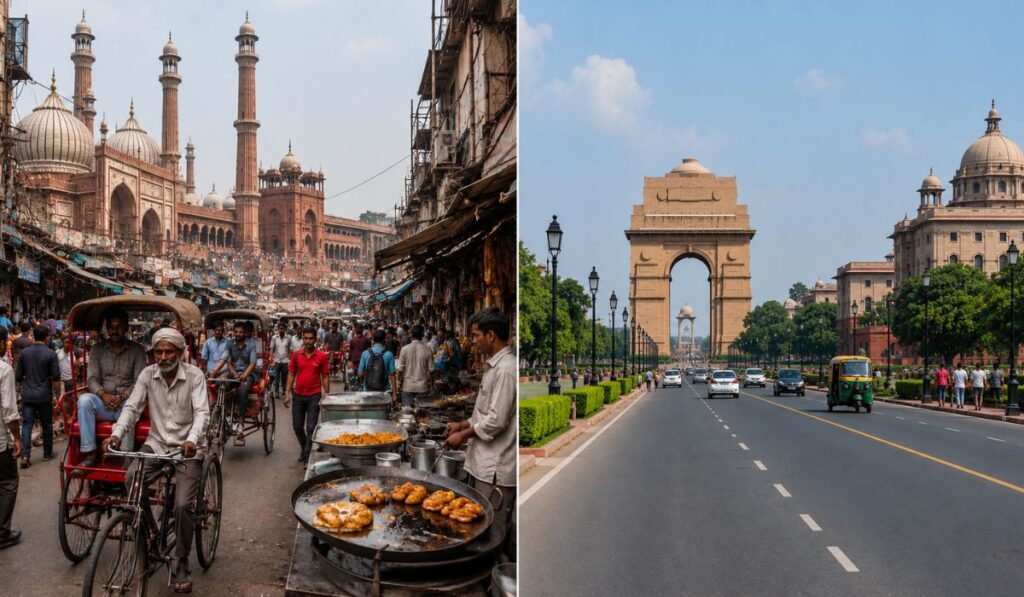
Old Delhi is the original walled city built by Mughal emperor Shah Jahan in the 17th century. It is dense, ancient, and sensory in a way that few urban environments in the world still are. The lanes of Chandni Chowk are barely wide enough for a cycle-rickshaw and a pedestrian to pass simultaneously. The food here — parathas at Parathe Wali Gali, biryani near Jama Masjid, rabri at the old milk shops — is reason enough to visit Delhi specifically. Old Delhi tourist places reward slow, unhurried exploration.
New Delhi is the British-built capital, designed by Edwin Lutyens and completed in 1931. It is broad, planned, and greener than its reputation suggests. New Delhi attractions are more spread out, which means transport matters more here. The monuments are larger, the experience more formal, and the scale genuinely extraordinary.
| Feature | Old Delhi | New Delhi |
| Era | Mughal, 17th century | British, early 20th century |
| Character | Dense, chaotic, ancient | Planned, spacious, formal |
| Key Sites | Red Fort, Jama Masjid, Chandni Chowk | India Gate, Humayun’s Tomb, Qutub Minar |
| Best Transport | Cycle rickshaw, walking | Metro or private car |
| Best For | Food, culture, street life | Monuments, architecture, history |
Most first-time visitors underestimate how far apart these two Delhis are in both distance and character. A morning in Old Delhi and an afternoon in New Delhi is the ideal combination — but only with logistics sorted in advance. This is exactly where an Old and New Delhi private guided tour by car changes the day: a driver who knows the traffic patterns, parking restrictions near Red Fort, and the right entrance at Humayun’s Tomb is not a luxury — it is a practical upgrade.
Top Tourist Places in Delhi: The Essential Monuments
Red Fort
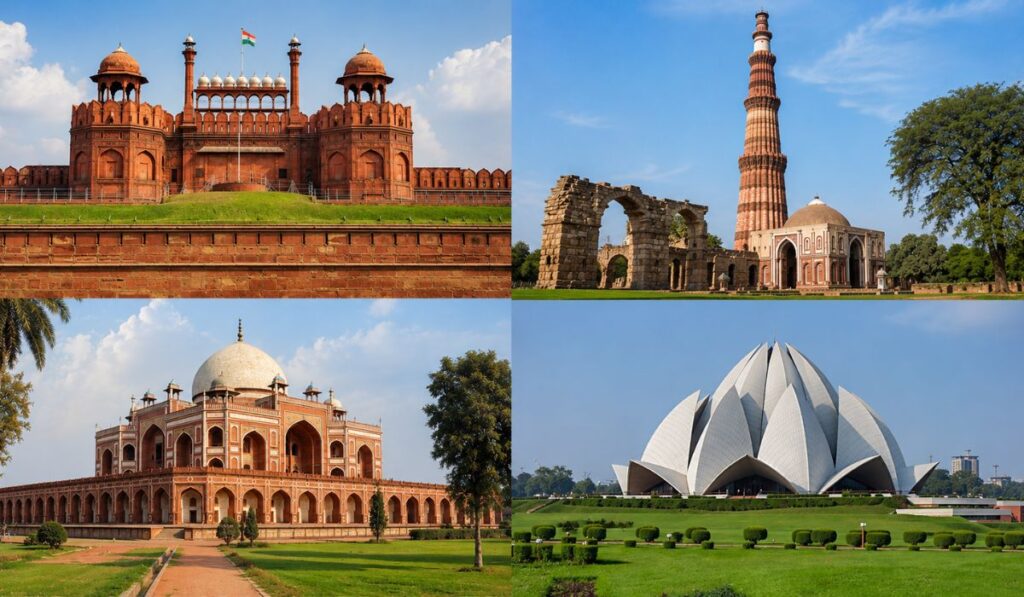
The Red Fort is Delhi’s most iconic monument. Built by Shah Jahan between 1638 and 1648 as the seat of Mughal power, its massive sandstone walls glow deep amber in afternoon light. The complex covers 254 acres and includes royal audience halls, private palaces, and Mughal gardens.
Timings: Tuesday–Sunday, 9:30 AM–4:30 PM. Closed Mondays. Entry: ₹35 Indians / ₹500 foreigners. Local tip: Arrive before 9:30 AM. The Diwan-i-Khas and Rang Mahal deserve unhurried attention — most visitors rush them. Don’t miss: The Sound and Light show on evenings — it provides historical context the daytime visit cannot.
Qutub Minar
A UNESCO World Heritage Site and one of the most famous places in Delhi, the Qutub Minar stands 73 metres tall and was begun in 1193 by Qutb ud-Din Aibak, founder of the Delhi Sultanate. The surrounding complex includes the Quwwat-ul-Islam mosque and the mysterious Iron Pillar — a 1,600-year-old metallurgical marvel that has never rusted.
Timings: Sunrise to sunset, daily. Entry: ₹35 Indians / ₹550 foreigners. Local tip: The Mehrauli Archaeological Park directly adjacent contains over 70 historical structures and is almost entirely unvisited. If you have an extra hour, walk in — it is free and extraordinary.
Humayun’s Tomb
Built in 1570, Humayun’s Tomb is the finest Mughal garden tomb in India and the direct architectural predecessor of the Taj Mahal. It pioneered the chaharbagh — the formal Persian garden divided by water channels — that defined all Mughal memorial architecture that followed. Another UNESCO World Heritage Site, and on most weekday mornings, considerably less crowded than the Taj.
Timings: Sunrise to sunset, daily. Entry: ₹35 Indians / ₹550 foreigners. Local tip: Walk five minutes to the Nizamuddin Dargah after your visit — the Sufi shrine of Hazrat Nizamuddin Auliya is one of Delhi’s most spiritually charged spaces. Thursday evenings bring live qawwali music.
India Gate
India Gate is Delhi’s most visited landmark — a 42-metre war memorial designed by Lutyens, completed in 1931, honouring 70,000 Indian soldiers who died in World War One. The lawns surrounding it are Delhi’s great public gathering space.
Timings: Open 24 hours. Free entry. Local tip: Visit at sunset or after dark when it is illuminated and the lawns fill with families. Midday in summer is punishing — this is strictly an evening destination. Don’t miss: The National War Memorial directly behind India Gate. It is newer, more detailed, and rarely crowded.
Lotus Temple
The Lotus Temple is a Bahá’í House of Worship completed in 1986, shaped like an opening lotus in white marble. Open to people of all religions. No rituals, no sermons — just 2,500 seats of unusual silence in the middle of a loud city.
Timings: Tuesday–Sunday, 9 AM–5:30 PM (winter), 9 AM–7 PM (summer). Closed Mondays. Entry: Free. Local tip: Avoid Sunday afternoons — queues can stretch 90 minutes. Come on a weekday morning and stay for at least 20 minutes inside. The building is designed for stillness.
Jama Masjid
India’s largest mosque, built by Shah Jahan between 1644 and 1658, accommodating 25,000 worshippers in its main courtyard. The red sandstone and white marble construction, visible from blocks away, is one of Delhi’s most commanding architectural statements.
Timings: Daily, 7 AM–noon and 1:30 PM–6:30 PM. Closes during prayer times. Entry: Free. Photography permit ₹300. Local tip: Karim’s restaurant — established 1913, two minutes from the mosque — serves Mughal-style food that justifies the entire trip to Old Delhi.
Akshardham Temple
Completed in 2005, Akshardham is built entirely from Rajasthani pink sandstone with hand-carved figures across every surface. The evening fountain show is one of Delhi’s best free experiences.
Timings: Tuesday–Sunday, 9:30 AM–8 PM. Closed Mondays. Entry: Free for main monument. Exhibitions charged separately. Critical note: No electronics — no phones, no cameras — are permitted inside. Lockers are provided at the entrance. Plan for this or you will lose 20 minutes at the cloak room.
Chandni Chowk
Chandni Chowk is Old Delhi’s main artery and one of Asia’s oldest markets. Shah Jahan designed it as a moonlit bazaar with a canal running through the centre. Today it is one of the densest concentrations of commerce, food, temples, mosques, and street life in the world.
Timings: Most shops 10 AM–8 PM. Street food from early morning. Entry: Free. Local tip: You cannot drive into most lanes. Leave the car at the main road and explore on foot or by cycle-rickshaw. A local guide transforms the noise into culture — this is one location where guided navigation adds the most value.
Tourist Places in Delhi for Families
Delhi works exceptionally well for families when logistics are right.
Purana Qila is the single best family attraction in Delhi — an ancient fort with a lake, paddle-boating, open green space, and a small museum. Never as crowded as Red Fort, and far more child-friendly in scale.
National Zoological Park, directly adjacent to Purana Qila, is one of India’s better zoos — 1,300 animals across 176 species. Closed Fridays.
Dilli Haat is an open-air crafts market where artisans from every Indian state display and sell their work. Ideal for families wanting culture, shopping, and food in one manageable enclosed space.
Rail Museum in Chanakyapuri has historic locomotives and royal carriages across 10 acres of green space — underrated and genuinely good for children.
Summer planning note: Delhi’s peak summer (April–June) sees afternoon temperatures above 42°C. Plan all outdoor monuments for before 11 AM or after 4 PM. October to March is the comfortable family sightseeing window.
Hidden Gems: Lesser-Known Tourist Places in Delhi
Delhi rewards travelers who move beyond the standard list.
Agrasen ki Baoli — a 14th-century stepwell on a quiet lane off Connaught Place, free to enter, almost always uncrowded, and visually extraordinary. Most people who work in surrounding offices have never visited it.
Mehrauli Archaeological Park — 70+ historical monuments across 200 acres adjacent to the Qutb complex. The Jamali Kamali Mosque and Balban’s Tomb inside the park are architecturally significant and receive almost no visitors.
Tughlaqabad Fort — Delhi’s most dramatically scaled fort, with walls up to 15 metres thick, visible from the main road. Receives a fraction of Red Fort’s visitors despite being arguably more impressive in sheer engineering scale.
Lodi Garden — 90 acres of manicured parkland containing 15th-century Sayyid and Lodi dynasty tombs, used daily by joggers, yoga practitioners, and office workers. One of Delhi’s most graceful spaces and genuinely free.
Delhi in One Day: Smart Sightseeing Itinerary
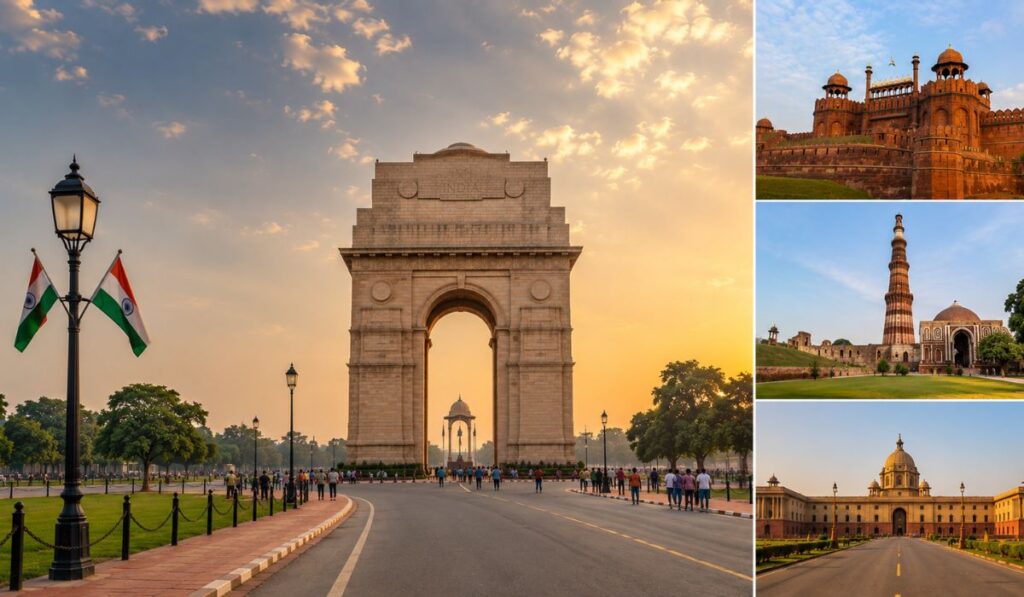
A realistic one-day Delhi itinerary that covers both Old and New Delhi without feeling rushed:
5:45 AM — Humayun’s Tomb at sunrise. Opens at sunrise. Morning light on the sandstone is extraordinary, and you will likely have the garden almost to yourself for the first 30 minutes.
7:30 AM — Nizamuddin Dargah. A short auto ride. Mornings are calm and atmospheric.
9:00 AM — India Gate and Kartavya Path. Arrive before the heat builds. Walk the full length toward Rashtrapati Bhavan. Allow 45 minutes including the National War Memorial.
11:00 AM — Drive to Old Delhi. This transition is where Delhi sightseeing by car makes the clearest practical difference. The 40-minute cross-city drive in traffic is handled efficiently with a driver who knows the route and the parking restrictions.
11:30 AM — Chandni Chowk. A guided walk through the lanes with a street food stop. Allow 75 minutes.
1:00 PM — Jama Masjid. Arrive after the midday prayer. Spend 30–40 minutes in the courtyard.
1:45 PM — Lunch at Karim’s. Two minutes from the mosque. Non-negotiable.
3:00 PM — Red Fort. Afternoon light on red sandstone is warm and photogenic. Allow 90 minutes.
5:00 PM — Raj Ghat. Ten minutes by car. The Yamuna views at evening are beautiful.
6:30 PM — Lotus Temple or Akshardham. Lotus Temple for quiet; Akshardham for the evening fountain show.
This itinerary works best as a full day Delhi tour with a guide and driver. Attempting the same circuit independently — managing autos, Metro changes, and parking — typically costs 90 minutes of additional transit time.
Metro vs Private Car: What Works Better for Delhi Sightseeing
Delhi’s metro is genuinely excellent — 390 kilometres of track, reliable air conditioning, stations near most major monuments. For budget travelers and solo visitors with flexible time, it is entirely viable.
The limitation is the last mile. Many monument gates are 15–25 minutes on foot from the nearest Metro station. On a cool October morning that is pleasant. On a May afternoon at 41°C it changes the calculation entirely.
| Factor | Delhi Metro | Private Car |
| Cost | Low (₹20–₹60 per journey) | Fixed day rate, higher overall |
| Speed | Fast between stations | Door-to-door |
| Flexibility | Fixed routes | Complete |
| Best for | Solo travelers, budget trips | Families, seniors, tight itineraries |
For families, senior travelers, and visitors on a single-day schedule, Delhi local sightseeing by private car covers the same ground in roughly 30 percent less time — and removes the logistical decisions from the day entirely.
Essential Delhi Travel Tips
Monday closures matter. Red Fort, Lotus Temple, National Museum, and Akshardham are all closed on Mondays. A Monday itinerary needs deliberate replanning.
Dress appropriately. Jama Masjid requires covered shoulders and legs. Gurudwaras require a head covering. Carry a lightweight scarf — it handles every situation.
Heat management is not optional. In summer, outdoor monuments before 11 AM and after 4 PM only. Carry at least 1.5 litres of water. Know your indoor options for midday.
Negotiate before you ride. Pre-paid auto counters at major transport hubs give fixed fares. Worth the marginal extra cost for the clarity.
Street food strategy. The legendary Chandni Chowk establishments — Old Famous Jalebi Wala, Natraj Dahi Bhalla Wala — have operated for decades with high turnover and good standards. Trust the queues. Avoid low-traffic stalls in unfamiliar lanes.
FAQs About Tourist Places in Delhi
Which is the single best tourist place in Delhi?
For architecture and atmosphere combined: Humayun’s Tomb. For cultural immersion: Chandni Chowk and Jama Masjid. For national significance: India Gate. Most first-time visitors find Humayun’s Tomb the most rewarding single monument.
Can Delhi be covered in one day?
The major highlights of both Old and New Delhi can be experienced meaningfully in one well-planned day. Understanding Delhi deeply takes longer — but one good day gives you enough to want to return.
What is the best time of year to visit?
October to March. November is the sweet spot — comfortable temperatures, clear light, and post-monsoon greenness. December and January bring morning fog that affects early monument visits. Summer (April–June) is manageable with early starts but genuinely demanding.
Are the monuments safe for solo women travelers?
The major ticketed monuments are staffed and regulated. Old Delhi’s lanes are busier and benefit from confident navigation — a guide adds genuine comfort here. New Delhi’s tourist precincts are straightforward.
What is the best way to see both Old and New Delhi in one day?
An Old and New Delhi private guided tour by car is the most practical answer for visitors with a single day. It handles routing, monument sequencing, parking, and local context — so the traveler’s entire attention goes to the city rather than the logistics of moving through it.
Conclusion for Tourist Places in Delhi
The tourist places in Delhi are not a checklist to complete. They are a civilisation in built form — the accumulated decisions of a thousand years of rulers, architects, saints, and ordinary people who built, destroyed, and rebuilt the same stretch of north Indian plain again and again.
A good day in Delhi leaves you feeling the weight of that history in the best possible sense. The Mughal garden at Humayun’s Tomb, the medieval commerce of Chandni Chowk, the British imperial sweep of Kartavya Path, the Sufi devotion at Nizamuddin — these are not separate attractions. They are one continuous story, told across fourteen kilometres of one extraordinary city.
Plan the logistics carefully. Get to the monuments early. Eat where the queues are longest. Take a guide if the day is short. And stay open to the places you did not plan for — the stepwell you stumbled into, the lane that led somewhere unexpected — because those are often the parts of Delhi you will remember most.
The best places to visit in Delhi reward both preparation and curiosity. Bring both.
Travelers planning to cover Delhi’s highlights efficiently in a single day will find that a private guided tour combining Old Delhi sightseeing with New Delhi’s major monuments is the most practical and rewarding approach — particularly for families, international visitors, and anyone on a tight Golden Triangle schedule.

Comments